Plugging a spewing oil well with cornstarch
February 1, 2011 By Anne M. Stark
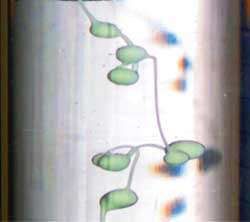
The research team observed strange arrangements of globules descending the oil column. The globules are strung together by filaments that don't break even when highly distorted.
A substance more like quicksand and less like ketchup could improve the "top kill" method of plugging a blown-out oil well.
New research by Laboratory scientists in collaboration with a Washington University researcher suggests that a new "mud recipe" using materials such as cornstarch to create a more viscous formula for plugging up a spewing oil well might just work in the future.
In May 2010, BP started a top-kill procedure, in which it would pump heavy mud down the wellbore in an attempt to stop the oil flow coming out of the Macondo well in the Gulf of Mexico. It would take three months before the oil spill was stopped in July by capping the gushing oil head.
The new top-kill method involves overcoming a form of turbulence, which physicists call the Kelvin-Helmholtz instability. This instability can occur whenever two fluids move past one another at different speeds. For example, when wind blows over water, the instability manifests itself in the form of waves on the surface of the water. If the wind is strong enough the waves then break up into tiny water droplets, which are blown away by the wind. The instability also occurs when a heavier liquid like drilling mud is poured into a lighter liquid like crude oil. The trick is to create a liquid that resists the instability by becoming thicker and even hard like a solid under stress, but otherwise flows like a thin fluid.
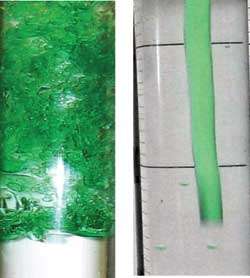
At left, highly turbulent behavior as water flows into(clear) oil. At right, all turbulence is suppressed by using cornstarch.
The Lab's Peter Beiersdorfer, Edward Magee, and David Layne along with Washington University's Jonathan Katz created such a liquid, dubbed shear-thickening by physicists, by using ordinary cornstarch. A shear-thickening liquid like the cornstarch mixture can easily be poured out of its container, but it thickens when shaken. Cornstarch mixed with water acts like quicksand. If you sink in quicksand, it is important to move slowly. The faster you move, the more the quicksand, or in this case the cornstarch mixture, resists your movement. Fast motion, like turbulence, is suppressed by the cornstarch.In the case of the BP top-kill method, the drilling mud that is made up of a slurry mixture of clay and other minerals broke up into small droplets when mixed with the upstream of the oil, thus not plugging the well, Beiersdorfer said.
The top-kill method is much like ketchup -- a shear-thinning fluid -- which first resists flow and begins to flow quickly only when it is stressed by shaking or by squeezing the bottle.
The researchers conducted a series of experiments at LLNL in which they injected the cornstarch mixture into a five-foot cylinder of oil at speeds comparable to those of the Macondo well to see if it would resist breaking up into droplets.
Beiersdorfer, Magee, and Layne normally work on experiments that explain the radiation from the sun. "Our laboratory is equipped to carry out new ideas on a short notice," Beiersdorfer said. "This was the right thing to do given the nation's needs."
The results, published in the Jan. 31 issue of Physical Review Letters, show that the cornstarch formula descended down the oil column without breaking up. Adding a shear-thickening agent like cornstarch may work as a top-kill procedure to plug up a gushing oil well in the future.
"For a denser fluid (mud) to descend through an upwelling vertical column of lighter fluid (oil), it must not break up into packets or droplets with a settling velocity less than the upwelling velocity," he said.
The project was funded by the Laboratory Directed Research and Development Program.
"These experiments provide a new tool in energy exploration and well control in the future," Beiersdorfer said. "Hopefully, if such a disaster occurs next time, the response will be greatly improved."
Provided by
Lawrence Livermore National Laboratory
-
From lemons to lemonade: Reaction uses carbon dioxide to make carbon-based semiconductor,
30 comments
-
Thioridazine kills cancer stem cells in human while avoiding toxic side-effects of conventional cancer treatments,
3 comments
-
SpaceX private rocket blasts off for space station (Update),
42 comments
-
Climate scientists say they have solved riddle of rising sea,
30 comments
-
Research team claims to have found evidence Lake Cheko is impact crater for Tunguska Event,
18 comments
-
More human population = greater mass?
May 25, 2012
-
Conversion from aircraft bearing to normal degrees
May 23, 2012
-
Interpretation/Analysis of the Lab results(HEPA filter)
May 22, 2012
-
Has anyone here attended the The Urbino Summer School in Paleoclimatology?
May 22, 2012
-
Earthquakes: Mag 6 N. Italy and Mag 5.6 W. Bulgaria
May 21, 2012
-
determining time frame for most recent geological layers
May 17, 2012
- More from Physics Forums - Earth
More news stories
SpaceX capsule has 'new car' smell, astronauts say (Update)
SpaceX's Dragon cargo vessel smells like a new car, said astronauts at the International Space Station after opening the hatches Saturday following the spacecraft's landmark mission to the orbiting lab.
Space & Earth / Space Exploration
13 hours ago |
4.6 / 5 (18) |
0
Australia hails surprise super-telescope decision
Australia has hailed a surprise decision giving it a role in a radio telescope project aimed at revolutionising astronomy, vowing to draw on its decades of experience in space science.
13 hours ago |
5 / 5 (3) |
0
Astronomers seize last chance in lifetime for Venus Transit
Astronomers are gearing for one the rarest events in the Solar System: an alignment of Earth, Venus and the Sun that will not be seen for another 105 years.
13 hours ago |
5 / 5 (1) |
0
Astronauts enter world's 1st private supply ship
(AP) -- Space station astronauts floated into the Dragon on Saturday, a day after its heralded arrival as the world's first commercial supply ship.
Space & Earth / Space Exploration
13 hours ago |
5 / 5 (5) |
0
Dragon arrives at space station in historic 1st (Update 2)
The privately bankrolled Dragon capsule made a historic arrival at the International Space Station on Friday, triumphantly captured by astronauts wielding a giant robot arm.
Space & Earth / Space Exploration
May 25, 2012 |
5 / 5 (10) |
19
Dell tablet leak: 10.1-inch display, two-battery choice
(Phys.org) -- Headline after headline talks about vendors tablets in the wings as likely number-one contenders for the iPad. Such claims have justifiably been taken with a grain of salt, considering ...
Scientist: Evolution debate will soon be history
(AP) -- Richard Leakey predicts skepticism over evolution will soon be history. Not that the avowed atheist has any doubts himself.
SpotterRF debuts Radar Backpack Kit (w/ Video)
(Phys.org) -- SpotterRF has announced a special radar backpack kit designed to enhance situational awareness for soldiers on the ground. The company says its special radar is designed for warfighters as part ...
Keep food safety in mind this memorial day weekend
(HealthDay) -- Picnics, parades and cookouts are as much a part of Memorial Day weekend as tributes to the United States' war veterans.
Thousands of shellfish found dead in Peru
Thousands of crustaceans were found dead off the coast of Lima following the mystery mass death of dolphins and pelicans, the Peruvian Navy said Friday.
Family history of Alzheimer's affects functional connectivity
(HealthDay) -- Cognitively normal individuals with a family history of late-onset Alzheimer's disease (AD) may display lower resting state functional connectivity in the default mode network (DMN) of the brain, ...