Simpler way of making proteins could lead to new nanomedicine agents
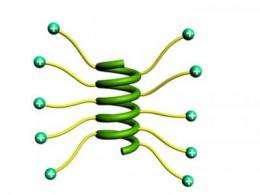
Researchers have developed a simple method of making short protein chains with spiral structures that can also dissolve in water, two desirable traits not often found together. Such structures could have applications as building blocks for self-assembling nanostructures and as agents for drug and gene delivery.
Led by Jianjun Cheng, a professor of materials science and engineering at the University of Illinois, the research team will publish its findings in the Feb. 22 edition of the journal Nature Communications.
Materials scientists have been interested in designing large polymer molecules that could be used as building blocks for self-assembling structures. The challenge has been that the molecules generally adopt a globular, spherical shape, limiting their ability to form orderly aggregates. However, polypeptides – chains of amino acids such as proteins – can form helical structures. Short polypeptide chains that adopt a spiral shape act like cylindrical rods.
"If you have two rigid rods, one positive and one negative, right next to each other, they're going to stick to each other. If you have a way to put the charge on the surface then they can pack together in a close, compact way, so they form a three-dimensional structure," Cheng said.
However, it is difficult to make helical polypeptides that are water-soluble so they can be used in solution. Polypeptides gain their solubility from side chains – molecular structures that stem from each amino acid link in the polypeptide chain. Amino acids with positive or negative charges in their side chains are needed to make a polypeptide disperse in water.
The problem arises when chains with charged side chains form helical structures. The charges cause a strong repulsion between the side chains, which destabilizes the helical conformation. This causes water-soluble polypeptides to form random coil structures instead of the desired helices.
In exploring solutions to the riddle of helical, water-soluble polypeptides, researchers have tried several complicated methods. For example, scientists have attempted grafting highly water-soluble chemicals to the side chains to increase the polypeptides' overall solubility, or creating helices with charges only on one side.
"You can achieve the helical structure and the solubility but you have to design the helical structure in a very special way. The peptide design needs a very specific sequence. Then you're very limited in the type of polypeptide you can build, and it's not easy to design or handle these polypeptides," Cheng said.
In contrast, Cheng's group developed a very straightforward solution. Since the close proximity of the charges causes the repulsion that disrupts the helix, the researchers simply elongated the side chains, moving the charges farther from the backbone and giving them more freedom to keep their distance from one another.
The researchers observed that as they increased the length of the side chains with charges on the end, the polypeptides' propensity for forming helices also increased.
"It's such a simple idea – move the charge away from the backbone," Cheng said. "It's not difficult at all to make the longer side chains, and it has amazing properties for winding up helical structures simply by pushing the distance between the charge and the backbone."
The group found that not only do polypeptides with long side chains form helices, they display remarkable stability even when compared to non-charged helices. The helices seem immune to temperature, pH, and other denaturing agents that would unwind most polypeptides.
This may explain why amino acids with large hydrophobic side chains are not found in nature. Such immutability would preclude dynamic winding and unwinding of protein structures, which is essential to many biological processes. However, rigid stability is a desirable trait for the types of applications Cheng's group explores: nanostructures for drug and gene delivery, particularly targeting cancerous tumors and stem cells.
"We want to test the correlation of the lengths of the helices and the circulation in the body to see what's the impact of the shape and the charge and the side chains for clearance in the body," Cheng said. "Recent studies show that the aspect ratio of the nanostructures – spherical structures versus tubes – has a huge impact on their penetration of tumor tissues and circulation half-lives in the body."
Cheng plans to create a library of short helical polypeptides of varying backbone lengths, side chain lengths and types of charge. He hopes to simplify the chemistry even further and make the materials widely accessible. His lab already has demonstrated that helical structures can be effective gene delivery and membrane transduction agents, and building the library of soluble helical molecules will allow further investigation of tailoring such nanostructures for specific biomedical applications.
Provided by University of Illinois at Urbana-Champaign


