Scientists build world's first anti-laser
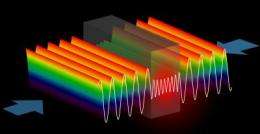
In the anti-laser, incoming light waves are trapped in a cavity where they bounce back and forth until they are eventually absorbed. Their energy is dissipated as heat. Credit: Yidong Chong/Yale University
More than 50 years after the invention of the laser, scientists at Yale University have built the world's first anti-laser, in which incoming beams of light interfere with one another in such a way as to perfectly cancel each other out. The discovery could pave the way for a number of novel technologies with applications in everything from optical computing to radiology.
Conventional lasers, which were first invented in 1960, use a so-called "gain medium," usually a semiconductor like gallium arsenide, to produce a focused beam of coherent lightlight waves with the same frequency and amplitude that are in step with one another.
Last summer, Yale physicist A. Douglas Stone and his team published a study explaining the theory behind an anti-laser, demonstrating that such a device could be built using silicon, the most common semiconductor material. But it wasn't until now, after joining forces with the experimental group of his colleague Hui Cao, that the team actually built a functioning anti-laser, which they call a coherent perfect absorber (CPA).
The team, whose results appear in the Feb. 18 issue of the journal Science, focused two laser beams with a specific frequency into a cavity containing a silicon wafer that acted as a "loss medium." The wafer aligned the light waves in such a way that they became perfectly trapped, bouncing back and forth indefinitely until they were eventually absorbed and transformed into heat.
Stone believes that CPAs could one day be used as optical switches, detectors and other components in the next generation of computers, called optical computers, which will be powered by light in addition to electrons. Another application might be in radiology, where Stone said the principle of the CPA could be employed to target electromagnetic radiation to a small region within normally opaque human tissue, either for therapeutic or imaging purposes.
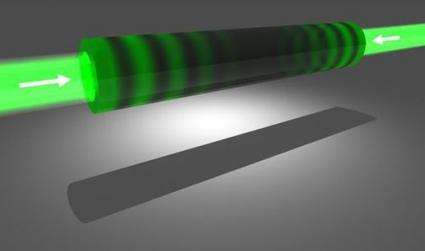
Anti-lazing. Image credit: Science/AAAS
Theoretically, the CPA should be able to absorb 99.999 percent of the incoming light. Due to experimental limitations, the team's current CPA absorbs 99.4 percent. "But the CPA we built is just a proof of concept," Stone said. "I'm confident we will start to approach the theoretical limit as we build more sophisticated CPAs." Similarly, the team's first CPA is about one centimeter across at the moment, but Stone said that computer simulations have shown how to build one as small as six microns (about one-twentieth the width of an average human hair).
The team that built the CPA, led by Cao and another Yale physicist, Wenjie Wan, demonstrated the effect for near-infrared radiation, which is slightly "redder" than the eye can see and which is the frequency of light that the device naturally absorbs when ordinary silicon is used. But the team expects that, with some tinkering of the cavity and loss medium in future versions, the CPA will be able to absorb visible light as well as the specific infrared frequencies used in fiber optic communications.
It was while explaining the complex physics behind lasers to a visiting professor that Stone first came up with the idea of an anti-laser. When Stone suggested his colleague think about a laser working in reverse in order to help him understand how a conventional laser works, Stone began contemplating whether it was possible to actually build a laser that would work backwards, absorbing light at specific frequencies rather than emitting it.
"It went from being a useful thought experiment to having me wondering whether you could really do that," Stone said. "After some research, we found that several physicists had hinted at the concept in books and scientific papers, but no one had ever developed the idea."
Provided by
Yale University
-
From lemons to lemonade: Reaction uses carbon dioxide to make carbon-based semiconductor,
30 comments
-
Thioridazine kills cancer stem cells in human while avoiding toxic side-effects of conventional cancer treatments,
3 comments
-
SpaceX private rocket blasts off for space station (Update),
42 comments
-
Climate scientists say they have solved riddle of rising sea,
30 comments
-
Research team claims to have found evidence Lake Cheko is impact crater for Tunguska Event,
18 comments
-
why do trucks have bigger brakes?
5 hours ago
-
Solar Sail Physics - Do they work on a large scale?
6 hours ago
-
How should I switch an air conditioner off?
6 hours ago
-
Question about current decay in R-L circuit
7 hours ago
-
Elementary time - how does it work?
9 hours ago
-
How can squinting be used by both a myopic & hyperopic eye?
12 hours ago
- More from Physics Forums - General Physics
More news stories
Landmark calculation clears the way to answering how matter is formed
(Phys.org) -- An international collaboration of scientists, including Thomas Blum, associate professor of physics, is reporting in landmark detail the decay process of a subatomic particle called a kaon ...
May 25, 2012 |
4.6 / 5 (18) |
46
|
Is a classical electrodynamics law incompatible with special relativity?
(Phys.org) -- The laws of classical electromagnetism that were developed in the 19th century are the same laws that scientists use today. They include Maxwell’s four equations along with the Lorentz la ...
Lying in wait for WIMPs: Researchers seek to dramatically increase sensitivity of Large Underground Xenon detector
Although it's invisible, dark matter accounts for at least 80 percent of the matter in the universe. No one knows what it is, but most scientists would bet on weakly interacting massive particles, or WIMPs.
May 23, 2012 |
4 / 5 (7) |
15
|
Hall effect at the speed of light: How can you demonstrate relativistic effects with your mobile phone?
The relativistic Hall effect describing objects rotating at speeds comparable with the speed of light has been reported.
May 21, 2012 |
4.3 / 5 (3) |
8
Cloak of invisibility: Engineers use plasmonics to create an invisible photodetector
A team of engineers at Stanford and the University of Pennsylvania has for the first time used "plasmonic cloaking" to create a device that can see without being seen - an invisible machine that detects light. It is the first ...
May 21, 2012 |
4.8 / 5 (16) |
7
|
Dell tablet leak: 10.1-inch display, two-battery choice
(Phys.org) -- Headline after headline talks about vendors tablets in the wings as likely number-one contenders for the iPad. Such claims have justifiably been taken with a grain of salt, considering ...
Scientist: Evolution debate will soon be history
(AP) -- Richard Leakey predicts skepticism over evolution will soon be history. Not that the avowed atheist has any doubts himself.
SpaceX capsule has 'new car' smell, astronauts say (Update)
SpaceX's Dragon cargo vessel smells like a new car, said astronauts at the International Space Station after opening the hatches Saturday following the spacecraft's landmark mission to the orbiting lab.
SpotterRF debuts Radar Backpack Kit (w/ Video)
(Phys.org) -- SpotterRF has announced a special radar backpack kit designed to enhance situational awareness for soldiers on the ground. The company says its special radar is designed for warfighters as part ...
Keep food safety in mind this memorial day weekend
(HealthDay) -- Picnics, parades and cookouts are as much a part of Memorial Day weekend as tributes to the United States' war veterans.
Thousands of shellfish found dead in Peru
Thousands of crustaceans were found dead off the coast of Lima following the mystery mass death of dolphins and pelicans, the Peruvian Navy said Friday.

Feb 17, 2011
Rank: 4.8 / 5 (6)
Space based laser xmits, ground based receives.
BB
Feb 17, 2011
Rank: 3 / 5 (2)
So if we constantly excite a sample which is surrounded by detectors in all directions but the one to the antilaser, shouldn't turning it on cause that detectors caught smaller amount of light ... earlier?
I thought about something similar, but conceptually simpler - imagine CPT transformation of free electron laser:
thescienceforum.com/viewtopic.php?p=255510
Feb 17, 2011
Rank: not rated yet
Feb 17, 2011
Rank: not rated yet
Feb 17, 2011
Rank: not rated yet
Who needs solar panels, or mirrors?
Feb 18, 2011
Rank: 5 / 5 (1)
Feb 18, 2011
Rank: 1.6 / 5 (7)
Light is energy and there is a law for the conservation of energy, Maybe this could explain dark energy.
Only new at this so be kind.
Feb 18, 2011
Rank: not rated yet
laser hits half-silvered mirror behind which there is near detector on one optical path and far such antilaser on the second - does turning it on make that detector gets less amount of light ... earlier?
Feb 18, 2011
Rank: 5 / 5 (3)
Feb 18, 2011
Rank: not rated yet
Ninja-ed!
Feb 18, 2011
Rank: 5 / 5 (1)
Black body is a theoretical device. It doesn't exist, nor do they claim it should.
Feb 18, 2011
Rank: not rated yet
It only works with coherent light, not the non-coherent variety from the sun. Too many phases going around at once to cancel anything out. You have to do that with white light by using the best black stuff you can make like carbon nanotubes and such, it also absorbs 99.99% of the incoming light and does it a lot cheaper than making a semiconductor device for the job.
Feb 18, 2011
Rank: not rated yet
Feb 18, 2011
Rank: not rated yet
Feb 18, 2011
Rank: not rated yet
I'm pretty sure they use variable frequencies, so this won't work.
The people who make this stuff anticipate countermeasures.
Feb 20, 2011
Rank: not rated yet
Feb 20, 2011
Rank: not rated yet
I'm not that impressed, though. It's a neat proof of concept but I don't see of what use this could be in an optical computer. It basically turns monochromatic, coherent light into heat and it does this in a very specific setup, with 2 beams head on, as I understand.
Now, if this would work in 90 degrees setup, you could use one beam as a gate for the other one, assuming you can control the phase or wavelength of either of them. That I could see in an optical computer. Then again, several thousands of these switches per square cm dissipating heat might be a problem.
Feb 21, 2011
Rank: not rated yet
I thought it was this but it seems it's more subtle than that.