Scientists uncover surprising features of bear hibernation
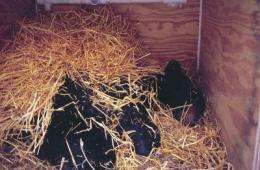
Black bears show surprisingly large and previously unobserved decreases in their metabolism during and after hibernation according to a paper by scientists at the Institute of Arctic Biology at the University of Alaska Fairbanks and published in the 18 February issue of the journal Science.
"In general, an animal's metabolism slows to about half for each 10 degree (Celsius) drop in body temperature. Black bears' metabolism slowed by 75 percent, but their core body temperature decreased by only five to six degrees," said Øivind Tøien, IAB research scientist and lead author.
The amount of metabolic suppression was a surprise since the decrease in body temperatures of hibernating bears was moderate. Tøien and colleagues were also surprised when the bears' metabolism remained suppressed for several weeks after the animals emerged from their dens.
Interest in the physiology of human-sized hibernators like black bears extends beyond comparative biology, since application of the mechanisms of metabolic suppression to people in emergency situations could save lives. "Quickly reducing metabolic demand in victims of stroke, heart attack or trauma would put them in a stabilized, protected state to provide more time to arrange advanced, medical care. It could extend the golden hour to a golden day or longer." said Brian Barnes, IAB director and senior author of the paper.
This is the first study to continuously measure the metabolic rates and body temperatures of black bears as they hibernated during the winter under natural conditions and after they emerged from their dens in spring. Technical limitations have previously prevented continuous long-term monitoring of such large animals.
The study included five American black bears, which were nuisance bears captured in south-central and Interior Alaska by the Alaska Department of Fish and Game.
Tøien and colleagues implanted radio transmitters into each bear to record its body temperature, heart beats and muscle activity. The bears were kept in structures mimicking dens, away from human disturbance, and monitored via infrared cameras.
"We measured the bears' metabolism by continuously measuring the oxygen and carbon dioxide concentrations of the air entering and leaving the den," Tøien said The transmitters inside each bear told us that the bear's body temperature was not stable, but varied over the winter in slow cycles each lasting several days."
"Such large, multi-day fluctuations in core body temperature are unlike those observed in any other mammal before. This detail was missed by past studies, and may have caused overestimation of metabolic rate because bears periodically shiver when they increase their body temperature," Tøien said.
Hibernating bears only breathe one to two times per minute and their heart slows between breaths; sometimes there is 20 seconds between beats. "Each time the bear takes a breath, the heart accelerates for a short time to almost that of a resting bear in summer," said Tøien. "When the bear breathes out, the heart slows down again and there will be another 30 to 60 seconds until the next breath."
Tøien and colleagues had expected to find the animals' metabolism returning to normal levels right away when the bears resumed activity and emerged from their dens in spring just like a small hibernator such as the arctic ground squirrel would do. "We were surprised to find that the bears' metabolic rates were still only about half of their normal, summer levels even though body temperature had returned to near normal of 37°C," Tøien said.
They continued to monitor the bears' metabolism for another month after emergence and observed that it took the bears two to three full weeks to stabilize at their summer metabolic levels. "Free-ranging bears one may encounter out in the woods in early spring may be in a transition state," Tøien said.
Toien, Barnes and collaborators will continue studies to determine the changes in gene expression that accompany transitions in hibernating state in black bears and whether protection of tissues can be activated during the summer.
Provided by University of Alaska Fairbanks


