Rare native bat 'missing' in Ireland since 2003: study
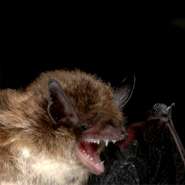
(PhysOrg.com) -- Using acoustic lures and mist nets, scientists have been unable to catch any living sample of a rare bat species thought to be resident in Ireland.
The Brandt’s bat or Myotis brandtii has remained unidentified in Ireland since 2003 when a sample was first discovered by a wildlife ranger stuck to a freshly painted fence in Glendalough, County Wicklow.
According to the latest findings by the Centre for Irish Bat Research published in the scientific journal Acta Chiropterologica, the Brandt’s bat is listed as ‘data deficient’ and as such should not be considered as resident in Ireland.
“Our results suggest that Myotis brandtii or Brandt’s bat are rare and possibly endangered in Ireland,” says Dr Emma Boston from the UCD School of Biology and Environmental Science, University College Dublin, one of the scientists involved in the study.
“We conducted surveys in Killarney National Park and Glendalough where suspected Myotis brandtii had been caught before, but we did not catch one single Myotis brandtii.”
“Little is known about their ecology, but they are generally thought to be associated with broadleaf woodland.”
“It is possible that the Brandt’s bat has been resident in Ireland since the early Holocene [about 9,000 years ago] and the destruction of Irish forests may have caused a major decrease in its distribution and abundance.”
Due to historical deforestation, only about 1% of Ireland is covered in native woodland today. It is thought that almost 80% of Ireland was once covered by native forest.
Given the morphological similarity of Myotis brandtii and Myotis mystacinus (the whiskered bat), previous Brandt’s bat examples discovered in Ireland may have been misidentifications. More research is required to determine the status and distribution of this bat species in Ireland.
According to the Red List of Terrestrial Mammals for Ireland, there are 27 species of native Irish mammals: nine are species of bats, the grey wolf (Canis lupus) is regionally extinct, and the black rat (Rattus rattus) is vulnerable.
With funding from the National Parks and Wildlife Service, the Irish Research Council for Science, Engineering and Technology and the Heritage Council, the Centre for Irish Bat Research is conducting a large research project on the three rare Myotis bats species in Ireland; Natterer’s bat (Myotis nattereri), the whiskered bat (Myotis mystacinus) and Brandt’s bat (Myotis brandtii).
The Center for Irish Bat Research is a cross-border collaboration between University College Dublin and Queens University Belfast, under the Directorship of Dr. Emma Teeling.
"Year of the Bat" 2011 – 2012
2011 – 2012 is the "Year of the Bat". The campaign is jointly coordinated by the UNEP Convention on Migratory Species (CMS) and The Agreement on the Conservation of Populations of European Bats (EUROBATS).
“Education regarding the essential roles of bats in maintaining healthy ecosystems and human economies has never been more important,” says Dr. Merlin Tuttle, Honorary Ambassador for the 2011-2012 Year of the Bat campaign.
“Bats are found nearly everywhere and approximately 1,200 species account for almost a quarter of all mammals.
Nevertheless, in recent decades their populations have declined alarmingly. Many are now endangered, though they provide invaluable services that we cannot afford to lose,” explains Dr. Tuttle.
“Bats rank among our planet’s most misunderstood and intensely persecuted mammals. Those that eat insects are primary predators of the vast numbers that fly at night, including ones that cost farmers and foresters billions of dollars in losses annually. As such bats decline, demands for dangerous pesticides grow, as does the cost of growing crops like rice, corn and cotton.”
“Fruit and nectar-eating bats are equally important in maintaining whole ecosystems of plant life. In fact, their seed dispersal and pollination services are crucial to the regeneration of rain forests which are the lungs and rain makers of our planet. Many of the plants which depend on such bats are additionally of great economic value, their products ranging from timber and tequila to fruits, spices, nuts and even natural pesticides.”
Provided by University College Dublin


