Increasing processor efficiency by 'shutting off the lights'
February 28, 2011

Increasing processor efficiency by 'shutting off the lights'

Enlarge

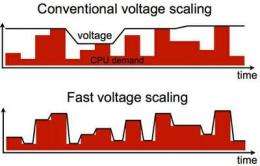
The multi-core voltage regulator responds almost instantaneously to changes in power demand from each core of the processor. As a result, the power supply matches the demand more closely, conserving energy. Credit: Image courtesy of Wonyoung Kim, Harvard School of Engineering and Applied Sciences

There was a time when a laptop could weigh 10 pounds and still sell—a time when a cell phone was larger than a pocket—and a time when an iPod only played music.

Today's consumers expect mobile devices that are increasingly small, yet ever-more powerful. All the bells and whistles, however, suck up energy, and a phone that lasts only 4 hours because it's also a GPS device is only so much use.

To promote energy-efficient multitasking, Harvard graduate student Wonyoung Kim has developed and demonstrated a new device with the potential to reduce the power usage of modern processing chips.

The advance could allow the creation of "smarter" smartphones, slimmer laptops, and more energy-friendly data centers.

Kim's on-chip, multi-core voltage regulator (MCVR) addresses what amounts to a mismatch between power supply and demand.

"If you're listening to music on your MP3 player, you don't need to send power to the image and graphics processors at the same time," Kim says. "If you're just looking at photos, you don't need to power the audio processor or the HD video processor."

"It's like shutting off the lights when you leave the room."

Kim's research at Harvard's School of Engineering and Applied Sciences (SEAS) showed in 2008 that fine-grain voltage control was a theoretical possibility. This month, he presented a paper at the Institute of Electrical and Electronics Engineers' (IEEE) International Solid-State Circuits Conference (ISSCC) showing that the MCVR could actually be implemented in hardware.
Increasing processor efficiency by 'shutting off the lights'
Enlarge

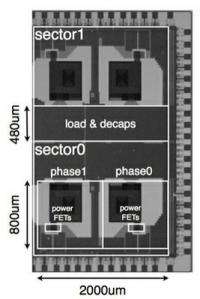
This is a die micrograph of the fully integrated DC-DC converter chip. Credit: Image courtesy of Wonyoung Kim, Harvard School of Engineering and Applied Sciences

Essentially a DC-DC converter, the MCVR can take a 2.4-volt input and scale it down to voltages ranging from 0.4 to 1.4V. Built for speed, it can increase or decrease the output by 1V in under 20 nanoseconds.

The MCVR also uses an algorithm to recognize parts of the processor that are not in use and cuts power to them, saving energy. Kim says it results in a longer battery life (or, in the case of stationary data centers, lower energy bills), while providing the same performance.

The on-chip design means that the power supply can be managed not just for each processor chip, but for each individual core on the chip. The short distance that signals then have to travel between the voltage regulator and the cores allows power scaling to happen quickly—in a matter of nanoseconds rather than microseconds—further improving efficiency.

Kim has obtained a provisional patent for the MCVR with his Ph.D. co-advisers at SEAS, Gu-Yeon Wei, Gordon McKay Professor of Electrical Engineering, and David Brooks, Gordon McKay Professor of Computer Science, who are coauthors on the paper he presented this week.

"Wonyoung Kim's research takes an important step towards a higher level of integration for future chips," says Wei. "Systems today rely on off-chip, board-level voltage regulators that are bulky and slow. Integrating the voltage regulator along with the IC chip to which it supplies power not only reduces broad-level size and cost, but also opens up exciting opportunities to improve energy efficiency."

"Kim's three-level design overcomes issues that hamper traditional buck and switch-capacitor converters by merging good attributes of both into a single structure," adds Brooks. "We believe research on integrated voltage regulators like Kim's will be an essential component of future computing devices where energy-efficient performance and low cost are in demand."

Although Kim estimates that the greatest demand for the MCVR right now could be in the market for mobile phones, the device would also have applications in other computing scenarios. Used in laptops, the MCVR might reduce the heat output of the processor, which is currently one barrier to making slimmer notebooks. In stationary scenarios, the rising cost of powering servers of ever-increasing speed and capacity could be reduced.

"This is a plug-and-play device in the sense that it can be easily incorporated into the design of chips," says Kim. "Including the MCVR on a chip would add about 10 percent to the manufacturing cost, but with the potential for 20 percent or more in power savings."

Provided by Harvard University search and more info website

4.7 /5 (18 votes)  

Filter


Move the slider to adjust rank threshold, so that you can hide some of the comments.


Display comments: newest first

88HUX88
Feb 28, 2011

Rank: 5 / 5 (1)
excellent, like all the best ideas your initial response is why hasn't this been done before?
antialias
Feb 28, 2011

Rank: 5 / 5 (1)
...because it didn't translate into added value (i.e. into more sales which outweigh the risks any additional component poses)

Now that we have a highly competitive environment among smartphonse, laptops and other categories of electronics which, among themselves, basically all have the same performance we start to focus on less and less obvious details for marketing value.
El_Nose
Feb 28, 2011

Rank: not rated yet
ummm.. it just wasn't necessary before. Previous battery life times were in an acceptable range but now that range is getting smaller and smaller and this is yet another idea to extend them. Granted if you are plugged into a wall you could care less but as we move to more and more of a ubiquitous computing platforms then this becomes a demand from consumers across all parts of the spectrum.
Bonkers
Feb 28, 2011

Rank: not rated yet
Its not been done before because switch-mode regulators on-chip are horribly noisy, they require external inductors, and are a poor usage of expensive silicon (simple FET processes are 5-10 times cheaper per mm2 than high-end CMOS). I don't think they can be using inductors since they mention 20ns response time - this would have to be one or more cycles of the switch-mode frequency, which would put it way outside efficient operation, due to skin effect and transition losses, never mind the EMC.
switched capacitor converters are also v. noisy, and the efficiency of "fractional" conversion is very poor, I can't see a sensible design emerging there.
the final option is simple linear regulation - which is inefficient, there is only a second-order benefit in that when you drop a bit more voltage in the linear regulator (increasing its dissipation) the processor takes a little less currrent, its marginal in terms of improvement.

So, as explained, can't see it...
Sylvain
Mar 04, 2011

Rank: 5 / 5 (1)
It _has_ been done before.

I developed a technique with similar benefits (fine grain control, sub-µs switching) as a PhD student, 4 years ago.
See: "A Power Supply Selector for Energy- and Area-Efficient Local Dynamic Voltage Scaling", Miermont et al, 2007

No on-chip inductance for us, 95% efficiency, 100% digital-process compatible, and it works great.

The technique has been proven in silicon in 65 and 45nm. An article was published on the 65nm circuit: "An asynchronous power aware and adaptive NoC based circuit", Beigne et al, 2008.
A 32nm implementation was done last year.

We also hold 2 patents:
- EP1993019 on the power control device
- EP2250541 fine grain voltage control for variability compensation and power optimization

M. Wonyoung Kim technique and ours provide great power benefits for complex digital System-on-Chip, but the major roadblock seems to be the slow adoption of the GALS (Globally Asynchronous, Locally Synchronous) design methodology by major manufacturers.
Rank 4.7 /5 (18 votes)
Relevant PhysicsForums posts
  • Drawing energy band diagrams
    created3 hours ago
  • Using multiple 555 timers in astable
    created6 hours ago
  • PCB design/fabrication quote - online or offline?
    created7 hours ago
  • PCB Design / Fab / Assembly start up experience?
    created8 hours ago
  • Half-wave rectification
    created11 hours ago
  • Electronic Speed Controls & Brushless Motors
    created12 hours ago
  • More from Physics Forums - Electrical Engineering

More news stories

SpotterRF debuts Radar Backpack Kit (w/ Video)

(Phys.org) -- SpotterRF has announced a special radar backpack kit designed to enhance situational awareness for soldiers on the ground. The company says its special radar is designed for warfighters as part ...

Technology / Hi Tech & Innovation

created 12 hours ago | popularity 5 / 5 (3) | comments 10 | with audio podcast report

Probability of contamination from severe nuclear reactor accidents is higher than expected: study

Catastrophic nuclear accidents such as the core meltdowns in Chernobyl and Fukushima are more likely to happen than previously assumed. Based on the operating hours of all civil nuclear reactors and the number ...

Technology / Energy & Green Tech

created May 22, 2012 | popularity 3.7 / 5 (20) | comments 50 | with audio podcast

Delphi gasoline-injection engine technique rivals hybrid's edge

(Phys.org) -- Running a diesel like engine on gasoline is something Delphi is doing in notable fashion. They claim they are on to a promising way to enjoy an engine that gives the vehicle owner high efficiency ...

Technology / Energy & Green Tech

created May 21, 2012 | popularity 4.7 / 5 (18) | comments 37 | with audio podcast report

HyperSolar shows dirty water no barrier to power world

(Phys.org) -- The Santa Barbara, California, company, HyperSolar, is set to transparently share the ups and downs of its research experiences toward the company’s ultimate vision, successfully producing ...

Technology / Energy & Green Tech

created May 24, 2012 | popularity 4.8 / 5 (14) | comments 17 | with audio podcast report

Tesla to launch electric sedan in US on June 22

Tesla Motors said Tuesday it would begin deliveries of "the world's first premium electric sedan" on June 22, slightly ahead of schedule.

Technology / Energy & Green Tech

created May 22, 2012 | popularity 4.5 / 5 (11) | comments 18


Dell tablet leak: 10.1-inch display, two-battery choice

(Phys.org) -- Headline after headline talks about vendors’ tablets in the wings as likely number-one contenders for the iPad. Such claims have justifiably been taken with a grain of salt, considering ...

Scientist: Evolution debate will soon be history

(AP) -- Richard Leakey predicts skepticism over evolution will soon be history. Not that the avowed atheist has any doubts himself.

SpaceX capsule has 'new car' smell, astronauts say (Update)

SpaceX's Dragon cargo vessel smells like a new car, said astronauts at the International Space Station after opening the hatches Saturday following the spacecraft's landmark mission to the orbiting lab.

Keep food safety in mind this memorial day weekend

(HealthDay) -- Picnics, parades and cookouts are as much a part of Memorial Day weekend as tributes to the United States' war veterans.

Thousands of shellfish found dead in Peru

Thousands of crustaceans were found dead off the coast of Lima following the mystery mass death of dolphins and pelicans, the Peruvian Navy said Friday.

Australia hails surprise super-telescope decision

Australia has hailed a surprise decision giving it a role in a radio telescope project aimed at revolutionising astronomy, vowing to draw on its decades of experience in space science.