Pollution controls used during China Olympics could save lives if continued
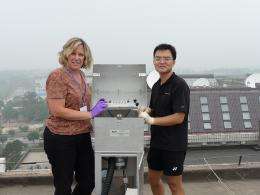
The air pollution control measures that were put in place in Beijing during the 2008 Olympic Games – if continued – would cut almost in half the lifetime risk of lung cancer for the area's residents from certain inhaled pollutants, a new study concludes.
This might translate to about 10,000 fewer lifetime cases of lung cancer in this large metropolitan area, scientists said, which is only one of several in China that have unhealthy levels of air pollution, largely from the burning of coal, biomass and automobile exhaust in a rapidly growing economy.
The findings were published today in Environmental Health Perspectives, a professional journal, by researchers from Oregon State University and Peking University in Beijing. This is one of the first studies to actually study the health benefits of pollution control strategies in a Chinese population.
The research looked at the chemical composition and carcinogenic impact of a range of polycyclic aromatic hydrocarbons, or PAHs – a group of compounds that result from almost any type of combustion, ranging from a wood stove to a coal-fired power plant or an automobile's exhaust.
PAHs are known pollutants that have been of declining concern in the United States due to pollution controls and the move to cleaner forms of energy production, but are making a huge comeback in the developing world with the advent of industrialization, population growth and heavy use of fossil fuels.
Other OSU research has also found that the level of pollutants in some Asian nations is now so high that PAH compounds are crossing the Pacific Ocean and being deposited in the U.S., even in remote areas. China is now the leading emitter of PAH pollutants in the world, followed by India and the United States.
"PAH pollution was definitely reduced by the actions China took during the 2008 Olympics, such as restricting vehicle use, decreasing coal combustion and closing some pollution-emitting factories," said Staci Simonich, an associate professor of chemistry and environmental toxicology at OSU. "That's a positive step, and it shows that if such steps were continued it could lead to a significant reduction in cancer risk from these types of pollutants."
Some, but not all, of the steps taken during the Olympics have been continued, the researchers said, including some reductions in coal-burning emissions and other measures.
Other issues are more problematic. The number of vehicles in Beijing, for instance, is continuing to increase 13 percent a year, the report noted. "Controlling vehicle emissions is key to reducing the inhalation cancer risks due to PAH exposure in Chinese megacities," the researchers wrote in their study.
Outdoor air pollution is a major health concern in China, the researchers said in their report. Associated health care costs are possibly as high as 3.8 percent of the nation's gross domestic product, according to the World Bank.
It's been estimated that 300,000 people a year die in China from heart disease and lung cancer associated with ambient air pollution, including PAHs.
This research found that in Beijing, a metropolitan area with 22 million people, the existing level of PAH pollution would lead to about 21,200 lifetime cases of lung cancer, but that would drop to 11,400 cases if pollution controls similar to those imposed during the 2008 Olympics were sustained.
"This is definitely a health concern and one that deserves attention in China by both the government and public," said Yuling Jia, a postdoctoral research associate at OSU and co-author on this study.
"It's also worth noting that the leading PAH emitter in rural China is not automobiles or things like coal-fired power plants, but the biomass burning associated with many other local activities, such as wood fuel used for cooking or heating, or the burning of agricultural fields," Jia said. "All of this needs to be considered."
Another factor on an individual level, the researchers said, is that some people are more vulnerable to PAH inhalation than others, due to their genetics, behavioral issues such as smoking, or occupation.
Provided by Oregon State University


