New path to water efficient seeds opens as TIP pips PIP as water gatekeeper
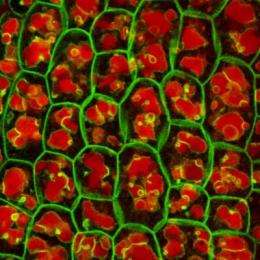
Research by University of Warwick's School of Life Sciences has opened up a new path to produce water efficient seeds that will be a significant tool to cope with drought resistance, and ensure global food security. The research not only provides the best map to date of the key protein that appears to be the principal gateway for water intake during seed germination - it also actually provides the right map as it appears much of the research to date was focussed on a much less relevant protein.
The research team led by Dr Lorenzo Frigerio looked at two proteins that are members of the large family of "Major Intrinsic Proteins", or MIPs, which are widespread among living organisms and are known to act as water channels governing water uptake.
The first of the types of protein they looked at PIPs - are intrinsic proteins that take the P at the start of their name from being normally found in the "plasma membrane", the outer casing of a cell. Because of their normal position on this outer covering these plasma membrane (PM) intrinsic proteins (PIPs) have received much of researcher's attention as the probable prime gatekeepers of the water transport into and out of cells.
The researchers focussed much of their attention on a second group of intrinsic proteins known as "Tonoplast Intrinsic Proteins" or TIPs as they are most usually found in an inner cell layer called the tonoplast which surrounds a vacuole in a cell (vacuoles are enclosed compartments in a cell filled with water and containing inorganic and organic molecules).
Despite the fact that the TIPs appear to be able to govern water uptake the fact that they are seen as being concentrated in the tonoplast has reduced researchers interest in time as key player in water uptake. This is because the tonoplast itself is generally not considered to present a major problem for intracellular water flow, as its water permeability is thought to be much higher than that of the outer plasma membrane.
This has led to a concentration of study on PIP rather that TIP and meant that virtually nothing was known about how TIPs acted in processes such as seed maturation and germination. The University of Warwick's research team work not only resulted in the most complete plant TIP expression map produced to date - it also threw up a major surprise in that they found that TIP not only had a role to play in water management in seed maturation and germination - in fact they found that it probably plays the crucial water management role, as PIP was almost literally nowhere to be seen.
As PIP, but not TIP, are generally found at the plasma membrane of plant cells, one would expect the involvement of PIP in seed de/rehydration. Intriguingly, however, the Warwick researchers studied microarray datasets and found that - out of 13 PIPs encoded by the Arabidopsis genome - only 3 (PIP1;2, PIP1;4, PIP1;5) seemed to be detectable in their seeds. They also found that those 3 PIPs did not show up until 60 hours after germination, i.e. only after the end of the most important phases of water uptake in a germinating seed. In contrast the researchers found that very high levels of TIP3 protein appeared to be present in the plasma membrane during seed development and germination.
Dr Frigerio's working hypothesis is that TIP3, besides residing in the tonoplast, is recruited to the plasma membrane to compensate for the absence (or very low concentration) of PIP. We are now on the right path to build a real understanding of how water uptake is regulated in seed development and germination. That understanding will help researchers produce seeds to meet the challenges of Global climate change, and food security through improved drought resistance and increased water use efficiency.
More information: The research has just been published in a paper entitled "Mapping of Tonoplast Intrinsic Proteins in Maturing and Germinating Arabidopsis Seeds Reveals Dual Localization of Embryonic TIPs to the Tonoplast and Plasma Membrane" by Stefano Gattolin, Mathias Sorieul and Lorenzo Frigerio (all from the University of Warwick's School of Life Sciences) in the journal Molecular Plant, Volume 4, Number 1, Pages 180-189.
Provided by University of Warwick


