Oysters disappearing worldwide: study
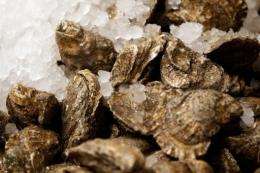
A survey of oyster habitats around the world has found that the succulent mollusks are disappearing fast and 85 percent of their reefs have been lost due to disease and over-harvesting.
Most of the remaining wild oysters in the world, or about 75 percent, can be found in five locations in North America, said the study published in BioScience, the journal of the American Institute of Biological Sciences.
An international team of researchers led by Michael Beck of the Nature Conservancy and the University of California, Santa Cruz, examined the condition of native oyster reefs in 40 ecoregions, including 144 bays.
"Oyster reefs are at less than 10 percent of their prior abundance in most bays (70 percent) and ecoregions (63 percent)," said the study.
"They are functionally extinct -- in that they lack any significant ecosystem role and remain at less than one percent of prior abundances in many bays (37 percent) and ecoregions (28 percent) -- particularly in North America, Australia and Europe."
By averaging the loss among all regions, the researchers came up with an estimate that 85 percent of oyster reef ecosystems have been lost, but said that figure was likely low because some areas lacked historical records for comparison.
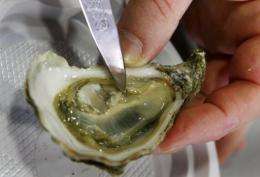
The study also did not include oyster reefs in parts of South Africa, China, Japan, and North and South Korea.
Other studies and observations in those areas "suggest that wild oyster abundance was much higher in the past and that reefs have declined greatly in abundance or have disappeared altogether," the authors said.
The one bright spot in the oyster world was in the Gulf of Mexico, where native oyster catches are "the highest in the world despite significant declines in abundance and reefs," according to the study.
Five regions where oyster catches were globally the highest were located in eastern North America, from the Virginia coast southward and also in the Gulf of Mexico.
Oysters are important to ecosystems because they filter impurities from water and provide food and employment for people living in coastal communities.
The decline in oyster population often begins when trawling or dredging destroys the structure of parts of the reef, leaving surviving oysters vulnerable to stresses in the environment.
In some cases, non-native species of oysters are introduced after a population decline, and they bring with them diseases that further kill off the native oysters.
The authors recommended that any reefs with less than 10 percent of their former abundance be closed to further harvesting until the oysters can build up their numbers again.
(c) 2011 AFP


