Opposites may attract, but they aren't better parents
Feb 01, 2011
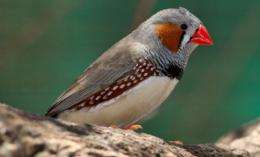
A zebra finch. Picture by Peripitus

(PhysOrg.com) -- A study by experts at the University of Exeter has revealed that couples with similar personalities make much better parents than those with different dispositions – at least in the world of zebra finches.

Researchers found birds expressing strong personality traits, such as aggressive behaviour or a willingness to explore, did a much better job of raising young if they had a like-minded partner.

Where couples were markedly different in personality, chicks didn’t fare as well – being less well-fed and in poorer condition.

The research paper, published in the journal Animal Behaviour, isn’t able to give a definitive reason for the parenting benefits of matched personalities – but authors say it could be down to improved cooperation and coordination of effort.

Dr Sasha Dall, an author of the study and part of the University of Exeter’s Centre for Ecology and Conservation, said: “The personality differences we focused on with these birds reflected how they go about their daily lives.

“In the case of , to be good you need to be able to coordinate your behaviour so that while one parent is searching for food, the other is feeding the chick. It’s a lot easier to co-ordinate your behaviour if you’re similar in the way you go about things.”

For the study, researchers focused in on the ‘personalities’ of a group of zebra finches. They were able to establish that some showed consistent patterns of behaviour, normally either reflected in different levels of aggressiveness or willingness to explore. Often the traits were combined, but some finches didn’t demonstrate them at all.

Then couples were artificially paired together – with a selection of couples who were like-minded and some who had no common traits. When mated, eggs were swapped between nests in order to distinguish the advantages of genetic, as opposed to the behavioural compatibility of parents.

Experts then studied the animals while they were feeding their chicks, and monitored the progress of hatchlings to see which were doing the best job as parents.

Dr Nick Royle, an author of the study from the University of Exeter’s Centre for Environment and Ecology, said: “We found that if birds were highly exploratory and their partners shared that trait, their offspring were in really good condition. It was the same for highly aggressive birds. If only one parent showed the trait, the chicks fared less well.

“Our study ruled out the idea that this was due to genetic compatibility, so this could only be due to the behavioural compatibility of the individuals while they were raising offspring.”

The full paper, Pairs of zebra finches with similar ‘’ make better parents, is available to view online in Animal Behaviour.

Explore further: Cat owners need better information about when to neuter their cat

More information: Pairs of zebra finches with similar ‘personalities’ make better parents, Animal Behaviour, doi:10.1016/j.anbehav.2010.12.006

Related Stories

Studies suggest males have more personality

Nov 18, 2009

(PhysOrg.com) -- Males have more pronounced personalities than females across a range of species - from humans to house sparrows - according to new research. Consistent personality traits, such as aggression ...

'Nervous' birds take more risks

Oct 26, 2007

Scientists have shown that birds with higher stress levels adopt bolder behaviour than their normally more relaxed peers in stressful situations. A University of Exeter research team studied zebra finches, which had been ...

Cuckoo chicks in Zebra finches

Apr 22, 2010

(PhysOrg.com) -- Some female zebra finches foist a part of their eggs on their neighbours. Scientists of the Max Planck Institute for Ornithology in Seewiesen discovered that in every fifth nest there is one ...

Modern society made up of all types

Nov 04, 2010

Modern society has an intense interest in classifying people into ‘types’, according to a University of Melbourne Cultural Historian, leading to potentially catastrophic life-changing outcomes for those typed – ...

Cuckoos evolve to fool angry birds

Jan 12, 2011

(PhysOrg.com) -- Australian cuckoo birds have taken a new evolutionary step – mimicking the color of their host young to avoid certain death, according to a study by researchers from The Australian National ...

Recommended for you

Scientists announce Top 10 New Species from 2012

5 hours ago

An amazing glow-in-the-dark cockroach, a harp-shaped carnivorous sponge and the smallest vertebrate on Earth are just three of the newly discovered top 10 species selected by the International Institute for ...

New cave-dwelling arachnids discovered in Brazil

16 hours ago

Two new species of cave-dwelling short-tailed whipscorpions have been discovered in northeastern Brazil, and are described in research published May 22 in the open access journal PLOS ONE by Adalberto Santos ...

Do songbirds hold key to stuttering?

22 hours ago

A tiny Australian songbird may hold the answer to discovering the biological source of stuttering, which affects 3 million Americans and is notoriously difficult to treat.

User comments : 0

More news stories

Wildlife losses now stabilising

Efforts to conserve biodiversity in the UK, Belgium and Netherlands may be working, despite the widespread perception that wildlife is in terminal decline, a new study suggests.

Unlocking secrets of cell reproduction

Research published in Open Biology today identifies, for the first time, nearly all the genes required for reproduction of a cell in a living organism.

Researchers forward quest for quantum computing

Research teams from UW-Milwaukee and the University of York investigating the properties of ultra-thin films of new materials are helping bring quantum computing one step closer to reality.

Cold plasma successful against brain cancer cells

For the first time, physicists from the Max Planck Institute for Extraterrestrial Physics (MPE), biologists and physicians demonstrated the synergistic effect of cold atmospheric plasma - a partly ionized ...

Chemists find new compounds to curb staph infection

(Phys.org) —In an age when microbial pathogens are growing increasingly resistant to the conventional antibiotics used to tamp down infection, a team of Wisconsin scientists has synthesized a potent new ...