NRL researchers study ways to reduce jet aircraft noise
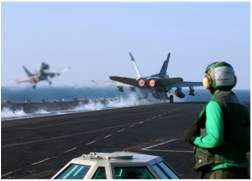
Advanced military jet aircraft have engines that provide the needed speed and maneuverability. However, with this greater power there is significant noise during takeoff and landing. The noise can impact the public and affect the health and safety of flight line workers. To confront the challenges of the noise problem, the Naval Research Laboratory (NRL) collaborated with the University of Cincinnati (UC) and GE Aircraft Engines to investigate the use of mechanical chevrons (serrations at the rim of the exhaust nozzle) and fluidics to successfully reduce the noise from supersonic military jet aircraft.
The initial research, sponsored by the Strategic Environmental Research and Development Program (SERDP), revealed the potential for significant noise reduction of high performance jet engines without compromising performance or environmental standards. SERDP is DoD's environmental science and technology program, planned and executed in partnership with DOE and EPA. The Navy recognized this research as a Top Twenty Research Accomplishment of 2009.
NRL scientists, Drs. Junhui Liu, Ravi Ramamurti and Kazhikathra Kailasanath from the Laboratory for Computational Physics and Fluid Dynamics, performed computational analysis to characterize the flow from the nozzle exhaust of a supersonic jet engine. Their findings revealed that the spacing of the shock cells and the length of the core increased as the ratio of the pressure inside the nozzle to the pressure outside (total pressure ratio) increased. These results were confirmed by experimental data from UC, showing that computational analysis works in assessing the effectiveness of chevrons and fluidics. The research team published their finding in the American Institute of Aeronautics and Astronautics journal and received a 2009 Alan Berman Research Publication Award for outstanding archival research, as judged by NRL management.
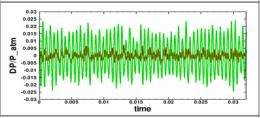
Following the successful simulations of the jet flow and noise, the research team shifted their work to simulate and assess specific noise reduction concepts. They conducted experiments and simulations to assess the impact of the mechanical chevrons on the flow from the exhaust nozzle and near-field noise. Their simulation results revealed that the chevrons caused the shock cells to move closer to the nozzle and reduce the spacing between them. The chevrons also induced more spread of the jet flow and decreased the strength of the shock cells. Together, these factors reduced the noise significantly, by more than 3 decibels at the locations where they tested.
As a next step, the researchers replaced the mechanical chevrons with fluidic injections of air at discrete locations along the jet nozzle rim. Using a 1 to 2 percent injection of air under a variety of operating conductions, the researchers achieved the same noise reduction as they did using the mechanical chevrons. The advantage of the fluidic injection technique is that is can be easily turned on and off.
The researchers then investigated a combination of mechanical chevrons and fluidics. They were able to improve the effect of the chevrons on flow modification and noise reduction by properly positioning the fluidic injections of air. They also injected air upstream of the nozzle exit, near the throat, to effectively modify the flow area. This modified the shock cell structures and reduced the noise generated.
Working under the Office of Naval Research-Rapid Technology Transition program, GE researchers then tested the mechanical chevrons on a full-scale Navy engine. The tests, conducted at the NAWC-Lakehurst Facility, proved the mechanical chevrons to be effective, as predicted by the NRL simulations. Work will continue on this project, using the validated computational capability, to further increase the noise reduction level and advance the technology. ONR is funding this research.
Provided by Naval Research Laboratory


