NJIT biomedical engineer helps stroke patients
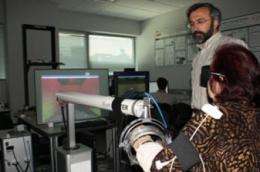
The Journal of the American Medical Society ("Medical News & Perspectives", Jan. 19, 2011) featured the research of NJIT Associate Professor Sergei Adamovich, a biomedical engineer. Adamovich and his research partners, physical therapists Alma Merians, PhD, PT, and Eugene Tunik, PhD, PT, at the University of Medicine and Dentistry of New Jersey, have developed innovative robotic and virtual reality-based video game therapies to help stroke patients regain use of hands and arms.
JAMA reported that the efforts of this team are making headway. Twenty-four patients who completed the program report improvements completing daily tasks. One patient reported cutting strawberries with both hands without realizing it, something she had previously been unable to do.
The article noted that patients in the program underwent about 22 hours of practice using a library of virtual reality video games designed by Adamovich's group. Clinical tests of arm and hand function showed improvement. Adamovich attributed the program's success to the increased intensity of repetitions and interesting exercises. With the assistance of the robotic arm, a key component of the program, the patient may complete many more repetitions than in the usual clinical setting. The researchers also analyzed brain activity before and after training and believe their work is making key neurological changes.
Last fall, the researchers reported their work to the media at a press conference at the Society for Neuroscience Conference, the world's largest source of emerging news on brain science and health in San Diego, CA. More volunteers are continually needed for the study. For information about requirements, contact Gerard G. Fluet, DPT, (732) 986-8621, fluet179@comcast.net.
"Strokes are the largest cause of disability in adults in the U.S.," Adamovich said. "That's why we feel our research is important. More people than ever survive strokes and live longer lives, but they are hobbled by major disabilities. We would like to see that change and give stroke patients the opportunity to live better lives."
While other researchers around the nation have pursued similar therapies, only a few currently focus on hand functions. Adamovich's team is trying to determine whether it is better to train the hand and arm separately or together.
Two at a time, subjects come to Adamovich's sixth-floor laboratory in Fenster Hall on the NJIT campus. Once there, they spend up to three hours a day, five days a week, for two weeks to play the specialized video games. In one game, their arms are attached to a robot called the Haptic Master. The robot, supporting their weakened arms, enables them to touch virtual spheres, which if done correctly will explode with a satisfying boom. At first glance, the uninitiated might imagine he has stepped into a video arcade. For finger-strengthening exercises, subjects in another room play a simulated piano keyboard on a wall-hung computer screen.
Interestingly, the researchers want subjects as young as 25 and as old as 80. "Age makes no difference when it comes to making improvements," Adamovich adds. Even more surprising, they've had people come to them as many as 15 years past their strokes and make even better progress than individuals six months after the event.
Today's work is based upon a research paper by Adamovich that appeared in 2006: "Sensorimotor training in a virtual reality environment: Does it improve functional recovery post-stroke?" (Neurorehabilitation and Neural Repair). The paper detailed an earlier version of what's in his lab today. "We weren't using the kinds of robotic arms that we have now," said Adamovich. "Subjects played computer games using hand/finger motions in a special glove capable of measuring their finger movements." Additionally, the training used only hands, unlike now, in which the technology has enabled hand-training to be combined with robot-assisted elbow and shoulder-training.
Adamovich, a physicist by education, began studying how the brain controls hand and arm function because of an underlying interest in the basic research principles of brain and body movement, planning and execution. Several years ago, he moved into applied research. "We believe that motor control and learning are important when trying to understand rehabilitation," he said. "Neuroscience has demonstrated through animal studies that you can induce changes in adult brain networks through intensive stimulation and sensory motor training. And, thanks to the recent changes in technology—especially the availability of robots—this whole area of neuro-rehabilitation has taken off."


