NASA satellites capture data on monster winter storm affecting 30 states (w/ Video)
February 1, 2011

NASA satellites capture data on monster winter storm affecting 30 states

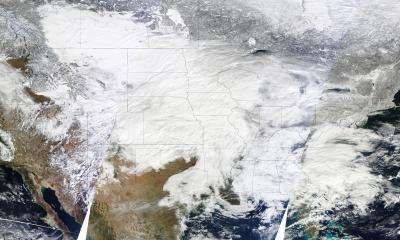
Three images from the Moderate Resolution Imaging Spectroradiometer (MODIS) aboard NASA's Terra satellite were combined to create this image of the storm system. The images were captured on Jan. 31 at 10:30 a.m., 12:05 p.m., and 1:45 p.m. ET (15:30, 17:05, and 18:45 UTC). Diagonal lines across the image show the boundaries between the overpasses. White gaps are areas where the sensor did not collect data. The image has a resolution of one kilometer per pixel. Credit: NASA Goddard MODIS Rapid Response Team

It has already been called one of the largest winter storms since the 1950s and it is affecting 30 U.S. states today with snow, sleet, freezing rain and rain. NASA satellites have gathering data on the storm that stretches from Texas and the Rockies to the New England states.

NASA's Aqua and Terra satellites have been providing visible, infrared and microwave looks at the system's clouds, precipitation, temperatures and extent.

Visible and and animations of the storm's clouds and movement are created every 15 minutes by the NASA GOES Project at NASA's Goddard Space Flight Center, Greenbelt, Md. using data from GOES-11 and GOES-13, the Geostationary Operational Environmental Satellites. The GOES-13 and GOES-11 satellites that cover the eastern and western U.S., respectively, are operated by NOAA.

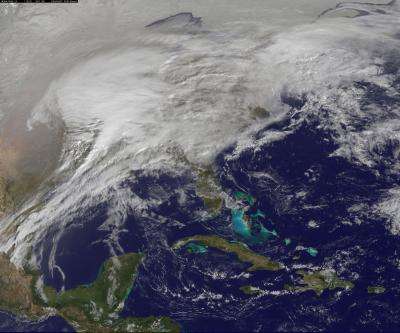
A visible image captured by the GOES-13 satellite this morning, Feb. 1 at 1401 UTC (9:01 a.m. EST) showed the low pressure area stretching from the Colorado Rockies and Texas east to New England and a massive area of clouds over the Midwest. The image showed what appeared to be "tails" over Texas and the Gulf coast. Those "tails" are areas where severe thunderstorms are possible today. See an animation of the last two days of GOES-13 that show the progression of the storm:

This video is not supported by your browser at this time.

Another amazing satellite image created at NASA Goddard involved data from the (MODIS) that flies aboard NASA's Terra satellite. Because of its massive size, three MODIS images were combined to create an image of the storm system. The images were captured each time the passed over the U.S. on January 31 at 10:30 a.m., 12:05 p.m., and 1:45 p.m. Eastern Time (15:30, 17:05, and 18:45 UTC). The image clearly shows snow on the ground from Pennsylvania into the New England states, while the large area of clouds associated with the storm lie to the west. The image has a resolution of one kilometer per pixel.

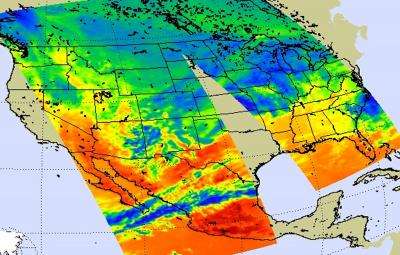
NASA's Jet Propulsion Laboratory in Pasadena, Calif. supplied infrared data of the storm system. The Atmospheric Infrared Sounder (AIRS) instrument that flies aboard NASA's Aqua satellite captured infrared imagery of the storm on Jan. 31, 2011 at 18:47 UTC (1:47 p.m. EST). The image showed the early stages of a developing storm in the plains and Midwestern states and highlighted a preponderance of cold air in Canada and the northern U.S. that set the stage for the snowfall today.
NASA satellites capture data on monster winter storm affecting 30 states

This visible image was captured by the GOES-13 satellite and shows the low pressure area stretching from the Colorado Rockies and Texas east to New England. The image shows the storm on Feb. 1 at 1401 UTC (9:01 a.m. EST) by the NASA GOES Project, located at NASA's Goddard Space Flight Center in Greenbelt, Md. The GOES series of satellites are operated by NOAA. Credit: NOAA/NASA GOES Project

A visible image created from AIRS data on Jan. 31 showed thickening clouds along a developing intense front in the plains and Midwestern states that will produce excessive snow, freezing rain, sleet, and wind in those areas today. The associated low pressure area guiding the storm will slide from Texas through the Mississippi Valley, Ohio Valley and then into New England.

NOAA's National Weather Service noted in their discussion today that this winter storm could easily be "one of the worst this season with blizzard conditions throughout much of the Midwest states, severe ice accretion from the middle Mississippi River valley eastward through parts of the Ohio Valley and into southern New England and heavy rain and severe thunderstorms over the deep south."

Nine states are under blizzard warnings today and Chicago is expecting two feet of snow. Residents of Oklahoma City are experiencing snow and gusty winds and expecting up to one and a half feet of snow today. On the southern end of this storm system, severe storms moved through Texas this morning, while areas from Birmingham to Memphis and Atlanta may also receive severe weather and between 1 and 2 inches of heavy rainfall as the system continues move east today.
NASA satellites capture data on monster winter storm affecting 30 states

This NASA satellite image from the Atmospheric Infrared Sounder (AIRS) instrument on NASA's Aqua spacecraft, taken Jan. 31, 2011 at 18:47 UTC (1:47 p.m. EST), shows the early stages of a developing storm in the plains and Midwestern states. This image highlights a preponderance of cold air in Canada and the northern US (green and blue colors). Credit: NASA JPL, Ed Olsen

The U.S. northeast is expecting snow, sleet and rain. Some northeastern U.S. cities have already recorded record snowfall and more is expected from this storm. Philadelphia has already recorded 37 inches of snow and New York City has received 56 inches. Philadelphia is expecting freezing rain today while New York City is forecast to receive between 3 and 6 inches of snow and sleet and between a quarter to 4 tenths of an inch of ice accumulation by late Wednesday.

As the system continues east, the National Weather Service is forecasting a large snowfall for New England. Boston is forecast to receive between 8 and 18 inches of and Portland, Maine, is expected to receive between 11 and 17 inches. It has already been a long winter in the U.S. northeast and today is the first day of February, a month known to be the snowiest of the season.

Provided by NASA's Goddard Space Flight Center search and more info website

Filter


Move the slider to adjust rank threshold, so that you can hide some of the comments.


Display comments: newest first

ubavontuba
Feb 01, 2011

Rank: 5 / 5 (1)
Just musing:

I wonder, how many storms like this it would take to regenerate the Laurentide icesheet?
jyro
Feb 01, 2011

Rank: 5 / 5 (4)
since it took 80,000 years to form, quite a few.
geokstr
Feb 01, 2011

Rank: 1 / 5 (4)
since it took 80,000 years to form, quite a few.

According to an article published on this very site a while back, analysis of past ice ages indicate that some of them came on full force in less then ten years.

But we need to do everything we can, including impoverishing our economies, in order to make things colder.

What could possibly go wrong?
Sin_Amos
Feb 01, 2011

Rank: 3 / 5 (2)
You do realize that we are causing this, but as I've noticed, you seem to be an astroturfer, as I read more and more of your comments. Yeah, because our economies aren't tied directly to the resources of this planet and the natural living systems. That was sarcasm, GEO-ASTROTURFER-kstr.
ubavontuba
Feb 02, 2011

Rank: not rated yet
Did you all hear about the whopper hurricane headed for Queensland Australia? Those poor people. As if they haven't suffered enough already...
Rank 5 /5 (5 votes)
Relevant PhysicsForums posts

More news stories

SpaceX capsule has 'new car' smell, astronauts say (Update)

SpaceX's Dragon cargo vessel smells like a new car, said astronauts at the International Space Station after opening the hatches Saturday following the spacecraft's landmark mission to the orbiting lab.

Space & Earth / Space Exploration

created 14 hours ago | popularity 4.5 / 5 (19) | comments 0

Australia hails surprise super-telescope decision

Australia has hailed a surprise decision giving it a role in a radio telescope project aimed at revolutionising astronomy, vowing to draw on its decades of experience in space science.

Space & Earth / Astronomy

created 14 hours ago | popularity 5 / 5 (3) | comments 1

Astronomers seize last chance in lifetime for Venus Transit

Astronomers are gearing for one the rarest events in the Solar System: an alignment of Earth, Venus and the Sun that will not be seen for another 105 years.

Space & Earth / Astronomy

created 14 hours ago | popularity 5 / 5 (1) | comments 0

Astronauts enter world's 1st private supply ship

(AP) -- Space station astronauts floated into the Dragon on Saturday, a day after its heralded arrival as the world's first commercial supply ship.

Space & Earth / Space Exploration

created 14 hours ago | popularity 5 / 5 (5) | comments 0

Dragon arrives at space station in historic 1st (Update 2)

The privately bankrolled Dragon capsule made a historic arrival at the International Space Station on Friday, triumphantly captured by astronauts wielding a giant robot arm.

Space & Earth / Space Exploration

created May 25, 2012 | popularity 5 / 5 (10) | comments 19


Dell tablet leak: 10.1-inch display, two-battery choice

(Phys.org) -- Headline after headline talks about vendors’ tablets in the wings as likely number-one contenders for the iPad. Such claims have justifiably been taken with a grain of salt, considering ...

Scientist: Evolution debate will soon be history

(AP) -- Richard Leakey predicts skepticism over evolution will soon be history. Not that the avowed atheist has any doubts himself.

SpotterRF debuts Radar Backpack Kit (w/ Video)

(Phys.org) -- SpotterRF has announced a special radar backpack kit designed to enhance situational awareness for soldiers on the ground. The company says its special radar is designed for warfighters as part ...

Thousands of shellfish found dead in Peru

Thousands of crustaceans were found dead off the coast of Lima following the mystery mass death of dolphins and pelicans, the Peruvian Navy said Friday.

Keep food safety in mind this memorial day weekend

(HealthDay) -- Picnics, parades and cookouts are as much a part of Memorial Day weekend as tributes to the United States' war veterans.

Family history of Alzheimer's affects functional connectivity

(HealthDay) -- Cognitively normal individuals with a family history of late-onset Alzheimer's disease (AD) may display lower resting state functional connectivity in the default mode network (DMN) of the brain, ...