New nanoparticles make blood clots visible
For almost two decades, cardiologists have searched for ways to see dangerous blood clots before they cause heart attacks.
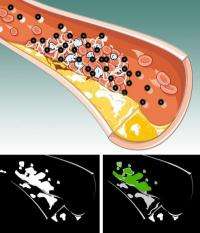
Now, researchers at Washington University School of Medicine in St. Louis report that they have designed nanoparticles that find clots and make them visible to a new kind of X-ray technology.
According to Gregory Lanza, MD, PhD, a Washington University cardiologist at Barnes-Jewish Hospital, these nanoparticles will take the guesswork out of deciding whether a person coming to the hospital with chest pain is actually having a heart attack.
"Every year, millions of people come to the emergency room with chest pain. For some of them, we know it's not their heart. But for most, we're not sure," says Lanza, a professor of medicine. When there is any doubt, the patient must be admitted to the hospital and undergo tests to rule out or confirm a heart attack.
"Those tests cost money and they take time," Lanza says.
Rather than an overnight stay to make sure the patient is stable, this new technology could reveal the location of a blood clot in a matter of hours.
Spectral CT
The nanoparticles are designed to be used with a new type of CT scanner that is capable of "seeing" metals in color. The new technology, called spectral CT, uses the full spectrum of the X-ray beam to differentiate objects that would be indistinguishable with a regular CT scanner that sees only black and white.
Lanza says the new scanner takes advantage of the same physics that astronomers use to look at the light from a star and tell what metals it contains.
"They're looking at the X-ray spectrum, and the X-ray spectrum tells them what metals are there," he says. "That's exactly what we do."
Bismuth nanoparticles
In this case, the metal in question is bismuth. Dipanjan Pan, PhD, research assistant professor of medicine, designed a nanoparticle that contains enough bismuth for it to be seen by the spectral CT scanner.
"Each nanoparticle is carrying a million atoms of bismuth," Lanza says. Since CT is a relatively insensitive imaging technique, this sheer quantity of metal is necessary for the particles to be visible to the scanner.
But bismuth is a toxic heavy metal, Pan says. It can't be injected into the body on its own. Instead, Pan used a compound made of bismuth atoms attached to fatty acid chains that can't come apart in the body. He then dissolved this compound in a detergent and encapsulated the mixture in a phospholipid membrane. Much like oil droplets suspended in a shaken vinaigrette, these particles self-assemble with the bismuth compound at the core.
As Pan showed in a mouse model, the design of the nanoparticles also allows the body to break them apart and release the inner bismuth compound in a safe form.
Once the nanoparticles carried enough bismuth to be visible to the scanner, Pan added a molecule to the particles' surface that seeks out a protein called fibrin. Fibrin is common in blood clots but is not found elsewhere in the vasculature.
"If you're having a heart attack, the lining of your coronary artery has ruptured, and a clot is forming to repair it," Lanza says. "But that clot is starting to narrow the vessel so blood can't get by. Now we have a nanoparticle that will see that clot."
A spectral CT image with the bismuth nanoparticles targeted to fibrin will provide the same information as a traditional black and white CT image, but the fibrin in any blood clots will show up in a color, such as yellow or green, solving the problem of calcium interference common to traditional CT scanners.
The spectral CT scanner used in this study is still a prototype instrument, developed by Philips Research in Hamburg, Germany. The nanoparticles have only been tested in rabbits and other animal models, but early results show success in distinguishing blood clots from calcium interference.
Saving lives
More than simply confirming a heart attack, the new nanoparticles and spectral CT scanner can show a clot's exact location.
Today, even if doctors determine the patient is having a heart attack, they can't locate the clot without admitting the patient to the cardiac catheterization lab, inserting a dye and looking for narrow plaque-filled arteries they could open with stents. But Lanza says looking for narrow arteries doesn't solve all the problems.
"The ones that have very narrow openings are not the worrisome ones," Lanza says. "We find those in the cardiac catheterization lab and we open them up."
What is worrisome is when blood is free to flow through the arteries, but there is unstable plaque on the artery wall, what Lanza calls "moderate-grade disease."
"Most people's heart attacks or strokes are from moderate-grade disease that breaks off and all of a sudden blocks an artery," Lanza says. "It's what happened to NBC newsman Tim Russert. You need something that tells you there is ruptured plaque even when the vessel isn't very narrow."
Since this nanoparticle finds and sticks to fibrin in the vessels, it would allow doctors to see problems that were previously difficult or impossible to detect.
With this imaging technique, Lanza predicts new approaches to treating coronary disease. Unstable plaque that doesn't restrict much blood flow does not require an expensive stent to prop the vessel open. Instead, Lanza foresees technologies that might act like Band-Aids, sealing weak spots in the vessel walls.
"Today, you wouldn't know where to stick the Band-Aid," Lanza says. "But spectral CT imaging with bismuth nanoparticles would show the exact location of clots in the vessels, making it possible to prevent the dangerous rupture of unstable plaque."
More information: Pan D, Roessl E, Schlomka JP, Caruthers SD, Senpan A, Scott MJ, Allen JS, Zhang H, Hu G, Gaffney PJ, Choi ET, Rasche V, Wickline SA, Proksa R, Lanza GM. Computed Tomography in color: NanoK-enhanced spectral CT molecular imaging. Angewandte Chemie, International Edition, Dec. 10, 2010.
Provided by Washington University School of Medicine


