Mud volcano set to erupt for quarter-century - scientists
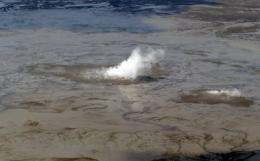
A mud volcano that has displaced more than 13,000 Indonesian families will erupt for at least a quarter of century, emitting belches of flammable gas through a deepening lake of sludge, scientists reported on Thursday.
Underground pressure means the volcano "Lusi," in Sidoarjo, East Java, is likely to gush grey mud until 2037, when volumes will become negligible, according to their computer model.
But gas will continue to percolate through it for decades and possibly centuries to come.
"Our estimate is that it will take 26 years for the eruption to drop to a manageable level and for Lusi to turn into a slow bubbling volcano," said team leader Richard Davies, a professor of Earth sciences at Durham University, in northeast England.
Thirteen people were killed after Lusi erupted on May 29 2006.
At its height, the volcano gushed 40 Olympic-sized pools of mud each day, a rate that has now slowed to four per day, Davies said by phone.
Its lake of mud has now smothered 12 villages to a depth of up to 15 metres (nearly 50 feet) and forced around 42,000 people from their homes.
The computer simulation is based on data from two existing commercial gas wells in the same region and on seismic reflection data that gives a picture of Lusi's geological structure.
"In the middle of the lake, or the volcano, is a vent that is 50 metres (164 feet) wide but there are 166 other vents that have popped up over the last four-plus years," said Davies.
"These have popped up in factories, in roads, in people's houses. Some of them have ignited, there have been examples of people being hurt by flames that have been formed due to the ignition."
Lusi's staying power means it will be a long-term but gradually less dramatic menace, he warned.
"You can't return to the area. In fact, ultimately, probably the impact of the volcano will increase," Davies declared.
"I think we've seen the most dramatic destruction. But it's not the end of the story. These vents are still forming."
The area is also slowly subsiding, and by 2037 could have formed a depression 95-475 metres (312-1558 feet) deep.
The Indonesian government blames the eruption on an earthquake that struck days before, about 280 kilometres (174 miles) away from Lusi.
But foreign experts accuse a gas drilling company, Lapindo Brantas, of failing to place a protective casing around a section of its well.
As a result, the well hole was exposed to a "kick" from pressurised water and gas that lie beneath the layer of mud, thus driving the grey, concrete-like fluid to the surface.
The study is released in the London-based Journal of the Geological Society.
(c) 2011 AFP


