Microbially produced ferrous iron may decrease technetium concentrations in groundwater
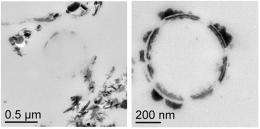
Transmission electron micrographs showing the variety of materials generated during simultaneous bioreduction of Fh and 99TcO4 - (left, Shewanella putrefaciens) in comparison with bioreduction of 99TcO4 - in the absence of Fh (right, Geobacter sulfurreducens).
(PhysOrg.com) -- The long-lasting radionuclide technetium is transported through the subsurface near former nuclear production and processing sites, moving toward rivers and lakes. But its journey can come to an abrupt end if it hits an area containing high levels of reduced iron generated by microbes.
Scientists from Pacific Northwest National Laboratory recently found that microbially generated iron creates significant roadblocks for the pollutant. They determined that in the presence of commonly occurring oxidized iron minerals, indirect technetium reduction by microbially generated ferrous iron, or Fe(II), may be favored over direct technetium reduction by bacteria, making the technetium as much as 10 times less soluble.
Technetium-99 (99Tc), a radioactive by-product of nuclear production and processing, has a half-life of 200,000 years. Its common oxidized form, Tc(VII)O4-, or pertechnetate, is highly mobile in subsurface sediments and groundwater. This makes it of concern at Department of Energy plutonium production sites such as the Hanford Site in Washington State, and others in Paducah, KY, and Portsmouth, OH.
Fortunately, pertechnetate can be chemically reduced to less mobile forms by subsurface minerals containing reduced or ferrous (Fe2+) iron. The ferrous iron content of the subsurface can, in turn, be increased by metal-reducing bacteria, such as Shewanella, Geobacter, and Anaeromyxobacter.
The tenfold difference in technetium solubility is important, because the Environmental Protection Agency limit for 99Tc in drinking water is extremely lownear the solubility value for the chemically reduced form of Tc, TcO2 (technetium dioxide). Furthermore, the PNNL researchers found that direct biological reduction of technetium by metal-reducing bacteria generated small-particle technetium colloids that could be highly mobile. Previous research revealed that technetium oxide associated with minerals can be resistant to reoxidation and mobility.
Pertechnetate can be reduced to technetium oxide or to various Tc(IV) chemical phases by microbial enzymes that can generate low redox potential, such as hydrogenase or c-type cytochromes. Various forms of reduced inorganic ions, such as ferrous iron or sulfide are also produced and these, have the potential to reduce pertechnetate. The effectiveness of these reductants is extremely dependent on their chemical speciation and mineral form.
Using several dissimilatory metal-reducing bacteria, the PNNL team examined the bioreduction of pertechnetate in the presence and absence of the poorly crystalline iron oxide. They examined the resulting bioreduced materials by transmission electron microscopy, X-ray absorption spectroscopy, microcapillary X-ray diffraction, and traditional wet-chemical analytical methods. Technetium solubility was determined by sequential ultrafiltration, solvent extraction, and liquid scintillation counting.
The researchers are now examining the enzymatic reduction of technetium by hydrogenase and cytochromes to gain insight into the properties of biogenic technetium oxide and the electron transfer mechanisms responsible for the reduction. Simultaneously, they are examining the biogeochemical transformation reactions in representative Hanford Site sediments and the microbial and geochemical catalysts responsible for technetium reduction.
More information: Plymale AE, JK Fredrickson, JM Zachara, AC Dohnalkova, SM Heald, DA Moore, DW Kennedy, MJ Marshall, C Wang, CT Resch, and P Nachimuthu. 2011. "Competitive Reduction of Pertechnetate (99TcO4-) by Dissimilatory Metal Reducing Bacteria and Biogenic Fe(II)." Environmental Science & Technology 45(3):951-957. DOI:10.1021/es1027647
Provided by
Pacific Northwest National Laboratory
-
From lemons to lemonade: Reaction uses carbon dioxide to make carbon-based semiconductor,
30 comments
-
Thioridazine kills cancer stem cells in human while avoiding toxic side-effects of conventional cancer treatments,
3 comments
-
SpaceX private rocket blasts off for space station (Update),
42 comments
-
Climate scientists say they have solved riddle of rising sea,
30 comments
-
Research team claims to have found evidence Lake Cheko is impact crater for Tunguska Event,
18 comments
-
Schwartz reagent-- NMR/MS/IR
12 hours ago
-
Inversion temp
17 hours ago
-
High school chemistry EEI
May 25, 2012
-
oxidation of I- by KMnO4
May 25, 2012
-
Invesion temp
May 25, 2012
-
Hybridization of SnCl3 -
May 25, 2012
- More from Physics Forums - Chemistry
More news stories
From lemons to lemonade: Reaction uses carbon dioxide to make carbon-based semiconductor
(Phys.org) -- A materials scientist at Michigan Technological University has discovered a chemical reaction that not only eats up the greenhouse gas carbon dioxide, it also creates something useful. And, by ...
May 21, 2012 |
4.7 / 5 (88) |
30
|
New CO2-removing catalyst can take the heat
(Phys.org) -- The current method of removing the greenhouse gas carbon dioxide (CO2) from the flues of coal-fired power plants uses so much energy that no one bothers to use it. So says Roger Aines, principal ...
May 24, 2012 |
5 / 5 (7) |
7
|
High-speed method to aid search for solar energy storage catalysts
Eons ago, nature solved the problem of converting solar energy to fuels by inventing the process of photosynthesis.
May 25, 2012 |
5 / 5 (3) |
4
|
Researchers demonstrate possible primitive mechanism of chemical info self-replication
(Phys.org) -- When scientists think about the replication of information in chemistry, they usually have in mind something akin to what happens in living organisms when DNA gets copied: a double-stranded molecule ...
May 25, 2012 |
5 / 5 (4) |
2
|
Castor oil: Action mechanism of one of the oldest drugs known to man elucidated
Castor oil is known primarily as an effective laxative; however, it was also used in ancient times with pregnant women to induce labour. Only now have scientists at the Max Planck Institute for Heart and Lung ...
May 21, 2012 |
3 / 5 (2) |
3
|
Dell tablet leak: 10.1-inch display, two-battery choice
(Phys.org) -- Headline after headline talks about vendors tablets in the wings as likely number-one contenders for the iPad. Such claims have justifiably been taken with a grain of salt, considering ...
Scientist: Evolution debate will soon be history
(AP) -- Richard Leakey predicts skepticism over evolution will soon be history. Not that the avowed atheist has any doubts himself.
SpotterRF debuts Radar Backpack Kit (w/ Video)
(Phys.org) -- SpotterRF has announced a special radar backpack kit designed to enhance situational awareness for soldiers on the ground. The company says its special radar is designed for warfighters as part ...
SpaceX capsule has 'new car' smell, astronauts say (Update)
SpaceX's Dragon cargo vessel smells like a new car, said astronauts at the International Space Station after opening the hatches Saturday following the spacecraft's landmark mission to the orbiting lab.
Thousands of shellfish found dead in Peru
Thousands of crustaceans were found dead off the coast of Lima following the mystery mass death of dolphins and pelicans, the Peruvian Navy said Friday.
Keep food safety in mind this memorial day weekend
(HealthDay) -- Picnics, parades and cookouts are as much a part of Memorial Day weekend as tributes to the United States' war veterans.
Feb 22, 2011
Rank: not rated yet