Calculating lifetime solar energy cost with new, balanced approach
February 8, 2011 By Angela Hardin

Calculateing lifetime solar energy cost with new, balanced approach

Enlarge

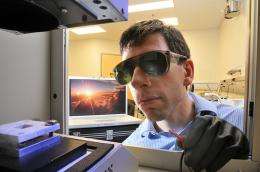
Argonne chemist Seth Darling measures the performance of a nanostructured organic photovoltaic cell. Credit: Argonne National Laboratory

Researchers at the U.S. Department of Energy's Argonne National Laboratory in partnership with an analyst at Gartner, Inc. have developed a new and more instructive approach to calculate the lifetime cost for a solar-generated energy system for comparison to other energy systems.

Usually when people consider the cost of , they use the dollars per Watt metric, which is only a measure of the initial capital cost and the solar panel vendor's performance specification. This doesn't take into account the actual you will get from the system or other cost factors such as maintenance. A far more informative metric is the levelized cost of energy (LCOE).

"In typical LCOE projections for solar energy, many assumptions are swept under the rug, and we wanted to make a small step toward lifting up that rug and showing how you can truly get a handle on those assumptions to develop a more accurate picture of the potential costs," said Argonne solar researcher Seth Darling, who leads the development of the new approach. LCOE is the cost of an over its lifetime per energy unit produced.

"Specifically, the Argonne approach uses a that statistically selects from probability distributions to account for the uncertainly associated with various cost and production parameters," Darling said. A Monte Carlo simulation can produce millions of possible performance outcomes that might occur in the future, weighted to reflect their likelihood.

A variety of stakeholders, including investors and , are tracking the generational development and commercialization of solar technologies and require greater insight into the projected costs of a solar energy project to aid in decision making.

"Investors need to know their expected return on investment, regulators and policy makers help define the economies of energy productions and require reliable information, funding agencies need a means to analyze proposed technology development, and technology developers want to understand how they will compete relative to other technologies," according to a new paper published by the researchers.

Argonne's optimized approach to calculating the LCOE for photovoltaics will provide each group with better guidance. However, implementing this approach will require development of more rigorous data sets of location-specific solar panel performance and other parameters. Fair comparison to traditional energy sources, such as coal or natural gas, will require a re-examination of the hidden costs associated with those technologies.

More information: The new methodology is presented in the paper "Assumptions and the levelized cost of energy for photovoltaics" in Energy & Environmental Science. http://pubs.rsc.or … E/c0ee00698j

Provided by Argonne National Laboratory search and more info website

Filter


Move the slider to adjust rank threshold, so that you can hide some of the comments.


Display comments: newest first

Quantum_Conundrum
Feb 08, 2011

Rank: 5 / 5 (1)
Like many things, going bigger is more efficient.

Yesterday, while search youtube for solar related advancements, I found videos of a 40MW parabolic trough power plant using pipes in vacuum tube. Well, 40mw is what the plant is really rated, but I calculated it probably produces closer to 58MW during the day, though some of this is used in pumping water, and some is stored as steam for night time use, so 40mw is probably an "average".

Going with larger mirrors means you can have larger pipes which hold more water, but have lower surface area, which in turn means even better performance because of less heat loss. with the vacuum tubes they have almost no heat loss, except at contact points, which is unavoidable.

You can still make back yard solar power for water heating and home heating, and these are still cheaper and more cost effective than photovoltaics. I've seen SMALL homemade solar units which cut winter water heating bill in half and removed summer bill completely.
antialias
Feb 08, 2011

Rank: 4.7 / 5 (3)
I'll use this new metric as soon as we

- add the environmental cost to fossil fuels
- add the cost of tens of thousands of years of storage for radioactive waste to nuclear power

THEN it will be a fair comparison.

(As an aside: Monte Carlo methods only give good resukts if you paramtrize them correctly. I somehow doubt that they have good parameters for all possible deployment scenarios (and if they did then a Monte Carlo smimulation would not be necessary because a simple expected value would enough)
Rank 3 /5 (2 votes)
Relevant PhysicsForums posts

More news stories

SpotterRF debuts Radar Backpack Kit (w/ Video)

(Phys.org) -- SpotterRF has announced a special radar backpack kit designed to enhance situational awareness for soldiers on the ground. The company says its special radar is designed for warfighters as part ...

Technology / Hi Tech & Innovation

created 14 hours ago | popularity 5 / 5 (3) | comments 11 | with audio podcast report

Probability of contamination from severe nuclear reactor accidents is higher than expected: study

Catastrophic nuclear accidents such as the core meltdowns in Chernobyl and Fukushima are more likely to happen than previously assumed. Based on the operating hours of all civil nuclear reactors and the number ...

Technology / Energy & Green Tech

created May 22, 2012 | popularity 3.6 / 5 (21) | comments 52 | with audio podcast

Delphi gasoline-injection engine technique rivals hybrid's edge

(Phys.org) -- Running a diesel like engine on gasoline is something Delphi is doing in notable fashion. They claim they are on to a promising way to enjoy an engine that gives the vehicle owner high efficiency ...

Technology / Energy & Green Tech

created May 21, 2012 | popularity 4.7 / 5 (18) | comments 37 | with audio podcast report

HyperSolar shows dirty water no barrier to power world

(Phys.org) -- The Santa Barbara, California, company, HyperSolar, is set to transparently share the ups and downs of its research experiences toward the company’s ultimate vision, successfully producing ...

Technology / Energy & Green Tech

created May 24, 2012 | popularity 4.8 / 5 (14) | comments 17 | with audio podcast report

Tesla to launch electric sedan in US on June 22

Tesla Motors said Tuesday it would begin deliveries of "the world's first premium electric sedan" on June 22, slightly ahead of schedule.

Technology / Energy & Green Tech

created May 22, 2012 | popularity 4.5 / 5 (11) | comments 18


Dell tablet leak: 10.1-inch display, two-battery choice

(Phys.org) -- Headline after headline talks about vendors’ tablets in the wings as likely number-one contenders for the iPad. Such claims have justifiably been taken with a grain of salt, considering ...

Scientist: Evolution debate will soon be history

(AP) -- Richard Leakey predicts skepticism over evolution will soon be history. Not that the avowed atheist has any doubts himself.

SpaceX capsule has 'new car' smell, astronauts say (Update)

SpaceX's Dragon cargo vessel smells like a new car, said astronauts at the International Space Station after opening the hatches Saturday following the spacecraft's landmark mission to the orbiting lab.

Thousands of shellfish found dead in Peru

Thousands of crustaceans were found dead off the coast of Lima following the mystery mass death of dolphins and pelicans, the Peruvian Navy said Friday.

Keep food safety in mind this memorial day weekend

(HealthDay) -- Picnics, parades and cookouts are as much a part of Memorial Day weekend as tributes to the United States' war veterans.

Australia hails surprise super-telescope decision

Australia has hailed a surprise decision giving it a role in a radio telescope project aimed at revolutionising astronomy, vowing to draw on its decades of experience in space science.