Lavender oil has potent antifungal effect
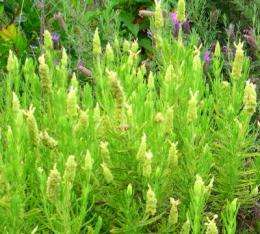
These are Lavendula viridis plants. Credit: Mónica Zuzarte
Lavender oil could be used to combat the increasing incidence of antifungal-resistant infections, according to a study published in the Journal of Medical Microbiology. The essential oil shows a potent antifungal effect against strains of fungi responsible for common skin and nail infections.
Scientists from the University of Coimbra in Portugal distilled lavender oil from the Lavandula viridis L'Hér shrub that grows in southern Portugal. The oil was tested against a range of pathogenic fungi and was found to be lethal to a range of skin-pathogenic strains, known as dermatophytes, as well as various species of Candida.
Dermatophytes cause infections of the skin, hair and nails as they use the keratin within these tissues to obtain nutrients. They are responsible for conditions such as Athletes' foot, ringworm and can also lead to scalp and nail infections. Candida species coexist with most healthy individuals without causing problems but may cause mucocutaneous candidosis - or thrush - in some people. In immunocompromised patients, Candida species are able to cause serious infection if the fungal cells escape into the blood stream.
Currently, there are relatively few types of antifungal drugs to treat infections and those that are available often have side effects. Professor Lígia Salgueiro and Professor Eugénia Pinto who led this study explained why novel fungicides are urgently needed. "In the last few years there has been an increase in the incidence of fungal diseases, particularly among immunocompromised patients," they said. "Unfortunately there is also increasing resistance to antifungal drugs. Research by our group and others has shown that essential oils may be cheap, efficient alternatives that have minimal side effects."
Essential oils distilled from the Lavandula genus of lavender plants are already used widely, particularly in the food, perfume and cosmetic industries. Studies of the biological activities of these oils suggest Lavandula oils have sedative and antispasmodic properties as well being potent antimicrobials and antioxidants.
This group has demonstrated that these oils work by destroying fungal cells by damaging the cell membrane. They believe that further research into the mechanisms by which this essential oil works could have significant clinical benefits. "Lavandula oil shows wide-spectrum antifungal activity and is highly potent. This is a good starting point for developing this oil for clinical use to manage fungal infections. What is now required is clinical trials to evaluate how our in vitro work translates in vivo," said Professor Salgueiro.
Provided by Society for General Microbiology
-
From lemons to lemonade: Reaction uses carbon dioxide to make carbon-based semiconductor,
30 comments
-
Thioridazine kills cancer stem cells in human while avoiding toxic side-effects of conventional cancer treatments,
3 comments
-
SpaceX private rocket blasts off for space station (Update),
42 comments
-
Climate scientists say they have solved riddle of rising sea,
30 comments
-
Research team claims to have found evidence Lake Cheko is impact crater for Tunguska Event,
18 comments
-
What would stain as translucent on light-coloured fabric?
4 hours ago
-
How do I identify different bacteria on culture plates?
14 hours ago
-
Why Do Dogs do Strange things...
May 25, 2012
-
What does exophillic and endophillic mean in terms of mosquito and their control?
May 24, 2012
-
Semen stains glows under black lights (uv light)?
May 23, 2012
-
Question on Human Chromosome 2
May 23, 2012
- More from Physics Forums - Biology
More news stories
Scientist: Evolution debate will soon be history
(AP) -- Richard Leakey predicts skepticism over evolution will soon be history. Not that the avowed atheist has any doubts himself.
4 hours ago |
2.8 / 5 (6) |
12
Thousands of shellfish found dead in Peru
Thousands of crustaceans were found dead off the coast of Lima following the mystery mass death of dolphins and pelicans, the Peruvian Navy said Friday.
14 hours ago |
4.8 / 5 (4) |
5
More plant species responding to global warming than previously thought
(Phys.org) -- Far more wild plant species may be responding to global warming than previous large-scale estimates have suggested.
May 22, 2012 |
4.6 / 5 (14) |
18
|
Totally rad: Scientists create rewritable digital data storage in DNA
(Phys.org) -- Scientists from Stanford's Department of Bioengineering have devised a method for repeatedly encoding, storing and erasing digital data within the DNA of living cells.
May 21, 2012 |
4.9 / 5 (17) |
11
|
For monogamous sparrows, it doesn't pay to stray (but they do it anyway)
It's quite common for a female song sparrow to stray from her breeding partner and mate with the male next door, but a new study shows that sleeping around can be costly.
May 22, 2012 |
5 / 5 (1) |
7
|
Dell tablet leak: 10.1-inch display, two-battery choice
(Phys.org) -- Headline after headline talks about vendors tablets in the wings as likely number-one contenders for the iPad. Such claims have justifiably been taken with a grain of salt, considering ...
SpotterRF debuts Radar Backpack Kit (w/ Video)
(Phys.org) -- SpotterRF has announced a special radar backpack kit designed to enhance situational awareness for soldiers on the ground. The company says its special radar is designed for warfighters as part ...
SpaceX capsule has 'new car' smell, astronauts say (Update)
SpaceX's Dragon cargo vessel smells like a new car, said astronauts at the International Space Station after opening the hatches Saturday following the spacecraft's landmark mission to the orbiting lab.
Keep food safety in mind this memorial day weekend
(HealthDay) -- Picnics, parades and cookouts are as much a part of Memorial Day weekend as tributes to the United States' war veterans.
Australia hails surprise super-telescope decision
Australia has hailed a surprise decision giving it a role in a radio telescope project aimed at revolutionising astronomy, vowing to draw on its decades of experience in space science.
Astronomers seize last chance in lifetime for Venus Transit
Astronomers are gearing for one the rarest events in the Solar System: an alignment of Earth, Venus and the Sun that will not be seen for another 105 years.
Feb 16, 2011
Rank: not rated yet