Jewel-toned organic phosphorescent crystals: A new class of light-emitting material
February 14, 2011

Jewel-toned organic phosphorescent crystals: A new class of light-emitting material

Enlarge

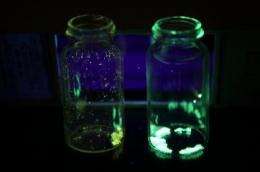
U-M researchers have developed pure organic phosphorescent crystals. Here, they glow yellow and green when triggered by ultraviolet light. Credit: Marcin Szczepanski, U-M College of Engineering

(PhysOrg.com) -- Pure organic compounds that glow in jewel tones could potentially lead to cheaper, more efficient and flexible display screens, among other applications.

University of Michigan researcher Jinsang Kim and his colleagues have developed a new class of material that shines with phosphorescence—a property that has previously been seen only in non-organic compounds or organometallics.

Kim and his colleagues made metal-free organic crystals that are white in visible light and radiate blue, green, yellow and orange when triggered by ultraviolet light. By changing the materials' chemical composition, the researchers can make them emit different colors.

The new luminous materials, or phosphors, could improve upon current organic light-emitting diodes (OLEDs) and solid-state lighting. Bright, low-power OLEDs are used in some small screens on cell phones or cameras. At this time, they aren't practical for use in larger displays because of material costs and manufacturing issues.

The OLEDs of today aren't 100 percent organic, or made of carbon compounds. The organic materials used in them must be spiked with metal to get them to glow.

"Purely organic materials haven't been able to generate meaningful phosphorescence emissions. We believe this is the first example of an organic that can compete with an organometallic in terms of brightness and color tuning capability," said Kim, an associate professor of materials science and engineering, chemical engineering, macromolecular science and engineering, and biomedical engineering.

This work is newly published online in .

The new phosphors exhibit "quantum yields" of 55 percent. Quantum yield, a measure of a material's efficiency and brightness, refers to how much energy an electron dissipates as light instead of heat as it descends from an excited state to a ground state. Current pure have a yield of essentially zero.

Jewel-toned organic phosphorescent crystals: A new class of light-emitting material
Enlarge

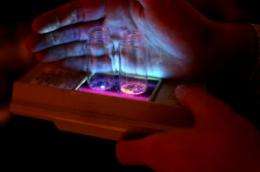
Organic phosphors developed at the University of Michigan could one day lead to cheaper organic light-emitting diodes. Here, they glow in blue and orange when triggered by ultraviolet light. Credit: Marcin Szczepanski, U-M College of Engineering

In Kim's phosphors, the light comes from molecules of oxygen and carbon known as "aromatic carbonyls," compounds that produce phosphorescence, but weakly and under special circumstances such as extremely low temperatures. What's unique about these new materials is that the aromatic carbonyls form strong halogen bonds with halogens in the crystal to pack the molecules tightly. This arrangement suppresses vibration and heat energy losses as the excited electrons fall back to the ground state, leading to strong phosphorescence.

"By combining aromatic carbonyls with tight halogen bonding, we achieve phosphorescence that is much brighter and in practical conditions," said Onas Bolton, a co-author of this paper who recently received his Ph.D. in Materials Science and Engineering.

This new method offers an easier way to make high-energy blue organic phosphors, which are difficult to achieve with organometallics.

Organic light emitting diodes are lighter and cheaper to manufacture than their non-organic counterparts, which are made primarily of ceramics. Today's OLEDs still contain small amounts of precious metals, though. These new compounds can bring the price down even further, because they don't require precious metals. They're made primarily of inexpensive carbon, oxygen, chlorine and bromine.

"This is in the beginning stage, but we expect that it will not be long before our simple materials will be available commercially for device applications," Kim said. "And we expect they will bring a big change in the LED and solid-state lighting industries because our compounds are very cheap and easy to synthesize and tune the chemical structure to achieve different colors and properties."

Former doctoral student Kangwon Lee discovered the unique properties of these materials while developing a biosensor—a compound that detects biological molecules and can be used in medical testing and environmental monitoring. The phosphors have applications in this area as well. After Lee's discovery, Bolton developed the metal-free pure-organic phosphors.

The paper is titled "Activating efficient phosphorescence from purely-organic materials by crystal design." In addition to Kim, Bolton, and Lee, other contributors are: former postdoctoral researcher Hyong-Jun Kim in the Department of Materials Science and Engineering and recent Chemical Engineering graduate Kevin Y. Lin. This work is partly funded by the National Science Foundation and the National Research Foundation of Korea.

The university is pursuing patent protection for the intellectual property, and is seeking commercialization partners to help bring the technology to market.

Provided by University of Michigan search and more info website

4.8 /5 (17 votes)  

Filter


Move the slider to adjust rank threshold, so that you can hide some of the comments.


Display comments: newest first

bmont
Feb 14, 2011

Rank: not rated yet
From the article: "The new phosphors exhibit "quantum yields" of 55 percent." For industrial/commercial/residential lighting applications, does this represent higher energy efficiency than conventional LED lights?
danman5000
Feb 15, 2011

Rank: not rated yet
According to the definition of quantum yield, I don't think that applies to LEDs. If you look at the Wiki article on it, it's defined as a ratio involving absorbed photons. LEDs work differently and don't absorb anything, so I don't think that metric applies.
Rank 4.8 /5 (17 votes)
Relevant PhysicsForums posts
  • Schwartz reagent-- NMR/MS/IR
    created12 hours ago
  • Inversion temp
    created16 hours ago
  • High school chemistry EEI
    created23 hours ago
  • oxidation of I- by KMnO4
    createdMay 25, 2012
  • Invesion temp
    createdMay 25, 2012
  • Hybridization of SnCl3 -
    createdMay 25, 2012
  • More from Physics Forums - Chemistry

More news stories

From lemons to lemonade: Reaction uses carbon dioxide to make carbon-based semiconductor

(Phys.org) -- A materials scientist at Michigan Technological University has discovered a chemical reaction that not only eats up the greenhouse gas carbon dioxide, it also creates something useful. And, by ...

Chemistry / Materials Science

created May 21, 2012 | popularity 4.7 / 5 (88) | comments 30 | with audio podcast

New CO2-removing catalyst can take the heat

(Phys.org) -- The current method of removing the greenhouse gas carbon dioxide (CO2) from the flues of coal-fired power plants uses so much energy that no one bothers to use it. So says Roger Aines, principal ...

Chemistry / Materials Science

created May 24, 2012 | popularity 5 / 5 (7) | comments 7 | with audio podcast

High-speed method to aid search for solar energy storage catalysts

Eons ago, nature solved the problem of converting solar energy to fuels by inventing the process of photosynthesis.

Chemistry / Materials Science

created May 25, 2012 | popularity 5 / 5 (3) | comments 4 | with audio podcast

Researchers demonstrate possible primitive mechanism of chemical info self-replication

(Phys.org) -- When scientists think about the replication of information in chemistry, they usually have in mind something akin to what happens in living organisms when DNA gets copied: a double-stranded molecule ...

Chemistry / Materials Science

created May 25, 2012 | popularity 5 / 5 (4) | comments 2 | with audio podcast

Castor oil: Action mechanism of one of the oldest drugs known to man elucidated

Castor oil is known primarily as an effective laxative; however, it was also used in ancient times with pregnant women to induce labour. Only now have scientists at the Max Planck Institute for Heart and Lung ...

Chemistry / Biochemistry

created May 21, 2012 | popularity 3 / 5 (2) | comments 3 | with audio podcast


Dell tablet leak: 10.1-inch display, two-battery choice

(Phys.org) -- Headline after headline talks about vendors’ tablets in the wings as likely number-one contenders for the iPad. Such claims have justifiably been taken with a grain of salt, considering ...

Scientist: Evolution debate will soon be history

(AP) -- Richard Leakey predicts skepticism over evolution will soon be history. Not that the avowed atheist has any doubts himself.

SpaceX capsule has 'new car' smell, astronauts say (Update)

SpaceX's Dragon cargo vessel smells like a new car, said astronauts at the International Space Station after opening the hatches Saturday following the spacecraft's landmark mission to the orbiting lab.

SpotterRF debuts Radar Backpack Kit (w/ Video)

(Phys.org) -- SpotterRF has announced a special radar backpack kit designed to enhance situational awareness for soldiers on the ground. The company says its special radar is designed for warfighters as part ...

Keep food safety in mind this memorial day weekend

(HealthDay) -- Picnics, parades and cookouts are as much a part of Memorial Day weekend as tributes to the United States' war veterans.

Thousands of shellfish found dead in Peru

Thousands of crustaceans were found dead off the coast of Lima following the mystery mass death of dolphins and pelicans, the Peruvian Navy said Friday.