Internet giants criticize Egypt blockade
Google, Facebook and Twitter, breaking with the usual practice of corporate silence, are speaking out forcefully against the Internet blockade by the Egyptian authorities.
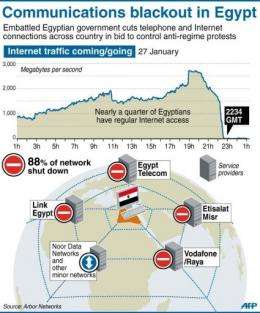
As Egypt is rocked by continuing protests against President Hosni Mubarak, the three companies spawned by the Internet have criticized the attempt by the authorities to sever the nation of 80 million people from the Web.
While corporate responsibility has been a front-burner issue since companies were pressured into cutting ties with apartheid South Africa decades ago, experts said the statements and moves by the three Web giants were unusual.
"Usually with most corporations the issue is what's going to make profits, not necessarily what's going to do good for the world," said Benjamin Hermalin a finance professor at the University of California, Berkeley's Haas School of Business.
"Particularly given a situation of political uncertainty it would be very strange for companies to take bets on one side because if the other side wins they're in deep trouble," Hermalin said.
The uncertainty in Egypt did not stop Facebook, which had about five million active users in the country before the Internet shutdown, from issuing a statement saying that "no one should be denied access to the Internet."
"Although the turmoil in Egypt is a matter for the Egyptian people and their government to resolve, limiting Internet access for millions of people is a matter of concern for the global community," Facebook spokesman Andrew Noyes said.
Google and Twitter went considerably further than merely expressing concern, jointly creating a tool to allow Egyptians to bypass the Internet closure and post messages to Twitter by making telephone calls.
Google said the "Speak to Tweet" service, which turns voice messages into "tweets," was aimed at "helping people in Egypt stay connected at this very difficult time."
Google-owned YouTube also highlighted videos from Egypt on its news and politics channel, CitizenTube, invited users to submit their own and began streaming live coverage of broadcasts by the Al Jazeera television network.
Google also created a "Crisis Response" page featuring links to the "Speak to Tweet" tool, CitizenTube, emergency telephone numbers and Google Maps of where protests have been occurring in Egypt.
Michael Connor, editor and publisher of the online magazine Business Ethics, noted that Google, whose motto is "Don't Be Evil," has taken stands previously, refusing to censor Internet search results in China, for example.
At the same time, Connor said Google, Facebook and Twitter were also acting out of self-interest.
"The image of these companies is being open and being involved in the free exchange of information," Connor said. "They had to do something. They've got a customer base that expects them to do certain things."
Timothy Fort, professor of business ethics at George Washington University and executive director of the Institute for Corporate Responsibility, agreed that Internet freedom is "core to their identity."
"In distinction with an established company that does earth-moving, say, or dam-building the identity of Google, Facebook and Twitter is the free flow of information," Fort said. "That is their business.
"It is very much in their corporate interest to be forcefully aligning themselves with that," he said.
Although a Google executive has gone missing in Egypt, Hermalin said Internet companies are better placed to speak out than a company such as Coca-Cola, which needs to protect its employees in a particular country.
"Internet companies are kind of a new breed of company," Hermalin said. "They have global reach but almost zero assets on the ground."
Coca-Cola, however "could really be hurt," Hermalin said.
"Let's suppose that Mubarak or allies of Mubarak retain control and Coke is out there handing out free Cokes to the demonstrators," he said.
"What's the first thing they're going to do? They're going to punish Coke like crazy, they're going to nationalize their bottling plants," he said.
"And if Coke is seen as someone who's going to use its assets to help overthrow dictators then other places in the world that have dictators are going to say 'Maybe having Coke around is not such a good idea.'"
For Google, Facebook and Twitter, the positive publicity they get from standing up to the Egyptian authorities "more than makes up for the risks to whatever business they have in Egypt," he said.
(c) 2011 AFP


