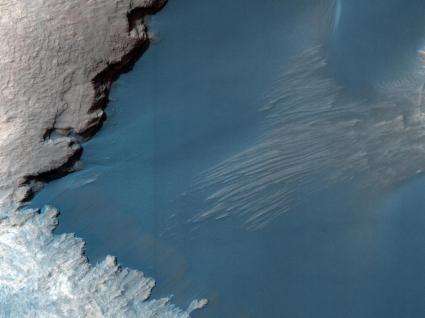
Image: Blue on Mars
Image Credit: NASA/JPL-Caltech/University of Arizona
This image shows part of the floor of Rabe Crater, a large impact crater in Mars' southern highlands.
Dark dunes--accumulations of wind blown sand--cover part of crater's floor, and contrast with the surrounding bright-colored outcrops.
The extreme close-up view reveals a thumbprint-like texture of smaller ridges and troughs covering the surfaces of the larger dunes. These smaller ripples are also formed and shaped by blowing wind in the thin atmosphere of Mars.
One puzzling question is why the dunes are dark compared with the relative bright layered material contained within the crater. The probable answer is that the source of the dark sand is not local to this crater; rather, this topographic depression has acted as a sand trap.
This image was originally released Oct. 24, 2007.
Provided by
JPL/NASA
-
From lemons to lemonade: Reaction uses carbon dioxide to make carbon-based semiconductor,
28 comments
-
Thioridazine kills cancer stem cells in human while avoiding toxic side-effects of conventional cancer treatments,
3 comments
-
SpaceX private rocket blasts off for space station (Update),
42 comments
-
Climate scientists say they have solved riddle of rising sea,
30 comments
-
Scotland passes turbine test to harness tidal power,
41 comments
-
revamping general concept and cosmological principle
May 25, 2012
-
Transiting Exoplanet Light Curve
May 25, 2012
-
Math behind Theoretical Physics
May 24, 2012
-
Do we know whats at the center of galaxies yet?
May 23, 2012
-
Structure of the Milky Way?
May 20, 2012
-
What would it take to terraform Pluto and Charon?
May 19, 2012
- More from Physics Forums - General Astronomy
More news stories
Australia hails surprise super-telescope decision
Australia has hailed a surprise decision giving it a role in a radio telescope project aimed at revolutionising astronomy, vowing to draw on its decades of experience in space science.
9 hours ago |
5 / 5 (2) |
0
Astronomers seize last chance in lifetime for Venus Transit
Astronomers are gearing for one the rarest events in the Solar System: an alignment of Earth, Venus and the Sun that will not be seen for another 105 years.
9 hours ago |
5 / 5 (1) |
0
SpaceX capsule has 'new car' smell, astronauts say
SpaceX's Dragon cargo vessel smells like a new car, said astronauts at the International Space Station after opening the hatches Saturday following the spacecraft's landmark mission to the orbiting lab.
Space & Earth / Space Exploration
9 hours ago |
4.5 / 5 (11) |
0
Astronauts enter world's 1st private supply ship
(AP) -- Space station astronauts floated into the Dragon on Saturday, a day after its heralded arrival as the world's first commercial supply ship.
Space & Earth / Space Exploration
9 hours ago |
5 / 5 (4) |
0
Dragon arrives at space station in historic 1st (Update 2)
The privately bankrolled Dragon capsule made a historic arrival at the International Space Station on Friday, triumphantly captured by astronauts wielding a giant robot arm.
Space & Earth / Space Exploration
May 25, 2012 |
5 / 5 (10) |
16
SpotterRF debuts Radar Backpack Kit (w/ Video)
(Phys.org) -- SpotterRF has announced a special radar backpack kit designed to enhance situational awareness for soldiers on the ground. The company says its special radar is designed for warfighters as part ...
Thousands of shellfish found dead in Peru
Thousands of crustaceans were found dead off the coast of Lima following the mystery mass death of dolphins and pelicans, the Peruvian Navy said Friday.
Family history of Alzheimer's affects functional connectivity
(HealthDay) -- Cognitively normal individuals with a family history of late-onset Alzheimer's disease (AD) may display lower resting state functional connectivity in the default mode network (DMN) of the brain, ...
Transvaginal mesh op restores pelvic organ prolapse at price
(HealthDay) -- Transvaginal mesh (TVM) procedures are effective for anatomical restoration of pelvic organ prolapse (POP), but patients report a worsening of sexual function following surgery, according to ...
Travel to high altitudes tied to Crohn's, colitis flare-ups
(HealthDay) -- People with inflammatory bowel disease, which includes Crohn's disease and colitis, may be at increased risk for flare-ups when they fly or travel to high altitudes for skiing or mountain climbing, ...
Landmark calculation clears the way to answering how matter is formed
(Phys.org) -- An international collaboration of scientists, including Thomas Blum, associate professor of physics, is reporting in landmark detail the decay process of a subatomic particle called a kaon ...
Feb 17, 2011
Rank: 4.2 / 5 (6)
Feb 17, 2011
Rank: 5 / 5 (6)
This is a poorly written article so I can understand some of your confusion. The image is a *false color* multispectral image taken by the Mars Reconnaissance Orbiter's HiRISE camera. The coloration seen here is not what would be seen by the naked eye (ie true color).
On a separate issue, the presence of (surface) water ice at the at the latitude of this feature is unlikely and AFAIK no signatures for deposits of water ice in this crater have been found.
Feb 17, 2011
Rank: 3.7 / 5 (3)
I thought this forum was about the latest breaking news.
Feb 17, 2011
Rank: 3.7 / 5 (3)
Great. Freakin' golfers are everywhere nowadays.
Feb 19, 2011
Rank: 1 / 5 (1)
I mostly like your comment, but they have many tools at their disposal to determine if it's water or not. First off, physics. It is too cold, and the atmospheric pressure is not high enough to sustain liquid water. They also have a spectrometer to determine the chemical makeup. Lastly, it's blue, but no it doesn't really look like water to me.
That picture is ridiculous cool.
Feb 23, 2011
Rank: 2.3 / 5 (3)
As YYZ correctly stated. This is a false-color image. They changed the contrast ratio and the colors so that the contrast between different types of material would stand out. The article even says that it is sand dunes. There's no need for anyone to say anything about how they know it isn't water because that's just stupid. That's like saying that they should also explain how they know it's not a jungle or a city. Completely absurd. The original image would look brown-ish just like the rest of Mars if you correct the colors to match up closely with what the human eye would see. You should understand that all images from Mars are color-corrected and the colors you see in the image are only close aproximations of what you would see if you were there.
Feb 23, 2011
Rank: 2.3 / 5 (3)
The cameras they use in space exploration are designed to be much more accurate than the human eye. The human eye sees best in certain colors and not so well in others, and we have a severely limited range of frequency as well. Space cameras are not the same as your digital camera, which is designed to mimic what you see with your eyes. Space cameras try to see just as much blue and red as they do yellow, and they usually include parts of the spectrum that are invisible to our eyes. Sometimes when you see a pic like the one above what you are seeing is actually a much broader range of spectrum that has been "squashed" into the visible colors we can see. The balance of red/green/blue in the picture will not be representative of real colors unless they specifically arrange the picture colors as such.