High Arctic avian athlete gives lessons about animal welfare
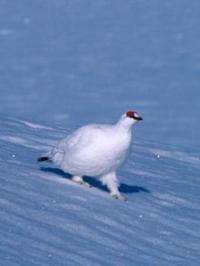
Researchers report that an arctic relative of the grouse has evolved to cope with its extreme environment by moving efficiently at high speeds or when carrying winter weight. This discovery is of relevance to welfare in the poultry industry where birds are bred to be heavier. Ultimately better understanding the physiology of a natural animal model of extreme weight gain could one day lead to improving the welfare and meat yield of domesticated breeds and so contribute to preventing a future food security crisis.
The Biotechnology and Biological Sciences Research Council (BBSRC) funded team from The University of Manchester has studied the Svalbard rock ptarmigan within the arctic circle in collaboration with colleagues at Norway's Tromso university; today (02 February) they publish their findings in the journal Proceedings of the Royal Society B.
Dr Jonathan Codd, who led the research team, said "We can learn a lot from the Svalbard rock ptarmigan because it is so well adapted for life in an extreme environment – minus 20 degrees and dark all day in the winter and then light for almost 24 hours a day in the summer. Like most wild birds, they put on fat for the winter to insulate them from the cold and also as an emergency energy store. For Ptarmigans this fat can be up to 32% of their body weight in the winter.
"We are hoping that the knowledge we gain from our studies will eventually help the poultry meat industry to breed birds that can put on weight quickly but have the necessary physiological features so that they don't suffer as a result."
In an additional paper published in PLoS ONE during November 2010 Dr Codd's team showed that – somewhat counter intuitively – Ptarmigans are actually more energy efficient in their movements when they are heaviest, making them particularly good at conserving resources during the extreme arctic winters when food is scarce and hard to find.
Dr Codd continued "You can see why this might be relevant to farmed birds that put on a lot of weight very quickly. For example, if Ptarmigans have a particular musculoskeletal structure that means being heavy doesn't cause them discomfort, and even makes them more efficient at storing energy, then we might be able to look for these features to breed into farmed birds."
Following this finding, the team went on to investigate the different gaits used by the Ptarmigan. In the work published today, they have shown that the most energy efficient gait for the Ptarmigan is aerial running at high speeds where both feet leave the ground.
Dr Robert Nudds, lead author on the paper said "In the lab, the Ptarmigan use three different gaits: walking, aerial running and an in between gait that we call 'grounded' running because unlike aerial running, but like walking, one foot is always in contact with the ground.
"Much like humans, the aerial running gait involves a springing off of the foot in contact with the ground, which then launches the body up and onwards into the next aerial stride. The leg may be thought of as a pogo stick, the spring compressing when the foot contacts the ground and the weight of the body lands upon it. The main difference being that the spring in the leg comes from elasticity in the tendons. In grounded running, there is still a spring forward from the grounded leg, but not so much as in aerial running when both feet leave the floor."
The research so far has been carried out in the lab where Ptarmigans have been trained to run on a treadmill inside a controlled environment within a Perspex box. This allows the researchers to measure the rate at which they are using Oxygen and therefore how energy efficient their movements are. The next stage of the research is to explore the energy efficiency of Ptarmigan movements in the wild.
Dr Nudds continued "We're actually not sure if the Ptarmigan definitely use grounded running in the wild – it could just be that we are asking them to move at a speed they don't particularly use outside."
Dr Codd added "The terrain may be very important as well. If it is very rough or if obstacles are covered by snow, they will need to be able to change direction quite quickly and so having both feet off the ground would be a distinct disadvantage. In that case they might be more likely to use walking or grounded running, which while less energy efficient, probably overall would enable them to find more food."
Professor Janet Allen, Director of Research, BBSRC said "It is really important that we increase food production and that includes meat. Our aim is to do this sustainably and with the same or improved welfare of the animals that are farmed. Studies such as this that tell us about the basic underlying biology of animals that operate in extreme environments are not only fascinating but can also tell us a great deal about how to breed farmed animals that are fit, healthy and productive."


