Geologists get unique and unexpected opportunity to study magma
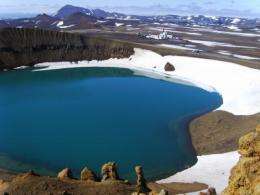
This is a view of the Krafla volcano, Iceland, across the explosion crater Viti that erupted in 1787, showing the drilling rig. The borehole encountered molten rock at 6,500 feet depth. Credit: G.O. Fridleifsson.
Geologists drilling an exploratory geothermal well in 2009 in the Krafla volcano in Iceland encountered a problem they were simply unprepared for: magma (molten rock or lava underground) which flowed unexpectedly into the well at 2.1 kilometers (6,900 ft) depth, forcing the researchers to terminate the drilling.
"To the best of our knowledge, only one previous instance of magma flowing into a geothermal well while drilling has been documented," said Wilfred Elders, a professor emeritus of geology in the Department of Earth Sciences at the University of California, Riverside, who led the research team. "We were drilling a well that was designed to search for very deep 4.5 kilometers (15,000 feet) geothermal resources in the volcano. While the magma flow interrupted our project, it gave us a unique opportunity to study the magma and test a very hot geothermal system as an energy source."
Currently, a third of the electric power and 95 percent of home heating in Iceland is produced from steam and hot water that occurs naturally in volcanic rocks.
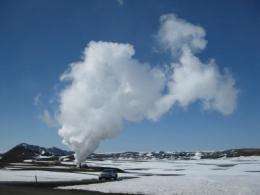
This is a view of the exploratory geothermal well during flow testing. Credit: Bjarni Palssen.
"The economics of generating electric power from such geothermal steam improves the higher its temperature and pressure," Elders explained. "As you drill deeper into a hot zone the temperature and pressure rise, so it should be possible to reach an environment where a denser fluid with very high heat content, but also with unusually low viscosity occurs, so-called 'supercritical water.' Although such supercritical water is used in large coal-fired electric power plants, no one had tried to use supercritical water that should occur naturally in the deeper zones of geothermal areas."Elders and colleagues report in the March issue of Geology (the research paper was published online on Feb. 3) that although the Krafla volcano, like all other volcanoes in Iceland, is basaltic (a volcanic rock containing 45-50 percent silica), the magma they encountered is a rhyolite (a volcanic rock containing 65-70 percent silica).
"Our analyses show that this magma formed by partial melting of certain basalts within the Krafla volcano," Elders said. "The occurrence of minor amounts of rhyolite in some basalt volcanoes has always been something of a puzzle. It had been inferred that some unknown process in the source area of magmas, in the mantle deep below the crust of the Earth, allows some silica-rich rhyolite melt to form in addition to the dominant silica-poor basalt magma."
Elders explained that in geothermal systems water reacts with and alters the composition of the rocks, a process termed "hydrothermal alteration." "Our research shows that the rhyolite formed when a mantle-derived basaltic magma encountered hydrothermally altered basalt, and partially melted and assimilated that rock," he said.
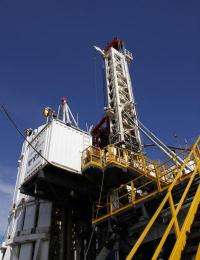
This is the Iceland Drilling Company rig at the Krafla geothermal field, in northern Iceland, that drilled into 900 C rhyolite magma at 2,140 meters depth in June 2009. Credit: W. Elders, UC Riverside.
Elders and his team studied the well within the Krafla caldera as part of the Iceland Deep Drilling Project, an industry-government consortium, to test whether geothermal fluids at supercritical pressures and temperatures could be exploited as sources of power. Elders's research team received support of $3.5 million from the National Science Foundation and $1.5 million from the International Continental Scientific Drilling Program.In the spring of 2009 Elders and his colleagues progressed normally with drilling the well to 2 kilometers (6,600 feet) depth. In the next 100 meters (330 feet), however, multiple acute drilling problems occurred. In June 2009, the drillers determined that at 2104 meters (6,900 feet) depth, the rate of penetration suddenly increased and the torque on the drilling assembly increased, halting its rotation. When the drill string was pulled up more than 10 meters (33 feet) and lowered again, the drill bit became stuck at 2095 meters (6,875 feet). An intrusion of magma had filled the lowest 9 meters (30 feet) of the open borehole. The team terminated the drilling and completed the hole as a production well.
"When the well was tested, high pressure dry steam flowed to the surface with a temperature of 400 Celsius or 750 Fahrenheit, coming from a depth shallower than the magma," Elders said. "We estimated that this steam could generate 25 megawatts of electricity if passed through a suitable turbine, which is enough electricity to power 25,000 to 30,000 homes. What makes this well an attractive source of energy is that typical high-temperature geothermal wells produce only 5 to 8 megawatts of electricity from 300 Celsius or 570 Fahrenheit wet steam."
Elders believes it should be possible to find reasonably shallow bodies of magma, elsewhere in Iceland and the world, wherever young volcanic rocks occur.
"In the future these could become attractive sources of high-grade energy," said Elders, who got involved in the project in 2000 when a group of Icelandic engineers and scientists invited him to join them to explore concepts of developing geothermal energy.
The Iceland Deep Drilling Project has not abandoned the search for supercritical geothermal resources. The project plans to drill a second deep hole in southwest Iceland in 2013.
Provided by
University of California - Riverside
-
From lemons to lemonade: Reaction uses carbon dioxide to make carbon-based semiconductor,
28 comments
-
Thioridazine kills cancer stem cells in human while avoiding toxic side-effects of conventional cancer treatments,
3 comments
-
SpaceX private rocket blasts off for space station (Update),
42 comments
-
Climate scientists say they have solved riddle of rising sea,
30 comments
-
Scotland passes turbine test to harness tidal power,
41 comments
-
More human population = greater mass?
May 25, 2012
-
Conversion from aircraft bearing to normal degrees
May 23, 2012
-
Interpretation/Analysis of the Lab results(HEPA filter)
May 22, 2012
-
Has anyone here attended the The Urbino Summer School in Paleoclimatology?
May 22, 2012
-
Earthquakes: Mag 6 N. Italy and Mag 5.6 W. Bulgaria
May 21, 2012
-
determining time frame for most recent geological layers
May 17, 2012
- More from Physics Forums - Earth
More news stories
Australia hails surprise super-telescope decision
Australia has hailed a surprise decision giving it a role in a radio telescope project aimed at revolutionising astronomy, vowing to draw on its decades of experience in space science.
9 hours ago |
5 / 5 (2) |
0
Astronomers seize last chance in lifetime for Venus Transit
Astronomers are gearing for one the rarest events in the Solar System: an alignment of Earth, Venus and the Sun that will not be seen for another 105 years.
9 hours ago |
5 / 5 (1) |
0
SpaceX capsule has 'new car' smell, astronauts say
SpaceX's Dragon cargo vessel smells like a new car, said astronauts at the International Space Station after opening the hatches Saturday following the spacecraft's landmark mission to the orbiting lab.
Space & Earth / Space Exploration
9 hours ago |
4.5 / 5 (11) |
0
Astronauts enter world's 1st private supply ship
(AP) -- Space station astronauts floated into the Dragon on Saturday, a day after its heralded arrival as the world's first commercial supply ship.
Space & Earth / Space Exploration
9 hours ago |
5 / 5 (4) |
0
Dragon arrives at space station in historic 1st (Update 2)
The privately bankrolled Dragon capsule made a historic arrival at the International Space Station on Friday, triumphantly captured by astronauts wielding a giant robot arm.
Space & Earth / Space Exploration
May 25, 2012 |
5 / 5 (10) |
16
SpotterRF debuts Radar Backpack Kit (w/ Video)
(Phys.org) -- SpotterRF has announced a special radar backpack kit designed to enhance situational awareness for soldiers on the ground. The company says its special radar is designed for warfighters as part ...
Thousands of shellfish found dead in Peru
Thousands of crustaceans were found dead off the coast of Lima following the mystery mass death of dolphins and pelicans, the Peruvian Navy said Friday.
Family history of Alzheimer's affects functional connectivity
(HealthDay) -- Cognitively normal individuals with a family history of late-onset Alzheimer's disease (AD) may display lower resting state functional connectivity in the default mode network (DMN) of the brain, ...
Transvaginal mesh op restores pelvic organ prolapse at price
(HealthDay) -- Transvaginal mesh (TVM) procedures are effective for anatomical restoration of pelvic organ prolapse (POP), but patients report a worsening of sexual function following surgery, according to ...
Travel to high altitudes tied to Crohn's, colitis flare-ups
(HealthDay) -- People with inflammatory bowel disease, which includes Crohn's disease and colitis, may be at increased risk for flare-ups when they fly or travel to high altitudes for skiing or mountain climbing, ...
Landmark calculation clears the way to answering how matter is formed
(Phys.org) -- An international collaboration of scientists, including Thomas Blum, associate professor of physics, is reporting in landmark detail the decay process of a subatomic particle called a kaon ...


Feb 16, 2011
Rank: 2.6 / 5 (5)
Feb 16, 2011
Rank: 2.9 / 5 (9)
Well, in theory, leaching heat away from the magma chamber should decrease the probability and severity of an eruption over the long term.
In order to make 25 megawatts at that temperature, this system would need to vaporizing about 5600 gallons of water per minute, since turbines aren't 100% efficient.
The amount of electricity alone is equivalent to the chemical energy associated with the combustion of 16489 gallons of gasoline per day, 6,018,000 gallons gasoline per year.
The total heat leached from the volcano is going to be much higher than this, and if they have the system set up well, they can use the condensation, which is still near boiling temps, to heat homes and businesses.
Live by the sword, die by the sword. They have "free" energy, but live on a ticking bomb.
Feb 16, 2011
Rank: not rated yet
Feb 16, 2011
Rank: 3.4 / 5 (11)
I am going to assume that you do not and that this is just another example of your outrageous propensity for asserting uninformed and ignorant opinions like theyre fact. Prove me wrong or STFU.
Feb 16, 2011
Rank: 2 / 5 (4)
Conservation laws demands that there isn't "new" energy being made in the volcano. So if you are heating water then the heat in the volcano is decreasing. The energy for an eruption comes ultimately from the temperature of the magma.
Feb 16, 2011
Rank: 3.8 / 5 (4)
I would also think that 'new energy', whatever the hell that might be, comes ultimately from whatever the volcano is connected to. You do not know what you are talking about, and do not stop to consider that before you dump.
Feb 17, 2011
Rank: 5 / 5 (2)
>hit magma stream and get set on fire
>sure is minecraft in here.