Same rules apply to some experimental systems regardless of scale
(PhysOrg.com) -- New experiments show that common scientific rules can apply to significantly different phenomena operating on vastly different scales.
The results raise the possibility of making discoveries pertaining to phenomena that would be too large or impractical to recreate in the laboratory, said Cheng Chin, associate professor in physics and the James Franck Institute at the University of Chicago. Chin and associates Chen-Lung Hung, Xibo Zhang and Nathan Gemelke will publish their results in the Feb. 10, 2011 issue of the journal Nature.
Chin aspires to simulate the impossibly hot conditions that followed the big bang, during the earliest moments of the universe, by using an ultracold vacuum chamber in his laboratory. “It’s fascinating to think about all these connections,” he said.
The UChicago experiments demonstrate the validity of two widely discussed topics in the physics community today: scale invariance and universality.
Theoretical physicist Lev Pitaevskii had predicted that scale invariance would apply to a two-dimensional, cold-atom gas in 1997. Scale invariance means that the properties of a given phenomenon will remain the same, no matter how much its size is expanded or contracted. This contrasts sharply the three-dimensional world of everyday life, where dynamics change dramatically.
In the biological world, for example, scale invariance does not apply to complex organisms like humans, but exists in simple biological structures like nautilus shells, ferns and even broccoli. In physics, special cases also exist that exhibit scale invariance. Fractal structures have been observed in nature, which manifest similar structures whether magnified 10, 1,000 or a million times.
“There are only a few systems in nature that can display this kind of scale invariance, and we have shown that our two-dimensional system belongs to this very special class,” Chin explained. “Once you identify these special cases and see how they are all linked together, then you can bring all these physical phenomena under the same umbrella,” Chin said. “Now they can be fully described using the same language.”
Exotic transformation
The universality concept applies to matter that undergoes smooth phase transitions. In the physics of everyday life, a phase transition occurs when water freezes to ice on a cold winter day. The phase transition in the UChicago experiment is more exotic: In the experiment, cesium atoms transform from a gas to a superfluid, a form of matter that exists only at temperatures of hundreds of degrees below zero.
Theoretical physicists in the early 1970s predicted that weakly interacting two-dimensional gases would exhibit similar behaviors under a variety of conditions as they neared the critical point of phase transition. Their prediction has remained unverified until now.
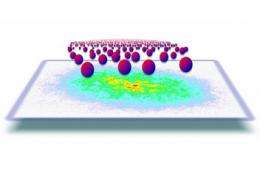
In their experiment, the UChicago researchers super-cooled thousands of cesium atoms to 10 nano-Kelvin, billionths of a degree above absolute zero (-459.67 degrees Fahrenheit), then loaded them into a pancake-like laser trap. The trap simulated a two-dimensional system by restricting the atoms’ motion vertically but allowed a significant degree of horizontal freedom.
Chin’s team was able to control the properties of this cold-atom gas system to make it non-interacting, weakly interacting or strongly interacting and then compared the results.
“At the same time, we can prepare the two-dimensional system at different sizes and also at different temperatures,” Chin said. They could adjust the size parameters from 10 to 100 microns (a human hair is approximately 50 microns in diameter), and the temperature parameters from 10 to 100 nano-Kelvin.
Their experiment showed that no matter how they changed these three parameters, just one general description could characterize the resulting dynamics.
“There’s a strong reason to believe that this kind of scale invariance can be extrapolated and on a more fundamental level can be mapped to other types of two-dimensional systems,” Chin said. “The bigger question is whether our observation can shed light on other complex phenomena in nature. So our next step will be to explore going beyond two-dimensional systems.”
More information: “Observation of scale invariance and universality in two-dimensional Bose gases,” by Chen-Lung Hung, Xibo Zhang, Nathan Gemelke, and Cheng Chin, Advance Online Publication on dx.doi.org/10.1038/nature09722 . Nature, Vol. 469, No. 7333, Jan. 26, 2011.
Provided by University of Chicago


