Experimental evidence adds to the likelihood of the existence of supersolids, an exotic phase of matter
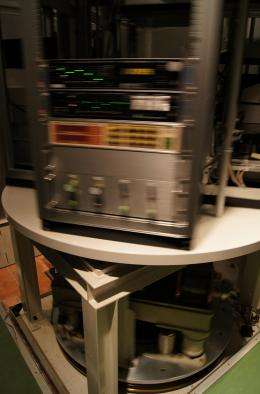
Figure 1: A custom-developed rotating cryostat capable of 15 millikelvin temperatures is helping physicists find evidence for the existence of supersolids. Credit: 2011 Kimitoshi Kono and Eunseong Kim
Supersolids and superfluids rank among the most exotic of quantum mechanical phenomena. Superfluids can flow without any viscosity, and experience no friction as they flow along the walls of a container, because their atoms 'condense' into a highly coherent state of matter. Supersolids are also characterized by coherent effects, but between vacancies in a crystal lattice rather than between the solids atoms themselves.
The reduction in the rotational inertia of a bar of solid helium-4 as it was cooled to very low temperatures provided the first experimental evidence for supersolids. Physicists interpreted the reduction to mean that some amount of supersolid helium had formed and decoupled from the remainder of the bar, affecting its rotational inertia and frequency. Others argued that the reduction in inertia resulted from a change in the heliums viscosity and elasticity with temperature, rather than from the onset of supersolidity.
Kimitoshi Kono from the RIKEN Advanced Science Institute in Wako, Japan, Eunseong Kim from KAIST in Korea, and their colleagues from these institutes have now disproved the alternative interpretation by simultaneously measuring the shear modulus (a measure of viscosity and elasticity) and the rotational inertia of a solid helium-4 cell as its temperature dropped from 1 kelvin to 15 thousandths of a kelvin. The cell was made to rotate clockwise and then counterclockwise periodically, as well as to rotate clockwise or counterclockwise continuously (Fig. 1). The continuous rotation affected the inertial mass of the helium but its shear modulus, allowing these quantities to be monitored independently.
Under continuous rotation, the degree of change in the rotational inertia had a clear dependence on rotation velocity, while the shear modulus did not. In addition, the energy dissipated by the rotation increased at high speeds. Both of these observations contrast to what would be expected if viscoelastic effects were at play, rather than supersolidity. The researchers also found that periodic rotation and continuous rotation affected the rotation differently, raising new questions about the experimental system.
The data support the interpretation that changes in the rotational inertia of helium-4 at low temperature result from supersolidity. This is important because of the novel and surprising nature of the phenomenon itself, says Kono. Superfluidity in a solid is a very radical concept which, if proven, is certainly a good candidate for the Nobel Prize he adds. Therefore the first priority is to determine whether it can be proven in a fashion that will convince the low-temperature physics community.
More information: Choi, H., et al. Evidence of supersolidity in rotating solid helium. Science 330, 15121515 (2010). http://www.science … 512.abstract
Provided by
RIKEN
-
From lemons to lemonade: Reaction uses carbon dioxide to make carbon-based semiconductor,
28 comments
-
Thioridazine kills cancer stem cells in human while avoiding toxic side-effects of conventional cancer treatments,
3 comments
-
SpaceX private rocket blasts off for space station (Update),
42 comments
-
Climate scientists say they have solved riddle of rising sea,
30 comments
-
Scotland passes turbine test to harness tidal power,
41 comments
-
Force on a particle constrained to move on the surface of a sphere
52 minutes ago
-
Force in a magnetic coupling
10 hours ago
-
Sign of scalar product in electric potential integral?
17 hours ago
-
Heat engines: how can we yield work?
18 hours ago
-
Work done by us on the spring
May 25, 2012
-
Surface current density
May 25, 2012
- More from Physics Forums - Classical Physics
More news stories
Landmark calculation clears the way to answering how matter is formed
(Phys.org) -- An international collaboration of scientists, including Thomas Blum, associate professor of physics, is reporting in landmark detail the decay process of a subatomic particle called a kaon ...
May 25, 2012 |
4.6 / 5 (17) |
46
|
Is a classical electrodynamics law incompatible with special relativity?
(Phys.org) -- The laws of classical electromagnetism that were developed in the 19th century are the same laws that scientists use today. They include Maxwell’s four equations along with the Lorentz la ...
Lying in wait for WIMPs: Researchers seek to dramatically increase sensitivity of Large Underground Xenon detector
Although it's invisible, dark matter accounts for at least 80 percent of the matter in the universe. No one knows what it is, but most scientists would bet on weakly interacting massive particles, or WIMPs.
May 23, 2012 |
4.2 / 5 (6) |
15
|
Hall effect at the speed of light: How can you demonstrate relativistic effects with your mobile phone?
The relativistic Hall effect describing objects rotating at speeds comparable with the speed of light has been reported.
May 21, 2012 |
4.3 / 5 (3) |
8
Cloak of invisibility: Engineers use plasmonics to create an invisible photodetector
A team of engineers at Stanford and the University of Pennsylvania has for the first time used "plasmonic cloaking" to create a device that can see without being seen - an invisible machine that detects light. It is the first ...
May 21, 2012 |
4.8 / 5 (16) |
7
|
Dell tablet leak: 10.1-inch display, two-battery choice
(Phys.org) -- Headline after headline talks about vendors tablets in the wings as likely number-one contenders for the iPad. Such claims have justifiably been taken with a grain of salt, considering ...
Scientist: Evolution debate will soon be history
(AP) -- Richard Leakey predicts skepticism over evolution will soon be history. Not that the avowed atheist has any doubts himself.
Keep food safety in mind this memorial day weekend
(HealthDay) -- Picnics, parades and cookouts are as much a part of Memorial Day weekend as tributes to the United States' war veterans.
SpaceX capsule has 'new car' smell, astronauts say (Update)
SpaceX's Dragon cargo vessel smells like a new car, said astronauts at the International Space Station after opening the hatches Saturday following the spacecraft's landmark mission to the orbiting lab.
SpotterRF debuts Radar Backpack Kit (w/ Video)
(Phys.org) -- SpotterRF has announced a special radar backpack kit designed to enhance situational awareness for soldiers on the ground. The company says its special radar is designed for warfighters as part ...
Australia hails surprise super-telescope decision
Australia has hailed a surprise decision giving it a role in a radio telescope project aimed at revolutionising astronomy, vowing to draw on its decades of experience in space science.
Feb 18, 2011
Rank: 5 / 5 (3)
I am assuming that the word NOT was omitted from this sentence in the article and should have read:
"The continuous rotation affected the inertial mass of the helium but NOT its shear modulus, allowing these quantities to be monitored independently."
Does no one proofread what they write anymore?
Feb 18, 2011
Rank: not rated yet
Feb 18, 2011
Rank: 1.7 / 5 (6)
HolographicGalaxy.blogspot.com
Feb 18, 2011
Rank: 5 / 5 (4)
I've noticed, msn, pcmag, cnn,...its like the entire internet doesn't have a single copy editor.
Feb 18, 2011
Rank: 5 / 5 (2)
If so, there is a possible theoretical explanation that has not yet been suggested, to my knowledge. Think of a supersolid as two states of matter--superfluid and solid--coexisting. One could be viewed as the normal state and the other could be viewed as a "chimera" state. (Look it up.)
There is a 2008 PRL article by Abrams, Mirollo, Strogatz and Wiley entitled "Solvable Model for Chimera States of Coupled Oscillators."
I have also suggested this article as a possible theoretical explanation for the recent Livermore Lab experiment involving cerium, which produced two different cerium crystals--one larger, one smaller--produced under extremely high pressure. See the Phys Org article entitled "Cerium's Unusual Behavior," Jan 27 2011.
Both of these intriguing results may share the same explanation.
Feb 18, 2011
Rank: 2.3 / 5 (6)
IMO the well known crackling and crunching of snow has its origin in the same phenomena - in another words, snow appears supersolid at least for brief period of time, when exposed to external pressure. Another example of this mechanism is the ballistic transport of electrons at the surface of graphene.
Feb 19, 2011
Rank: not rated yet
The helium and cerium experiments to which I refer in my prior post both meet that general condition. They are networks of identical oscillators. And they are symmetrically coupled, pre-split.
Later in that same article, the authors explain the mathematically possible outcomes of such spontaneous splits. A stable chimera is one possibility. I say the cerium experiment at Lawrence Livermore is an example. A "breathing chimera" state is another possibility. I say the supersolid helium case (Penn State experiment) is an example. "The order parameter pulsates, and the chimera starts to breathe" as the authors say, colorfully, in their 2008 article. That's Kim and Chan's (the Penn State guys) torsional oscillator, which produces superfluid as the chimera.
Feb 19, 2011
Rank: not rated yet
These two apparently special cases--the cerium chimera and the helium chimera--are not special. They simply prove that Art Winfree's coupled oscillator theory is the equivalent of plate tectonics, explaining all phases of matter and their transitions.
Feb 20, 2011
Rank: 1 / 5 (2)
In a "lossless" (no energy dissipated) medium?
Does shear modulus exist? In an incompressible sphere? Liquid or solid?
Please ignore (habitual out loud thinking)
Nobel - the motivation?