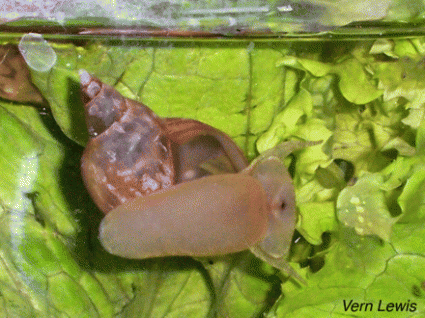
First evidence of sleep in snails
February 18, 2011 by Lin Edwards
Image credit: The Company of Biologists Limited
(PhysOrg.com) -- Scientists in Canada noticed pond snails spent around 10 percent of their time attached to the side of their tank with their tentacles partly withdrawn, their shells hanging away from their bodies, and with their feet symmetrical and relaxed. The researchers decided to do some experiments to find out if the snails were asleep or just resting, and their results provide the first evidence that gastropods sleep.
There is no single characteristic that defines sleep but sleep is deduced from a number of factors such as being unresponsive and hard to rouse, and adpoting a characteristic position. To determine if their snails did sleep, Associate Professor Richard Stephenson and Dr Vern Lewis of the University of Toronto observed pond snails (Lymnaea stagnalis) in their tanks and cataloged their behavior.
The researchers reasoned that if the snails were sleeping rather than merely resting, they would respond less to stimulation and would withdraw their bodies into their shells sluggishly when prodded with a metal rod, for example. They tested the responses of active and apparently sleeping snails to being tapped on the shell, prodded with a rod, and having their appetites simulated by exposing them to sucrose solution.
The results of their experiments showed that the active snails responded twice as quickly to physical stimulation and seven times faster to appetite simulation than the immobile snails, so it appears that the resting snails were actually asleep rather than just relaxing.
The researchers then monitored eight snails over a period of 79 days to monitor patterns of sleeping and see if the amount of light exposure affected their behavior. They found that the sleep patterns followed a two to three day period rather than a 24 hour cycle with clusters of around seven bouts of sleeping over a 13-15 hour period followed by over 30 hours of uninterrupted activity. They did not need to make up for lost sleep, a process known as sleep rebound.
Dr Stephenson said snails do not sleep at a regular time as most other animals do, and they need very little sleep because their lifestyles are not mentally demanding, so they probably do not need tight controls over their sleeping patterns.
Sleep is believed to be important to many biological processes such as memory formation, but there are still many unanswered questions. The researchers think a study of sleep in simple animals such as pond snails could be useful in aiding our understanding of cellular functions in sleep.
The paper was published in the Journal of Experimental Biology.
More information: Behavioural evidence for a sleep-like quiescent state in a pulmonate mollusc, Lymnaea stagnalis (Linnaeus), First published online February 9, 2011. Journal of Experimental Biology 214, 747-756 (2011) doi: 10.1242/jeb.050591
© 2010 PhysOrg.com
-
From lemons to lemonade: Reaction uses carbon dioxide to make carbon-based semiconductor,
28 comments
-
Thioridazine kills cancer stem cells in human while avoiding toxic side-effects of conventional cancer treatments,
3 comments
-
SpaceX private rocket blasts off for space station (Update),
42 comments
-
Climate scientists say they have solved riddle of rising sea,
30 comments
-
Scotland passes turbine test to harness tidal power,
41 comments
-
What would stain as translucent on light-coloured fabric?
1 hour ago
-
How do I identify different bacteria on culture plates?
11 hours ago
-
Why Do Dogs do Strange things...
May 25, 2012
-
What does exophillic and endophillic mean in terms of mosquito and their control?
May 24, 2012
-
Semen stains glows under black lights (uv light)?
May 23, 2012
-
Question on Human Chromosome 2
May 23, 2012
- More from Physics Forums - Biology
More news stories
Scientist: Evolution debate will soon be history
(AP) -- Richard Leakey predicts skepticism over evolution will soon be history. Not that the avowed atheist has any doubts himself.
27 minutes ago |
not rated yet |
0
Thousands of shellfish found dead in Peru
Thousands of crustaceans were found dead off the coast of Lima following the mystery mass death of dolphins and pelicans, the Peruvian Navy said Friday.
10 hours ago |
4.7 / 5 (3) |
5
More plant species responding to global warming than previously thought
(Phys.org) -- Far more wild plant species may be responding to global warming than previous large-scale estimates have suggested.
May 22, 2012 |
4.6 / 5 (14) |
18
|
Totally rad: Scientists create rewritable digital data storage in DNA
(Phys.org) -- Scientists from Stanford's Department of Bioengineering have devised a method for repeatedly encoding, storing and erasing digital data within the DNA of living cells.
May 21, 2012 |
4.9 / 5 (16) |
11
|
For monogamous sparrows, it doesn't pay to stray (but they do it anyway)
It's quite common for a female song sparrow to stray from her breeding partner and mate with the male next door, but a new study shows that sleeping around can be costly.
May 22, 2012 |
5 / 5 (1) |
7
|
Dell tablet leak: 10.1-inch display, two-battery choice
(Phys.org) -- Headline after headline talks about vendors tablets in the wings as likely number-one contenders for the iPad. Such claims have justifiably been taken with a grain of salt, considering ...
Keep food safety in mind this memorial day weekend
(HealthDay) -- Picnics, parades and cookouts are as much a part of Memorial Day weekend as tributes to the United States' war veterans.
SpaceX capsule has 'new car' smell, astronauts say (Update)
SpaceX's Dragon cargo vessel smells like a new car, said astronauts at the International Space Station after opening the hatches Saturday following the spacecraft's landmark mission to the orbiting lab.
SpotterRF debuts Radar Backpack Kit (w/ Video)
(Phys.org) -- SpotterRF has announced a special radar backpack kit designed to enhance situational awareness for soldiers on the ground. The company says its special radar is designed for warfighters as part ...
Australia hails surprise super-telescope decision
Australia has hailed a surprise decision giving it a role in a radio telescope project aimed at revolutionising astronomy, vowing to draw on its decades of experience in space science.
Astronomers seize last chance in lifetime for Venus Transit
Astronomers are gearing for one the rarest events in the Solar System: an alignment of Earth, Venus and the Sun that will not be seen for another 105 years.
Feb 19, 2011
Rank: 1 / 5 (1)