Europe launches trillion-euro energy revamp
February 4, 2011 by Roddy Thomson

The EU is the world's largest regional energy market

Enlarge

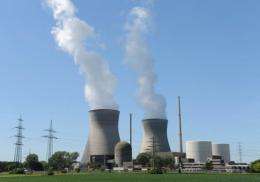
Smoke rises from the cooling towers the nuclear power station in Gundremmingen, southern Germany, 2010. European leaders launched Friday a trillion-euro bid to slash dependency on Middle East oil and Russian gas, clearing the way to place nuclear power at the centre of 21st century needs.

European leaders launched Friday a trillion-euro bid to slash dependency on Middle East oil and Russian gas, clearing the way to place nuclear power at the centre of 21st century needs.

At a summit shaken by instability over Egypt's popular revolt and soaring oil prices, the European Union moved to reclaim control over supply for the rest of the century with reforms designed to unlock private investment.

The EU is the world's largest regional -- 500 million people and 20 million companies.

Governments committed to a broad sweep of market reforms, linking national and regional electricity grids and by 2014 to allow power to circulate freely and cheaply, from those who produce it and have surpluses to those who don't and need it.

"No EU member state should remain isolated from the European gas and electricity networks after 2015 or see its jeopardised by lack of the appropriate connections," read summit conclusions whose adoption was announced by EU president Herman Van Rompuy on Twitter.

"Beyond the management of today's crisis, we're also laying the ground for a sustainable and job-creating growth," Van Rompuy tweeted.

Island states Cyprus and Malta, as well as Baltic countries whose infrastructure remains tied to the former Soviet Union, feared their needs may be considered too insignificant for the big energy players to invest in costly transmission networks.

But the EU agreed that pooled public money could underpin completion of this so-called 'supergrid' -- although ballpark sums will not be produced until the summer.

Initial European Commission estimates suggested that some 2.5 billion euros ($3.4 billion) could be diverted from unspent EU budgets.

While one EU diplomat said it was "doubtful" that Britain would back such an approach, Prime Minister David Cameron was comfortable with allowing "some limited public finance to leverage private funding," as the summit conclusions specified, provided it comes from cuts elsewhere in the EU budget.

The network development cost over the remainder of the decade is tipped to exceed 200 billion euros.

The other big change, at the instigation of France but firmly backed by the government in London, was to reposition domestically-produced nuclear energy at the heart of the bloc's long-term suppplies.

In a carefully-worded shift in emphasis, alongside investment in renewable energy technologies, EU states will also promote "safe and sustainable low-carbon technologies" -- this including nuclear -- under climate action goals.
The volume of gas used to generate electricity requirements in the EU has trebled over the past 15 years
Enlarge

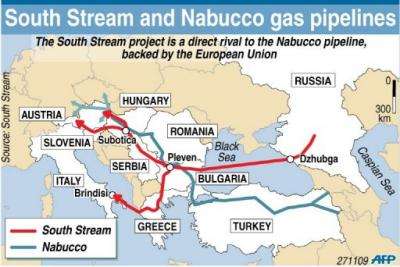
Map of northern Europe showing the route of the planned South Stream and Nabucco gas pipelines. European leaders launched a trillion-euro bid to slash dependency on Middle East oil and Russian gas, clearing the way to place nuclear power at the centre of 21st century needs.

This came under attack from ecologists and Poul Nyrup Rasmussen, the head of the Party of European Socialists, as: "Old leaders, with old ideas, simply proposing old energy methods for Europe’s future."

Brussels-based NGO Energy Strategy Center also saw a missed opportunity given a "significant shift currently underway in the climate and energy debate."

It pointed out that, yet again, "China is rapidly becoming a global leader in the technologies of a resource efficient, low-carbon economy."

France maintains it is not trying surreptitiously to reclassify nuclear alongside wind, wave, solar or biomass energy production as Europe tries to meet three-pronged commitments to combat global warming by 2020.

These are to reduce carbon dioxide emissions by 20 percent compared to 1990 levels, to raise renewables production to 20 percent of consumption and to make energy efficiency savings of 20 percent.

However, nothing is set in stone after 2020 -- and the political mood now, amid greater questioning of scientific evidence, is for a more substantial use of the nuclear alternative.

"Nuclear is not a renewable source," said a senior official under commission head Jose Manuel Barroso of post-2050 guidelines, but "the make-up of national energy mixes is a matter of national choice."

The volume of gas used to generate electricity requirements in the EU has trebled over the past 15 years, with some three quarters of all gas imported into the bloc between now and 2020 coming from Russia, Algeria and non-EU Norway -- ensuring a close link to the price of oil.

To that end, the EU must also develop "a reliable, transparent and rules-based partnership with Russia," leaders also concluded.

(c) 2011 AFP

4.3 /5 (13 votes)  

Filter


Move the slider to adjust rank threshold, so that you can hide some of the comments.


Display comments: newest first

newscience
Feb 04, 2011

Rank: 1.2 / 5 (13)
Boron hydrogen fusion is right around the corner and there is no radioactivity. See Eric Lerner and pinch fusion. Fission is too dangerous and could turn Europe into wasteland. Wind and solar is also proven to fill in the gap.
Koen
Feb 04, 2011

Rank: 1.8 / 5 (13)
Nuclear power is not a viable option. Uranium ore is depleted; the uranium mines in Canada and Australia are already exhausted, and these were the only rich uranium mines in the world. Already 27% of all uranium comes from Kazahkstan, now that the Australian and Canadian mines are depleted. Does Europe wants political dependence from Kazahkstan? Yippee, great geopolitical independence for Europe.

Nuclear fusion Tokamak style (tritium anyone?) is not working now, and will not work in the future, despite of ITER. The use of Tritium does not improve the economical outlook of Nuclear fusion reactors.

Thus, the only realistic option is to invest heavily in solar cell technology (there is enough sunlight for our daily needs, and not enough wind energy). Silicon is the most abundant metal in the world, and the production of solar-grade silicon can be cost-optimized considerably with respect with current Siemens process.

But this is not what European leaders (into the abyss) recommend.
gwrede
Feb 04, 2011

Rank: 5 / 5 (14)
This writer must be related to GW Bush.
Smoke rises from the cooling towers the nuclear power station in Gundremmingen, southern Germany, 2010.
It's water vapor. And the grammar doesn't make sense either.
Map of northern Europe showing the route of the planned South Stream and Nabucco gas pipelines.
This map shows SOUTHERN Europe.
ShotmanMaslo
Feb 04, 2011

Rank: 3.9 / 5 (11)
There is enough uranium and thorium to power humanity for hundreds of years, thousands with new efficient reactors and reprocessing. France already uses nuclear for almost 80 % of its consumption, and exports the rest as a largest electricity exporter in the world. Nuclear is the energy of the future, and a transition source until fusion becomes practical.
ShotmanMaslo
Feb 04, 2011

Rank: 4 / 5 (5)
Koen - if solar energy, then large solar concentrator plants, not photovoltaics.
rjsc2000
Feb 04, 2011

Rank: 2.4 / 5 (8)
Nuclear Energy is expensive to maintain, right? and also to dismantle when it's not needed anymore.
Maybe instead of just throw money at the problem, that is, the electrical bill raises, just get more money, maybe they should also think to reduce the electrical bill. Less wattage lights in the streets, More electronic machinery that doesn't spend too much energy like electronic transformers.
Investment in a way to beam light from outer space to ground stations. The ideas are many, but the easy way it to throw more money at the problem...sad really.
Quantum_Conundrum
Feb 04, 2011

Rank: 2 / 5 (2)
rjsc2000:

LoL?

The problem is solar is too expensive for any sort of total transition any time soon. It would take nearly 50 trillion to convert the U.S. to pure solar. These systems would have a life time of about 25 years at best. 50 trillion would be 1/7th of the U.S. GDP across 25 years. So to build, maintain, and replace solar in the U.S. would cost an average of 1/7th of the nation's GDP every year indefinitely.

This is enough panels or solar towers to provide power for day and night usage, provided the excess could be stored. However, I haven't counted the actual cost of batteries or other forms of storage so you have power at night...no power at night during the winter would be a bitch, especially starting from about 33 north and above.

My best idea is to use excess solar during the day to power electrolysis of water, and then burn the water at night in normal generators to produce electricity at night. This would lose a tremendous amount through inefficiencies...
Skeptic_Heretic
Feb 04, 2011

Rank: 4.3 / 5 (6)
Boron hydrogen fusion is right around the corner and there is no radioactivity. See Eric Lerner and pinch fusion. Fission is too dangerous and could turn Europe into wasteland. Wind and solar is also proven to fill in the gap.

Fusion creates radioactive waste as well. Stop shilling for a non-existant technology. I want to see fusion succeed as well, I want to see sustained fusion with positive energy balance actually happen first.

Fission is perfectly safe if done properly, with top end technology. No cutting corners.
Koen
Feb 04, 2011

Rank: 3 / 5 (3)
"The problem is solar is too expensive for any sort of total transition any time soon. It would take nearly 50 trillion to convert the U.S. to pure solar."

Not true, and considering the geo-political (military) costs of securing fossile/nuclear resources, it is a very wise decision to implement this transition. The US military budget alone is sufficient for this transition.
Koen
Feb 04, 2011

Rank: 2 / 5 (6)
"There is enough uranium and thorium to power humanity for hundreds of years."
This is a false 'nuclear industry claim'. Independent studies show there is no reason for a nuclear renaissance, see
en.wikipedia.org/wiki/Peak_uranium
Peak silicon is not possible, but peak uranium is already happening now, or already happened decades ago.

"Koen - if solar energy, then large solar concentrator plants, not photovoltaics."
Solar concentrators may provide the heat for purification of silicon, at least of metalurgic grade silicon. Therefore, the costs of photovoltaics can drop considerably. Avoiding the Siemens process is not wishful thinking either.
ShotmanMaslo
Feb 04, 2011

Rank: 1.5 / 5 (2)
Nuclear Energy is expensive to maintain, right? and also to dismantle when it's not needed anymore.


Nuclear is just a little more expensive than coal, and certainly less than renewables. Also, the cost of nuclear fuel makes up only a small part of the cost, so even if its cost multiplies, nuclear energy cost would not increase much.

Maybe instead of just throw money at the problem, that is, the electrical bill raises, just get more money, maybe they should also think to reduce the electrical bill. Less wattage lights in the streets, More electronic machinery that doesn't spend too much energy like electronic transformers.


They do, its in the article, 20 % more efficiency:

These are to reduce carbon dioxide emissions by 20 percent compared to 1990 levels, to raise renewables production to 20 percent of consumption and to make energy efficiency savings of 20 percent.
Skeptic_Heretic
Feb 04, 2011

Rank: 4.2 / 5 (5)
There is enough uranium and thorium to power humanity for hundreds of years.

This is a false 'nuclear industry claim'. Independent studies show there is no reason for a nuclear renaissance
Actually this was a poorly done survey that came from Hubbert, of Shell Laboratories, and was originally intended for fossil fuels. Mr. Hubbert wasn't looking at a closed fuel cycle as in the 50's we weren't even close. Now we're at a point where a closed fuel cycle isn't necessarily going to be a problem. There's enough discovered and easily extracted Uranium and Thorium to power the current needs of the planet for 10,000 years. With the leaps in techbnology, and consuption, we'll have reached by that time, I think peak uranium will be a non issue.
Peak silicon is not possible
Well, actually it is, but oh boy is that far off.
but peak uranium is already happening now
We haven't mined out 50%. Peak it is not.
StandingBear
Feb 04, 2011

Rank: 4.3 / 5 (3)
Eric Lerner's field of study is the dense plasma focus, called 'focus fusion. You can go to focusfusion.org on the net and see our progress. Not to be closed minded, nuclear has its place too, and most efficiently would be breeder reactors feeding small standardized 'local' reactors that use the fuel and return it to the breeder for the cycle to continue. Solar if fine if one has the solar resource, like Algeria, Libya, or China or the USA and Mexico..and Australia. But if you live in Germany or Osterreich, whose farm to you destroy to have a collector farm...in these agriculture dense and population dense small countries, solar is not viable. So solar in most of the world will be an expensive import. I pray that Eric succeeds in his venture. I think he and his team will, and I will put my money where my mouth is.
DoubleD
Feb 04, 2011

Rank: 4.2 / 5 (5)
Uranium ore is depleted; the uranium mines in Canada and Australia are already exhausted, and these were the only rich uranium mines in the world.

Nuclear fusion Tokamak style (tritium anyone?) is not working now, and will not work in the future, despite of ITER.


Breeders burn U-238. There is about 137 times as much U-238 as U-238 in natural uranium. Fissionable material is nowhere near exhausted. Your comments are fallacious.

Claiming that tokomaks or fusion will never work is another fallacy. 200 years ago human flight was impossible.

We need a diverse energy mix. Proven (low carbon footprint) technology for the next 50 years of baseload generation is nuclear. Ideally, research and hard work will produce viable technologies that are cleaner, cheaper and use abundant renewable materials will be available before that time horizon. But today is today and we need something that works and is not coal/oil/gas.
DoubleD
Feb 04, 2011

Rank: 5 / 5 (1)
Sorry 137x U238 than U235!!! My bad.
GSwift7
Feb 04, 2011

Rank: 4 / 5 (4)
This is enough panels or solar towers to provide power for day and night usage, provided the excess could be stored. However, I haven't counted the actual cost of batteries


The "power tower" kind of solar plant, now under construction in a few places and technically called concentrated solar power from thermal, uses heated liquid salts similar to the ones used in metal coatings. They store large tanks of the heated salts to provide 24/7 energy on-demand from steam turbines. No chemical batteries needed.

This writer must be related to GW Bush


If that was true, it would say nucular.
Quantum_Conundrum
Feb 04, 2011

Rank: 2.2 / 5 (5)
Not true, and considering the geo-political (military) costs of securing fossile/nuclear resources, it is a very wise decision to implement this transition. The US military budget alone is sufficient for this transition.


The US military is needed to prevent muslims and pirates from dong as they please.

wikipedia.org/wiki/Energy_in_the_United_States

The United States is the largest energy consumer in terms of total use, using 100 quadrillion BTUs (105 exajoules, or 29 PWh) in 2005. ... The U.S. ranks seventh in energy consumption per-capita after Canada and a number of small countries.


In order to produce this power through solar would required over 45 billion square meters of 11% efficient panels at $440 per square meter. This is already 20 trillion. Then you must pay installation costs and infrastructure costs. The costs of batteries. The cost of the additional 20% to 30% worth of panels to make up for the energy losses of transmission and batteries, etc.
Quantum_Conundrum
Feb 04, 2011

Rank: 2.3 / 5 (4)
The "power tower" kind of solar plant, now under construction in a few places and technically called concentrated solar power from thermal, uses heated liquid salts similar to the ones used in metal coatings. They store large tanks of the heated salts to provide 24/7 energy on-demand from steam turbines. No chemical batteries needed.


Correct, but have you looked into how big these things are, and how much they cost to build and maintain?

Because "peak solar" is only between about 9 am and 3 pm, with some from 6 to 9 and 3 to 6, etc, You really only get "good" power about 1/4 to maybe 3/8ths of the 24 hour day.

A square kilometer power plant would only make a few hundred megawatts during the day, which by the time you divide that in half to save half for night time, you're looking at like average 100 megawatts per square kilometer.

No matter how efficient the carnot cycles employed, they cannot exceed 66%...not counting losses of heat during storage of steam, etc.
Quantum_Conundrum
Feb 04, 2011

Rank: not rated yet
youtube.com/watch?v=uJGpbvvJA2I

This guy did some videos of him fooling around with home made "miniature solar tower" to turn an old steam engine he has repaired...
Quantum_Conundrum
Feb 04, 2011

Rank: not rated yet
youtube.com/watch?v=RQBO_zriLt0&feature=autoplay&list=SP7EAE21AC4AFE6F7B&index=40&playnext=3
ArcainOne
Feb 04, 2011

Rank: 5 / 5 (1)

Fusion creates radioactive waste as well. Stop shilling for a non-existant technology.


Actually Boron Hydrogen fusion would not produce nuclear waste as the DT or TT fusion does when it produces a free neutron. Boron Hydrogon produces 3 positively charged helium atoms, direct electricity. I Read about it a long time ago. That aside Fusion is the way to go for energy even if it is DT or TT reactions. It utilizes the most abundant materials in the universe and ITER has made ridiculous progress even while not being completed. I believe JET was retrofitted to to make it comparable to ITER which jumped its Q rating to 0.7. And if you really want crazy I believe on this site was an article about the probability of cold fusion and how military research is calling for more people who are interested.
lifewebb
Feb 04, 2011

Rank: 5 / 5 (3)
I believe that your caption for the photo is incorrect. Smoke is not something that you find at a nuclear power plant - that's the thing it does not emit! You are looking at steam, from boiling water to create electricity.... It needs to be cooled in big towers! Wow, Physorg - Correct me if I am wrong but this is a sign that someone in there is not up to speed on nuclear energy.
Caliban
Feb 04, 2011

Rank: 5 / 5 (2)
ALL of the above should be deployed.
It never pays to put all the eggs in one basket.
With solar, use both PV and CE- that way, demand can be met during peak, and then metered out during off-peak hours.
Renewables wherever space and resources are available.
All connected to the grid, and all at levelised cost, same price to the end consumer, wherever they may be.
Universal grid upgrade, and smart metering. Don't forget that solar and heat capture/conversion capability can now or soon will be incorporable into building/infrastructure products.

The only thing lacking for total fossil=fuel independence is the political will to develop and implement a COMPREHENSIVE ENERGY INFRASTRUCTURE AND PRODUCTION PLAN.
Ultimately, this would create untold numbers of jobs, radically reduce environmental damage, and provide endless real world R&D opportunities for process refinement, data gathering, and reduced unit-cost for energy.

All while we continue to search for the BREAKTHROUGH.
Caliban
Feb 04, 2011

Rank: not rated yet
Simultaneously with development and impementation of this comprehensive energy plan, I would advocate the deployment of regional incandescent-metal waste processing plants. These would be at least partially self-powered, and a fantastic way to deal with all the waste we are currently suffocating from, not to mention for environmental cleanup everywhere in the US, including decommissioned landfills and FEMA/SUPERFUND sites. Then the end products could be recycled for industrial use or permanent, safe disposal.

All of this can, should, and NEEDS TO BE done.
rwinners
Feb 05, 2011

Rank: 4.2 / 5 (5)
Hail to the ECU! They are already a generation ahead of the US and will be farther yet when this becomes reality. Our leaders are mired in the economic muck of carbon based energy and will be until they bring the economy down on our heads.
ormondotvos
Feb 05, 2011

Rank: 5 / 5 (3)
Keep coming with the corrections, people! That's what it takes to educate the public, especially the ones that go off half-cocked.

Focus Fusion looks theoretically good, with some recent advances to commercial use.

LFTR Liquid fluoride thorium reactors are recently taken up by India, which has much thorium.

Hydropower is still an unused resource.

Local solar electrics are more efficient that advertised, because they don't have the transmission losses of centralized plants and powerlines.

There are a lot of deserts with good sunshine still out there.

Conservation will kick in when prices rise, and they will.

Fossil fuel subsidies should be diverted to clean energy.
crhylove
Feb 05, 2011

Rank: not rated yet
Molten Salt Reactors. They actually USE nuclear waste, and are very, very safe. We've built them before. They work. China is building them now too, supposedly. This is the obvious answer. Well, that and solar.
Quantum_Conundrum
Feb 05, 2011

Rank: not rated yet
Home Made Solar Tower Generator:

youtube.com/watch?v=jTvAL7ty53M&feature=relmfu
Skeptic_Heretic
Feb 05, 2011

Rank: 5 / 5 (1)
Molten Salt Reactors. They actually USE nuclear waste, and are very, very safe. We've built them before. They work. China is building them now too, supposedly. This is the obvious answer. Well, that and solar.

They're safe, until they leak sodium. The Detroit reactor fire in the 80's showed us that.

It is certainly one of the most promising technologies as it leaves no weapons grade waste behind. They can effectively be sealed underground if necessary and left running on their own for 60 or more years.
Quantum_Conundrum
Feb 05, 2011

Rank: not rated yet
youtube.com/watch?v=VXN_1Kf18_I&feature=related

This is really nice...

This "solar furnace" is probably one of the most cost effective machines imaginable...no space age materials involved...
technicalengeneering
Feb 06, 2011

Rank: not rated yet
@Koen : silicon is not a metal but a metalloid. just so you know.

Skeptic_Heretic
Feb 06, 2011

Rank: 5 / 5 (2)
youtube.com/watch?v=VXN_1Kf18_I&feature=related

This is really nice...

This "solar furnace" is probably one of the most cost effective machines imaginable...no space age materials involved...

It's an open loop steam engine. That's not efficient. It's intersting that he built it so large, and the power output isn't bad, but it's in the desert, during the summer.
Sanescience
Feb 06, 2011

Rank: 5 / 5 (1)
"Old leaders, with old ideas, simply proposing old energy methods for Europe’s future."


Wow, BIG SOUR GRAPES, comes to mind. That and it is a good thing every other industry doesn't take that attitude. Improve it with technology and technique? MADNESS!!! LOL! Makes me wonder who exactly is struggling to avoid being "old" and irrelevant.

GSwift7
Feb 07, 2011

Rank: 3 / 5 (2)
Correct, but have you looked into how big these things are, and how much they cost to build and maintain


Yes, I've read that a normal sized CST plant will need the equivelant of a tank four stories tall and the size of a football field. The other problem is that the salt is dirty to produce and it has to be replaced fairly often. It's also highly corrosive, so it eats away the machinery it flows through. They're still learning how to work with it.

Smoke is not something that you find at a nuclear power plant - that's the thing it does not emit! You are looking at steam, from boiling water to create electricity.... It needs to be cooled in big towers


You're close, it's steam, but it's used to cool the cooling fluid that cools the turbines. They usually have something like a glycol mix that runs through the steam turbines to cool them, which circulates to those big towers and then the glycol (or something like it) is cooled with water, which is what you see there.
GSwift7
Feb 07, 2011

Rank: 3 / 5 (2)
Continued:

Some of the really big coal and gas plants have those cooling towers too. They go along with that type of steam turbine usually. Even a concentrated solar plant could use cooling towers like that to cool their turbines, if they used that design. Every type of steam turbine needs to be cooled somehow. These towers are one method among several.

mgb
Feb 07, 2011

Rank: not rated yet
Hard to believe that we still spend public funds to develop this only to be charged inflated *monthly* prices by the subsequent private providers.
GSwift7
Feb 07, 2011

Rank: 1 / 5 (1)
Hard to believe that we still spend public funds to develop this only to be charged inflated *monthly* prices by the subsequent private providers


The energy infrastructure is a matter of public concern for financial and military security. I think it's best to have some public control over the construction and regulation of it, and that means spending tax dollars on it. Think of the other way around: We built the power lines, the private company maintains them for us. Private investors risk their own money to build us new power plants, and they make a return on their investments. It's not perfect, but what in life is perfect? Even if we went 100% solar tomorrow, I assume that you aren't going to make your own solar panels, so private company is going to make a profit on them, and almost ALL solar research is backed by public money these days.
Mr_Jo_Atom
Feb 07, 2011

Rank: not rated yet
Nuclear fusion Tokamak style (tritium anyone?) is not working now, and will not work in the future, despite of ITER. The use of Tritium does not improve the economical outlook of Nuclear fusion reactors.


why do you think tritium reactors wont work in the future, koen?

thanks)
jamesrm
Feb 13, 2011

Rank: not rated yet
they should at least give some money to Bogdan Maglich
en.wikipedia.org/wiki/Migma

rgds
jms
Rank 4.3 /5 (13 votes)
Relevant PhysicsForums posts

More news stories

SpotterRF debuts Radar Backpack Kit (w/ Video)

(Phys.org) -- SpotterRF has announced a special radar backpack kit designed to enhance situational awareness for soldiers on the ground. The company says its special radar is designed for warfighters as part ...

Technology / Hi Tech & Innovation

created 10 hours ago | popularity 5 / 5 (2) | comments 10 | with audio podcast report

Probability of contamination from severe nuclear reactor accidents is higher than expected: study

Catastrophic nuclear accidents such as the core meltdowns in Chernobyl and Fukushima are more likely to happen than previously assumed. Based on the operating hours of all civil nuclear reactors and the number ...

Technology / Energy & Green Tech

created May 22, 2012 | popularity 3.5 / 5 (18) | comments 49 | with audio podcast

Delphi gasoline-injection engine technique rivals hybrid's edge

(Phys.org) -- Running a diesel like engine on gasoline is something Delphi is doing in notable fashion. They claim they are on to a promising way to enjoy an engine that gives the vehicle owner high efficiency ...

Technology / Energy & Green Tech

created May 21, 2012 | popularity 4.6 / 5 (17) | comments 33 | with audio podcast report

HyperSolar shows dirty water no barrier to power world

(Phys.org) -- The Santa Barbara, California, company, HyperSolar, is set to transparently share the ups and downs of its research experiences toward the company’s ultimate vision, successfully producing ...

Technology / Energy & Green Tech

created May 24, 2012 | popularity 4.8 / 5 (14) | comments 17 | with audio podcast report

Tesla to launch electric sedan in US on June 22

Tesla Motors said Tuesday it would begin deliveries of "the world's first premium electric sedan" on June 22, slightly ahead of schedule.

Technology / Energy & Green Tech

created May 22, 2012 | popularity 4.5 / 5 (11) | comments 18


Dell tablet leak: 10.1-inch display, two-battery choice

(Phys.org) -- Headline after headline talks about vendors’ tablets in the wings as likely number-one contenders for the iPad. Such claims have justifiably been taken with a grain of salt, considering ...

Scientist: Evolution debate will soon be history

(AP) -- Richard Leakey predicts skepticism over evolution will soon be history. Not that the avowed atheist has any doubts himself.

Keep food safety in mind this memorial day weekend

(HealthDay) -- Picnics, parades and cookouts are as much a part of Memorial Day weekend as tributes to the United States' war veterans.

SpaceX capsule has 'new car' smell, astronauts say (Update)

SpaceX's Dragon cargo vessel smells like a new car, said astronauts at the International Space Station after opening the hatches Saturday following the spacecraft's landmark mission to the orbiting lab.

Australia hails surprise super-telescope decision

Australia has hailed a surprise decision giving it a role in a radio telescope project aimed at revolutionising astronomy, vowing to draw on its decades of experience in space science.

Thousands of shellfish found dead in Peru

Thousands of crustaceans were found dead off the coast of Lima following the mystery mass death of dolphins and pelicans, the Peruvian Navy said Friday.