Chemists make discovery that may lead to drug treatment possibilities for Alzheimer's
Feb 10, 2011
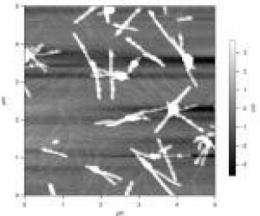
This is a piece of the Alzheimer's peptide. Credit: Bowers and the Buratto Groups, UCSB

UC Santa Barbara scientists have made a discovery that has the potential for use in the early diagnosis and eventual treatment of plaque-related diseases such as Alzheimer's disease and Type 2 diabetes. Their work is published in a recent issue of Nature Chemistry.

The amyloid diseases are characterized by plaque that aggregates into toxic agents that interact with cellular machinery, explained Michael T. Bowers, lead author and professor in the Department of Chemistry and Biochemistry. Other amyloid diseases include , Huntington's disease, and atherosclerosis. are protein fibrils that, in the case of Alzheimer's disease, develop prior to the appearance of symptoms.

"The systems we use are model systems, but the results are groundbreaking," said Bowers. He explained that his research provides the first examples of the conversion of randomly assembled aggregates of small peptides into ordered beta sheets that comprise fibrils. Fibrils are the final structural state of the aggregation process.

In the article, Bowers describes how understanding the fundamental forces that relate aggregation, shape, and biochemistry of soluble peptide aggregates is central to developing diagnostic and therapeutic strategies for amyloid diseases.

Bowers and his research team used a method called ion-mobility spectrometry-mass spectrometry (IMS-MS). This method enabled the team to deduce the peptide self-assembly method. They then examined a series of amyloid-forming peptides clipped from larger or proteins associated with disease.

Bowers explained that IMS-MS has the potential to open new avenues for investigating the pathogenic mechanisms of amyloid diseases, their early diagnosis and eventual treatment.

The first author of the paper is Christian Blieholder, a Humbolt Postdoctoral Fellow at UCSB. Thomas Wyttenbach, UCSB associate researcher, is a co-author. Nicholas F. Dupuis, who was a Ph.D. student at UCSB at the time of the research, is also a co-author; he is now a postdoctoral fellow at the University of Colorado.

Explore further: Protein study suggests drug side effects are inevitable

Related Stories

Alzheimer's research yields potential drug target

Jul 01, 2009

Scientists at UC Santa Barbara and several other institutions have found laboratory evidence that a cluster of peptides may be the toxic agent in Alzheimer's disease. Scientists say the discovery may lead ...

Researchers find new piece in Alzheimer's puzzle

Feb 25, 2009

Yale researchers have filled in a missing gap on the molecular road map of Alzheimer's disease. In the Feb. 26 issue of the journal Nature, the Yale team reports that cellular prion proteins trigger the process by which ...

New therapy targets for amyloid disease

Dec 04, 2009

A major discovery is challenging accepted thinking about amyloids - the fibrous protein deposits associated with diseases such as Alzheimer's and Parkinson's - and may open up a potential new area for therapeutics.

Vaccine triggers immune response, prevents Alzheimer's

May 19, 2008

A vaccine created by University of Rochester Medical Center scientists prevents the development of Alzheimer’s disease-like pathology in mice without causing inflammation or significant side effects.

Recommended for you

Protein study suggests drug side effects are inevitable

19 hours ago

A new study of both computer-created and natural proteins suggests that the number of unique pockets – sites where small molecule pharmaceutical compounds can bind to proteins – is surprisingly small, meaning drug side ...

Attacking MRSA with metals from antibacterial clays

May 17, 2013

In the race to protect society from infectious microbes, the bugs are outrunning us. The need for new therapeutic agents is acute, given the emergence of novel pathogens as well as old foes bearing heightened antibiotic resistance.

Keeping fruit, vegetables and cut flowers fresh longer

May 15, 2013

New technology offers the promise of reducing billions of dollars of losses that occur each year from the silent, invisible killer of fruits, vegetables and cut flowers—a gas whose effects are familiar to everyone who has ...

Why don't beetles freeze in the winter?

May 14, 2013

For 37 years, Queen's University Biochemistry professor Peter Davies has been unraveling the mystery of why some organisms including insects and fish don't freeze in the winter. His research into insect antifreeze protein ...

User comments : 0

More news stories

Protein study suggests drug side effects are inevitable

A new study of both computer-created and natural proteins suggests that the number of unique pockets – sites where small molecule pharmaceutical compounds can bind to proteins – is surprisingly small, meaning drug side ...

Non-wetting fabric drains sweat

(Phys.org) —Waterproof fabrics that whisk away sweat could be the latest application of microfluidic technology developed by bioengineers at the University of California, Davis.

Beautiful 'flowers' self-assemble in a beaker

By simply manipulating chemical gradients in a beaker of fluid, materials scientists at Harvard have found that they can control the growth behavior of crystals to create precisely tailored structures—such ...

Attacking MRSA with metals from antibacterial clays

In the race to protect society from infectious microbes, the bugs are outrunning us. The need for new therapeutic agents is acute, given the emergence of novel pathogens as well as old foes bearing heightened antibiotic resistance.

Study shows where scene context happens in our brain

In a remote fishing community in Venezuela, a lone fisherman sits on a cliff overlooking the southern Caribbean Sea. This man –– the lookout –– is responsible for directing his comrades on the water, ...