Bound neutrons pave way to free ones
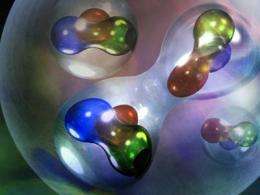
Some experiments seem to show that the building blocks of protons and neutrons inside a nucleus are somehow different from that of free ones (the EMC Effect). Other experiments show they behave differently when they pair up (Short-Range Correlations): they move faster and frequently overlap. Combining the data from experiments addressing these two effects, nuclear physicists showed that the two were connected. This connection has allowed scientists, for the first time, to extract information through experimentation about the internal structure of free neutrons, without the assistance of a theoretical model. Credit: DOE's Jefferson Lab
(PhysOrg.com) -- A study of bound protons and neutrons conducted at the Department of Energy's Thomas Jefferson National Accelerator Facility has allowed scientists, for the first time, to extract information through experimentation about the internal structure of free neutrons, without the assistance of a theoretical model. The result was published in the Feb. 4 issue of Physical Review Letters.
The major hurdle for scientists who study the internal structure of the neutron is that most neutrons are bound up inside the nucleus of atoms to protons. In nature, a free neutron lasts for only a few minutes, while in the nucleus, neutrons are always encumbered by the ubiquitous proton.
To tease out a description of a free neutron, a group of scientists compared data collected at Jefferson Lab and the SLAC National Accelerator Laboratory that detail how bound protons and neutrons in the nucleus of the atom display two very different effects. Both protons and neutrons are referred to as nucleons.
"Both effects are due to the nucleons behaving like they are not free," says Doug Higinbotham, a Jefferson Lab staff scientist.
Nucleons appear to differ when they are tightly bound in heavier nuclei versus when they are loosely bound in light nuclei. In the first effect, experiments have shown that nucleons tightly bound in a heavy nucleus pair up more often than those loosely bound in a light nucleus.
"The first thing was the probability of finding two nucleons close together in the nucleus, what we call a short-range correlation," says Larry Weinstein, a professor at Old Dominion University. "And the probability that the two nucleons are in a short-range correlation increases as the nucleus gets heavier."
Meanwhile, other experiments have shown a clear difference in how the proton's building blocks, called quarks, are distributed in heavy nuclei versus light nuclei. This difference is called the EMC Effect.
"People were measuring and discussing the EMC effect. And people were discussing things about the short-range correlations effect. Nobody bothered to look to see if there's any connection between them," adds Eliezer Piasetzky, a professor at Tel Aviv University in Israel.
When the group combined the data from a half-dozen experiments regarding these two different effects on one graph, they found that the two effects were correlated.
"Take a quantity that tells you how strong the EMC Effect is. And then take another quantity that tells you how many short-range correlations you have," Higinbotham explains. "And you see that when one is big, the other one is big. When one is small, the other one is small."
The scientists say that it's unlikely that one effect causes the other. Rather, the data shows that there is a common cause for both.
"I think that we certainly agree that from the position picture, it's due to nucleons overlapping that is causing this. And in the momentum picture, it is the high-momentum nucleons that are causing this. And, of course, it's quantum mechanics, so choose your picture," Higinbotham explains.
The group says the common cause may have remained a mystery for so long, because while the two effects they are studying are obviously related when laid out on a graph, the connection was previously obscured by the different, yet related ways in which the two effects are studied.
"When you do a measurement for the EMC Effect, what you do is you look inside the nucleon. You break open the nucleon and see inside. What happens inside the nucleon is very different from the short-range correlations, which is what happens between two different nucleons," Piasetzky says.
"What's very new here is that we have linked two fields that were completely disconnected. So now you can start asking questions about what that connection can help us learn," Higinbotham says.
They say the next step is to further compare the data from all of the source experiments that they used in their analysis to see if data for one effect may now be used to learn something new about the other. Then, of course, they'd like to use the knowledge that the two effects are connected to design new experiments for shining a light on other secrets buried in the nucleus of the atom.
More information: http://link.aps.or … t.106.052301
Provided by Thomas Jefferson National Accelerator Facility
-
From lemons to lemonade: Reaction uses carbon dioxide to make carbon-based semiconductor,
30 comments
-
Thioridazine kills cancer stem cells in human while avoiding toxic side-effects of conventional cancer treatments,
3 comments
-
SpaceX private rocket blasts off for space station (Update),
42 comments
-
Climate scientists say they have solved riddle of rising sea,
30 comments
-
Delphi gasoline-injection engine technique rivals hybrid's edge,
37 comments
-
why do trucks have bigger brakes?
4 hours ago
-
Solar Sail Physics - Do they work on a large scale?
5 hours ago
-
How should I switch an air conditioner off?
5 hours ago
-
Question about current decay in R-L circuit
6 hours ago
-
Elementary time - how does it work?
8 hours ago
-
How can squinting be used by both a myopic & hyperopic eye?
11 hours ago
- More from Physics Forums - General Physics
More news stories
Landmark calculation clears the way to answering how matter is formed
(Phys.org) -- An international collaboration of scientists, including Thomas Blum, associate professor of physics, is reporting in landmark detail the decay process of a subatomic particle called a kaon ...
May 25, 2012 |
4.6 / 5 (18) |
46
|
Is a classical electrodynamics law incompatible with special relativity?
(Phys.org) -- The laws of classical electromagnetism that were developed in the 19th century are the same laws that scientists use today. They include Maxwell’s four equations along with the Lorentz la ...
Lying in wait for WIMPs: Researchers seek to dramatically increase sensitivity of Large Underground Xenon detector
Although it's invisible, dark matter accounts for at least 80 percent of the matter in the universe. No one knows what it is, but most scientists would bet on weakly interacting massive particles, or WIMPs.
May 23, 2012 |
4 / 5 (7) |
15
|
Hall effect at the speed of light: How can you demonstrate relativistic effects with your mobile phone?
The relativistic Hall effect describing objects rotating at speeds comparable with the speed of light has been reported.
May 21, 2012 |
4.3 / 5 (3) |
8
Cloak of invisibility: Engineers use plasmonics to create an invisible photodetector
A team of engineers at Stanford and the University of Pennsylvania has for the first time used "plasmonic cloaking" to create a device that can see without being seen - an invisible machine that detects light. It is the first ...
May 21, 2012 |
4.8 / 5 (16) |
7
|
Dell tablet leak: 10.1-inch display, two-battery choice
(Phys.org) -- Headline after headline talks about vendors tablets in the wings as likely number-one contenders for the iPad. Such claims have justifiably been taken with a grain of salt, considering ...
Scientist: Evolution debate will soon be history
(AP) -- Richard Leakey predicts skepticism over evolution will soon be history. Not that the avowed atheist has any doubts himself.
Keep food safety in mind this memorial day weekend
(HealthDay) -- Picnics, parades and cookouts are as much a part of Memorial Day weekend as tributes to the United States' war veterans.
SpaceX capsule has 'new car' smell, astronauts say (Update)
SpaceX's Dragon cargo vessel smells like a new car, said astronauts at the International Space Station after opening the hatches Saturday following the spacecraft's landmark mission to the orbiting lab.
SpotterRF debuts Radar Backpack Kit (w/ Video)
(Phys.org) -- SpotterRF has announced a special radar backpack kit designed to enhance situational awareness for soldiers on the ground. The company says its special radar is designed for warfighters as part ...
Australia hails surprise super-telescope decision
Australia has hailed a surprise decision giving it a role in a radio telescope project aimed at revolutionising astronomy, vowing to draw on its decades of experience in space science.
Feb 07, 2011
Rank: 1 / 5 (5)
In nature, a free neutron lasts for only a few minutes.
If true, what is a neutron star, and how does it exist without protons.
Feb 07, 2011
Rank: 5 / 5 (8)
The neutrons in a neutron star are not free, so that is not an issue. At the surface, there is a thin layer of ordinary matter that contains plenty of protons. When it gets too thick, you get a nova. When the neutron star adds two much weight, it becomes a supernova.
Feb 07, 2011
Rank: 5 / 5 (7)
Neutron star is not formed by one neutron. In neutron stars there are massive amount of nucleus parts compressed together, so there are no free neutrons there. Therefore they are stable. Look at Wikipedia for more info.
Feb 07, 2011
Rank: 1 / 5 (11)
If so, it was a neutron star and neutrons on the surface being unbound would slowly decay. A neutron decays into a proton and electron plus neutrino radiation. The proton and electron would combine to form hydrogen which could at least in theory turn a neutron star into a sun again given enough time.
Feb 07, 2011
Rank: 4.2 / 5 (14)
Stop throwing the word theory around if you don't know what it means within the realm of science.
Feb 07, 2011
Rank: 4.6 / 5 (10)
Wha... Whaaaaaatttt?????
The things people will believe/parrot...
Feb 07, 2011
Rank: 5 / 5 (2)
It turns out that gravity is responsible for neutron star stability. Recall the neutron is slightly more massive than the proton; and under such high gravitational energy, it becomes more energetically favorable to occupy more massive states.
This is the reasoning why people have developed quark star models which predict exotic matter in the cores of these stars.
However, we don't have a neutron star equation of state, and we will never be able to probe the insides of the neutron star. So a methodology to prove any of these models is still far away.
Feb 07, 2011
Rank: 5 / 5 (3)
Neutrinos should be able to probe a neutron star. The star itself might emit electron antineutrinos when neutrons decay into protons. Also an artificial or natural source of neutrinos, on the opposite side of a neutron star, could reveal the inner workings of the star. Either way, never say never.
Feb 08, 2011
Rank: 1 / 5 (11)
And what is the present theory, all the heavy metals "just happened to be in the neighborhood when the sun formed?" Now that is dreaming.
Feb 08, 2011
Rank: 5 / 5 (10)
Feb 08, 2011
Rank: 5 / 5 (9)
Nearly, but not quite: A lot of the material that formed our sun and its solar nebula was made in a supernova which seeded and probably compressed a Hydrogen / Helium cloud with its blast. For example, the radioactive isotope Al-26 is only formed and ejected by core-collapse supernovae. Also, IIRC, all the 'Uranics' had similar origins...
Feb 08, 2011
Rank: 1 / 5 (11)
You got some problems with the stellar model for one where is the evidence for all the heavy metals in star forming regions?
Secondly, why wouldn't all the heavy metal end up in the sun (center) during the convalescing stage?
A supernova origin for our sun can explain all this in a logical sequence?
Feb 09, 2011
Rank: 5 / 5 (7)
Neutron stars are not recyclable, much less black holes, despite what some other pysorg poster would have you believe. That stuff has as much a solid foundation as Aether Theory.
Feb 10, 2011
Rank: 5 / 5 (8)
It may be possible to come up with something that resembles an aether theory that might not be a complete crock. There is NO WAY to do that with Oliver's idiotic idea. He is actually claiming that the Sun is a perpetual motion machine. And that is the good part. After all if Crank wants to keep Cranking without an additional input of Nonsense-Energy the Crank must have a Perpetual Cranking Machine fueled by Bovine Fertilizer, loaded by Maxwell's Demon with comments by Eliza.
No, I haven't had enough sleep lately. Why do you ask?
Ethelred
Feb 10, 2011
Rank: 5 / 5 (7)
Feb 10, 2011
Rank: 1 / 5 (10)
If the sun started out as giant star that exploded into a supernova it can be explained quite well, including the angular momentum in the heavy metals needed to orbit the remaining neutron star. It also explains the layers of heavy to lighter elements the further one goes from the center of the explosion.
As for Oliver's explanation of the origin of the sun's energy, I do not accept that either, but the source of that energy can be explained.
After the supernova a neutron star would be remaining. Now the question is what happens to a neutron star? The surface neutrons should slowly decay into hydrogen atoms. After enough hydrogen gas collects on the surface of a neutron star, it should start fusing again warming the convalescing planets.
Feb 10, 2011
Rank: 5 / 5 (6)
Seriously, how are you this stupid?
Feb 10, 2011
Rank: 5 / 5 (7)
More
Feb 10, 2011
Rank: 5 / 5 (5)
Since the gravitational energy of a neutron star is impossibly high (on the order of a million, million G at the surface) the hydrogen will start stellar fusion, however, the hydrogen will burn out so quickly that the only relevant aspect is the speed of accretion of hydrogen. If the hydrogen is quickly accreted it will ignite and burn through all available fuel very quickly, causing a burst of brightness that will taper off over a few months. This is a Nova. Then you can accrete at a rather moderate pace and result in cataclysmic eruptions of fusion which sputter out, called a cataclysmic variable. Then you can accrete incredibly slowly, which will maintain a continuous fusion reaction blasting portions of the Neutron star away or blasting the entire star apart at once in a Type I supernova.
So if you think this is wrong, provide your alternate explanation for this phenomina.
Feb 10, 2011
Rank: 5 / 5 (9)
The whole concept simply defies actual physics. Its all spitwadding and hoping the teacher doesn't notice the math is nonexistent. Oliver has NEVER run the numbers and simply holds his breath till his face turns blue when people mention the real numbers.
You want a neutron star within the Sun?
You need to prove that the minimum mass of a neutron star is LOWER than the mass of the Sun.
You meed to prove that hydrogen on the surface of the neutron star would NOT fuse catastrophically.
You need to show that the metals formed by the initial supernova would be captured by the neutron star despite the know high velocity of the ejecta.
You need to show that bound neutrons undergo beta decay and it has never been observed.
Please note that these things presently appear to be contrary to real physics.
Ethelred
Feb 10, 2011
Rank: 1 / 5 (8)
During the sun's convalescing phase all the heavy metals would have ended up in the center of the sun.
Where are your answers??
As for all the question you have asked me, try answering them yourself, you cannot with any more certainty than I can.
I will answer this one though with a question, why wouldn't neutrons decay on the surface of a neutron star? As far as I know gravity has no effect on decay rates.
And this one with a question also, does hydrogen fuse catastrophically in the sun? No, so why should that always be the case on the surface of a neutron star?
Feb 10, 2011
Rank: 5 / 5 (3)
Do you think that Iron and Aluminium are the same too?
Feb 10, 2011
Rank: 1 / 5 (8)
Fits the present day size of the sun nicely, after all neutrons lose mass when they decay.
Quote NASA: "A neutron star is about 20 km in diameter and has the mass of about 1.4 times that of our Sun. This means that a neutron star is so dense that on Earth, one teaspoonful would ..."
imagine.gsfc.nasa.gov/docs/science/know_l1/pulsars.html
Feb 10, 2011
Rank: 1 / 5 (8)
"Orbiting particles are not separated by mass because the velocity of the orbits is dependent on distance and independent of mass."
This is true but not during the convalescing stage, during that phase they are separated by "weight".
And SH your answer proves my point.
Feb 10, 2011
Rank: 5 / 5 (7)
Feb 10, 2011
Rank: 5 / 5 (7)
Feb 10, 2011
Rank: 1 / 5 (6)
You also do have a point about convection playing a part in mixing. But don't forget when the sun was condensing (is that better?) it was not the churning nuclear furnace of today.
Feb 10, 2011
Rank: 5 / 5 (4)
Feb 10, 2011
Rank: 2.3 / 5 (3)
No.
Feb 10, 2011
Rank: 5 / 5 (6)
Feb 10, 2011
Rank: 5 / 5 (7)
Feb 10, 2011
Rank: 1 / 5 (6)
As for gravity having an affect on neutron decay decay rates, I would like to see your source for that information.
That would also contradict what Ethelred stated earlier about neutron stars have catastrophic nuclear flares from time to time.
Feb 10, 2011
Rank: 5 / 5 (5)
Feb 10, 2011
Rank: 5 / 5 (6)
Feb 10, 2011
Rank: 1 / 5 (9)
But I am sorry to read that you do not have time to look up a source to back up your claim that gravity has an effect on the decay rates of neutrons. So I will disregard that until I find out otherwise. I do not accept hearsay as facts.
Feb 10, 2011
Rank: 5 / 5 (3)
Feb 10, 2011
Rank: 1 / 5 (3)
Question, a neutron star is bound by gravity. Gravity that is almost unimaginably strong. If you were somehow teleported to one's surface you would be liquefied into a slick less than one micron thick within a millisecond. Without the neutron star's own mass to provide that gravity, wich stabilizes the neutronium that makes up the neutron star, the NS will blow itself apart. And the minimal amount of mass needed to generate the gravity needed to form stable neutronium is roughly 1.5 solar masses. So how can the Sun have a NS inside it?
If you are not claiming that gravity is what is keeping the neutronium (neutrons stablized) bound what are you claiming??
Feb 10, 2011
Rank: 5 / 5 (4)
My claim is based on the fact that QM & symmetry principals (energy conservation) prevents beta decay in stable nuclei. A neutron star is a gigantic gravitationally bound and stabilized nuclei that has already undergone MASSIVE inverse beta decay. The latter is just a fact, plain and simple. Now what I'm saying is that BOUND is BOUND. Just because it's as a result of gravity overwhelming the electromagnetic force rather than bound as a result of strong force interactions DOESN'T SUSPEND QM restrictions on beta decay.
Sheesh guy! You're the one making outrageous claims about some kind of neutron star origin for the Sun, and in spite of the fact that YOUR claims violate known physics.
Feb 10, 2011
Rank: 5 / 5 (4)
O.k. Let's make sure we're gettign this stright. Gravity IS what binds and stabilizes NEUTRONIUM. Gravity does NOT bind and stabilize individual neutrons or normal, elemental nucleons.
Now, when did I write that this had anything to do with *decay rates*? I don't give a flying fig about rates, clocks and tic tocs. If you want to get into how GR impacts decay rate in different reference frames that whole other kettle of fish.
What I'm saying is BOUND is BOUND. Doesn't matter if it's as a result of gavity (in the case of neutron stars) or the strong force (in the case of normal nuclear matter): you'll have the same QM (pauli exclusion principle) and symmetry principle (conservation of energy) restrictions on beta decay.
And if that's not good enough for you, that's fine. I'm sure Oliver would love to have you as his protege.
Feb 10, 2011
Rank: 1 / 5 (8)
You need to go back and reread what I said, I have no idea as to whether there is a remnant of a neutron star in the center of our sun. My only claim is that our sun most likely originated from a supernova and therefore neutron star.
And secondly, show me one thing I claimed that violates know physics.
Now it appears you did make a claim that violates physics by your use of the word neutronium.
One thing you cannot seem to understand is that the neutrons on the surface of a neutron star are not bound by anything other than gravity.
And you cannot show me any proof that gravity prevents neutrons from decaying!
Feb 10, 2011
Rank: 1 / 5 (8)
Feb 10, 2011
Rank: 5 / 5 (5)
NEUTRONIUM!
NEUTRONIUM!
NEUTRONIUM!
Wow, that's 3 more times I must have violated physics. Neat eh?
To each other, YES. Is there an echo in here?Wow, feel any better?
Feb 10, 2011
Rank: 5 / 5 (5)
You're the one who started prattling about neutron stars. What do you think they are made from? Balsa wood?
Face.
Palm.
Feb 10, 2011
Rank: 1 / 5 (6)
Now let me answer the one point you claim I am violating the laws of physics on. I am not the one claiming bound neutrons cannot decay, and yes even by beta decay. It happens all the time in radioactive isotopes.
Again, neutrons on the surface of a neutron star are not bound by anything other than gravity and they most certainly can decay.
Show me otherwise!!
Feb 10, 2011
Rank: 5 / 5 (3)
Feb 10, 2011
Rank: 1 / 5 (6)
I know forces other than gravity are on the surface of a neutron star, like temperature increases from absorbed EMR and neutrinos from the outside. Now if you are implying that the strong nuclear force is involved, it isn't. Have scientist ever created a ball of just neutrons here on earth?
Feb 11, 2011
Rank: 5 / 5 (5)
That's the problem here, you mount a self defeating argument because you're ignorant of the theories that explain these phenomina.
Feb 11, 2011
Rank: 5 / 5 (5)
Feb 12, 2011
Rank: 5 / 5 (1)
Feb 13, 2011
Rank: 5 / 5 (4)
Dude, just let it go. Stop making yourself look more and more like a bigger jackass. You were wrong. Move on.
Feb 13, 2011
Rank: not rated yet
You aren't by any chance the "scientist" that does a lot of work for neal adams, are you?
Feb 14, 2011
Rank: not rated yet
While it is true that any fusion that goes beyond hydrogen consumes more energy than it creates this does NOT mean that heavy metals aren't created during the normal operations of a sun (even before any supernova event).
It's just a probabilistic distribution: Not all nucleons in the sun have the same (the average) energy at all times. There are rather large fluctuations. So you do get all kinds of fusion products even during the early stages (only with sharply diminishing probabilities) not only H to He, etc. This includes 'freak' fusion products that are heavier than iron.
Feb 14, 2011
Rank: 5 / 5 (1)