Arctic climate variation under ancient greenhouse conditions
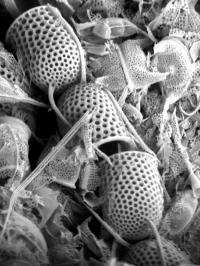
Studying the fossilized remains of diatoms in sediments tell us a great about past climate. Credit: Andrew Davies, Alan Kemp and Heiko Pälike
Tiny organisms preserved in marine sediments hold clues about Arctic climate variation during an ancient episode of greenhouse warming.
Based on reconstructions of Arctic climate variability in the greenhouse world of the Late Cretaceous, Southampton scientists have concluded that man-made global warming probably would not greatly change the climatic influence associated with natural modes of inter-annual climate variability such as the El Niño Southern Oscillation (ENSO) or the Arctic Oscillation/ North Atlantic Oscillation (AO/ NAO).
"Even in the warm Cretaceous period, the patterns of these climatic oscillations changed over longer decadal timescales," explained Professor Alan Kemp of the University of Southampton's School of Ocean and Earth Science based at the National Oceanography Centre, Southampton. "It is therefore difficult to predict whether anthropogenically driven warming will lead to systematic changes such as persistently milder European winters (a positive AO/ NAO) as some have suggested."
It is anticipated that the Arctic Ocean will become ice free during the summer within the next 15-50 years as a result of global warming. Because sea ice is reflective, its loss will reduce the amount of the Sun's energy bounced back out to space, thereby amplifying regional warming. However, changes in atmospheric circulation could also occur, making it difficult to unravel the likely net effect on climate.
"A key question is how an Arctic without permanent ice cover will affect atmospheric circulation and climate variability, particularly over high and mid latitudes," said Kemp.
One way of addressing this issue is to look back at previous greenhouse episodes in Earth's history. For example, Kemp's group has previously reported in the journal Nature that during the Late Cretaceous, when the dinosaurs roamed the world, the Arctic Ocean was free of ice in summer with only intermittent sea ice in the winter.
"Understanding Late Cretaceous climate should inform debate about future climate trends and variability under greenhouse conditions," said Kemp, whose team's new findings are published in Geophysical Research Letters.
In both studies, Kemp and his collaborators analysed sediment cores from a marine ridge in the Arctic Ocean. These sediments date to the Late Cretaceous (69-76 million years ago) and contain fossil remains of diatoms, an important group of phytoplankton tiny planktonic marine plants.
The sediments contain alternating band-like laminae of two types, representing diatom growth conditions in the Arctic spring and summer, respectively. Each year is represented by a couplet of laminae, one of each type, which allowed the researchers to reconstruct ocean conditions at annual resolution.
"The presence of diatom laminae testify to ice-free Arctic summers during the Late Cretaceous, although there is also evidence of ice rafting by intermittent winter ice," said Kemp.
The researchers analysed two sections of sediment core covering between them a continuous period of around 1,000 years. By analysing the characteristics of the diatom laminae and measuring their thickness they were able to reconstruct climate-driven variation in ocean conditions both between years and over decades.
Their analyses revealed that the Arctic climate of the Late Cretaceous varied over various timescales with periodicities closely matching those observed in the modern Arctic. It therefore appears that the Arctic was subject to some of the same climatic influences in the Late Cretaceous as it is today, including ENSO, which periodically transmits equatorial influences to high-latitudes via ocean-atmosphere interactions.
"A modern Arctic lacking permanent sea ice should be subject to similar influences as it was under greenhouse conditions in the Late Cretaceous," said Kemp.
This is important because there has been an ongoing debate about whether natural modes of climate variability such as ENSO and AO/ NAO would be perturbed or enhanced by global warming caused by greenhouse gas emissions. Particular controversy has surrounded whether such warming could cause a permanent El Niño state or milder European winters.
"Based on our findings, it seems unlikely that man-made global warming would cause a permanent El Niño state," concluded Kemp.
More information:
Davies, A., Kemp, A. E. S. & Pälike, H. Tropical ocean-atmosphere controls on inter-annual climate variability in the Cretaceous Arctic. Geophysical Research Letters 38, L03706, (011). doi:10.1029/2010GL046151
Davies, A., Kemp, A. E. S. & Pyke, J. Late Cretaceous seasonal ocean variability from the Arctic. Nature 460, 254-258 (2009). doi:10.1038/nature08141
Provided by National Oceanography Centre, Southampton
-
From lemons to lemonade: Reaction uses carbon dioxide to make carbon-based semiconductor,
30 comments
-
Thioridazine kills cancer stem cells in human while avoiding toxic side-effects of conventional cancer treatments,
3 comments
-
SpaceX private rocket blasts off for space station (Update),
42 comments
-
Climate scientists say they have solved riddle of rising sea,
30 comments
-
Delphi gasoline-injection engine technique rivals hybrid's edge,
37 comments
-
More human population = greater mass?
May 25, 2012
-
Conversion from aircraft bearing to normal degrees
May 23, 2012
-
Interpretation/Analysis of the Lab results(HEPA filter)
May 22, 2012
-
Has anyone here attended the The Urbino Summer School in Paleoclimatology?
May 22, 2012
-
Earthquakes: Mag 6 N. Italy and Mag 5.6 W. Bulgaria
May 21, 2012
-
determining time frame for most recent geological layers
May 17, 2012
- More from Physics Forums - Earth
More news stories
SpaceX capsule has 'new car' smell, astronauts say (Update)
SpaceX's Dragon cargo vessel smells like a new car, said astronauts at the International Space Station after opening the hatches Saturday following the spacecraft's landmark mission to the orbiting lab.
Space & Earth / Space Exploration
11 hours ago |
4.6 / 5 (15) |
0
Australia hails surprise super-telescope decision
Australia has hailed a surprise decision giving it a role in a radio telescope project aimed at revolutionising astronomy, vowing to draw on its decades of experience in space science.
11 hours ago |
5 / 5 (2) |
0
Astronomers seize last chance in lifetime for Venus Transit
Astronomers are gearing for one the rarest events in the Solar System: an alignment of Earth, Venus and the Sun that will not be seen for another 105 years.
11 hours ago |
5 / 5 (1) |
0
Astronauts enter world's 1st private supply ship
(AP) -- Space station astronauts floated into the Dragon on Saturday, a day after its heralded arrival as the world's first commercial supply ship.
Space & Earth / Space Exploration
11 hours ago |
5 / 5 (5) |
0
Dragon arrives at space station in historic 1st (Update 2)
The privately bankrolled Dragon capsule made a historic arrival at the International Space Station on Friday, triumphantly captured by astronauts wielding a giant robot arm.
Space & Earth / Space Exploration
May 25, 2012 |
5 / 5 (10) |
19
Dell tablet leak: 10.1-inch display, two-battery choice
(Phys.org) -- Headline after headline talks about vendors tablets in the wings as likely number-one contenders for the iPad. Such claims have justifiably been taken with a grain of salt, considering ...
Scientist: Evolution debate will soon be history
(AP) -- Richard Leakey predicts skepticism over evolution will soon be history. Not that the avowed atheist has any doubts himself.
Keep food safety in mind this memorial day weekend
(HealthDay) -- Picnics, parades and cookouts are as much a part of Memorial Day weekend as tributes to the United States' war veterans.
SpotterRF debuts Radar Backpack Kit (w/ Video)
(Phys.org) -- SpotterRF has announced a special radar backpack kit designed to enhance situational awareness for soldiers on the ground. The company says its special radar is designed for warfighters as part ...
Thousands of shellfish found dead in Peru
Thousands of crustaceans were found dead off the coast of Lima following the mystery mass death of dolphins and pelicans, the Peruvian Navy said Friday.
Family history of Alzheimer's affects functional connectivity
(HealthDay) -- Cognitively normal individuals with a family history of late-onset Alzheimer's disease (AD) may display lower resting state functional connectivity in the default mode network (DMN) of the brain, ...
Feb 11, 2011
Rank: 2.3 / 5 (3)
Do you mean those climate conditions, 1000 years ago, when there were dairy farms in Greenland and grape vines in Scotland and Nova Scotia/Newfoundland?
What a time is was, to go a viking.
Feb 11, 2011
Rank: 5 / 5 (2)
Feb 11, 2011
Rank: 3 / 5 (2)
Interestingly the average height of your Greenland Viking in 1300 was 5'7", in 1400 it was below 5'. The poor diet due to cold and short growing season took their toll on them and farming was to prove unsustainable regardless of the North Atlantic Cold Anomies that were to follow.
Feb 11, 2011
Rank: 2.6 / 5 (5)
Zero.
Why?
Because water vapor is the number one greenhouse gas. There has never been a warm period or cold period without greenhouse warming or cooling.
It won't prevent the end of this interglacial either.
A really interesting theory would be why ice ages occur, and how many hundred years we have left in this interglacial.
Feb 12, 2011
Rank: 3.7 / 5 (3)
You fail to understand that although water is a green house gas, there so much of it and the cycle is so fast the there is always a near equilibrium between atmosphere and the land. As such, the water is not the cause. It is the things that are away from equilibrium that affect the warming/cooling trends.
Feb 14, 2011
Rank: 1 / 5 (2)
Please provide a source. I think you have it dead wrong.
When talking about water as a greenhouse gas, only absolute humidity matters. Absolute humidity has HUGE variations both spacial and temporal. I suspect that you are trying to trivialize the effects of water because you think it competes with CO2. In reality, they are linked together and neither one can be looked at without looking at the other. The Earth has gone through many long period changes in atmospheric water vapor concentration. It is not in equilibrium on any time scale, long or short. It changes based on many related factors, such as global temperature, wind speed, water surface area, geographic changes in the size and shape of oceans and land masses, etc. etc. etc. You are way off.