Challenger: 25 years later, a still painful wound
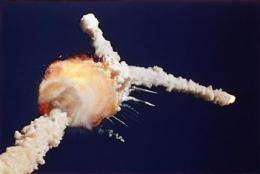
For many, no single word evokes as much pain. Challenger.
A quarter-century later, images of the exploding space shuttle still signify all that can go wrong with technology and the sharpest minds. The accident on Jan. 28, 1986 - a scant 73 seconds into flight, nine miles above the Atlantic for all to see - remains NASA's most visible failure.
It was the world's first high-tech catastrophe to unfold on live TV. Adding to the anguish was the young audience: School children everywhere tuned in that morning to watch the launch of the first schoolteacher and ordinary citizen bound for space, Christa McAuliffe.
She never made it.
McAuliffe and six others on board perished as the cameras rolled, victims of stiff O-ring seals and feeble bureaucratic decisions.
It was, as one grief and trauma expert recalls, "the beginning of the age when the whole world knew what happened as it happened."
"That was kind of our pilot study for all the rest to come, I think. It was so ghastly," said Sally Karioth, a professor in Florida State University's school of nursing.
The crew compartment shot out of the fireball, intact, and continued upward another three miles before plummeting. The free fall lasted more than two minutes. There was no parachute to slow the descent, no escape system whatsoever; NASA had skipped all that in shuttle development. Space travel was considered so ordinary, in fact, that the Challenger seven wore little more than blue coveralls and skimpy motorcycle-type helmets for takeoff.
In a horrific flash, the most diverse space crew ever - including one black, one Japanese-American and two women, one of them a Jew - was gone. The name of NASA's second oldest shuttle was forever locked in a where-were-you moment.
"You say 'Challenger' and then we see that figure of smoke in the sky," said Karioth, who teaches death and dying classes.
There has been a growing list of calamities since then.
Waco. Oklahoma City. Columbine. 9/11. Shuttle Columbia. Katrina. Virginia Tech. And now, Tucson.
With so much carnage, another space catastrophe wouldn't have the same impact as Challenger, Karioth noted. "We're used to everybody dying now," she said.
The death of a young, vivacious schoolteacher, combined with NASA's stubborn refusal to share information about the accident and the realization that America's space program was fallible, added to the nation's collective pain.
President Ronald Reagan's poetic tribute soothed the day's raw emotions.
"The crew of the space shuttle Challenger honored us by the manner in which they lived their lives," Reagan told a grieving nation after canceling that night's State of the Union address. "We will never forget them, nor the last time we saw them, this morning, as they prepared for their journey and waved goodbye and 'slipped the surly bonds of Earth' to 'touch the face of God.'"
NASA safely had launched shuttles 24 times before, and a sense of routine and hurry-it-up had crept in. The space agency wanted to pull off 15 missions in 1986. Repeated delays with Columbia on that year's first flight and then with Challenger were spoiling the effort.
The first federal Martin Luther King holiday had just been observed. NASA's Voyager 2 probe, flying farther than any previous spacecraft, had swung past Uranus, discovering 10 new moons. "That's What Friends Are For," the AIDS charity anthem, topped the music charts. And a 37-year-old schoolteacher from Concord, N.H., was about to rocket into orbit.
"Imagine a history teacher making history," McAuliffe observed before the flight. She got an apple from a technician atop the ice-encrusted launch pad, before boarding Challenger one final time.
In the 20s at daybreak, the temperature had risen only into the mid-30s by the time Challenger blasted off at 11:38 a.m. "Go at throttle up," radioed commander Francis "Dick" Scobee.
What happened next was unthinkable, his widow says.
"It was really a shock wave that went across our country and around the world," June Scobee Rodgers said in an interview this week with The Associated Press. "People witnessed the loss of Challenger over and over on their televisions."
Dick Scobee. Michael Smith. Ellison Onizuka. Judith Resnik. Ronald McNair. Christa McAuliffe. Gregory Jarvis. The first of the shuttle astronauts to die on the job.
Seventeen years later, almost to the day, seven more astronauts were killed, this time at the end of their mission. Instead of booster rockets and freezing launch weather, fuel-tank foam insulation was to blame. The similarities between Challenger and Columbia, though, were haunting. Another multiethnic crew lost, more poor decision-making, an intolerant work culture, drum-beating pressure to launch.
This week, as NASA observes the 25th anniversary of the Challenger disaster, the shuttle fleet is grounded once more. Fuel tank cracking is the latest culprit.
NASA hopes to get Discovery flying by the end of February. Endeavour - Challenger's replacement - will follow in April. It will fly with or without commander Mark Kelly, who's tending to his wounded wife, Arizona Congresswoman Gabrielle Giffords, who was shot Jan. 8 in Tucson. Atlantis will close out the 30-year shuttle program with a summertime flight, No. 135.
Shuttle program manager John Shannon prefers not "to compare and contrast" the Challenger era and now. But he points out that he's felt "zero pressure" to rush the remaining flights, even though "we kind of get beat up a little bit" in some quarters for all the delays.
Roger Launius, a senior curator at the National Air and Space Museum in Washington, says: "When we look back 50 years from now on the shuttle program, we are going to view it as this remarkable technological achievement. The one and only reusable human space vehicle in the world. And it had a remarkable run for 30 years. Some tragedies along the way, but enormous successes as well."
For their part, the families of the lost Challenger crew dwell on the good that came out of the accident: a network of education centers. The 48th Challenger Learning Center opens Friday in Louisville, Ky.
On Thursday, Steven J. McAuliffe, widower of Christa McAuliffe, said in a statement that remembrances by people across the country are "both comforting and inspirational to our family."
McAuliffe, a federal judge in Concord, N.H., said, "Christa confidently and joyfully embraced life, no less than her friends and colleagues on Challenger, and no less than the crews of Columbia, Apollo 1, and all of those people who courageously follow their own paths every day. I know Christa would say that that is the most precious lesson - ordinary people can make extraordinary contributions ..."
He said she would be especially pleased by the Challenger Center for Space Science Education. Dick Scobee's widow, June Rodgers, is an educator and founding board chairman of the center.
As she has on every Challenger anniversary, Rodgers will visit a learning center to watch the children in action. First, she will take part in NASA's public memorial service Friday morning at Kennedy Space Center, some 10 miles from Challenger's grave. The remains of the spacecraft - what was retrieved from the ocean - are buried in a pair of abandoned missile silos on Air Force property.
"I wonder if it's because the image is so ingrained in our brains, that it seems like yesterday," Rodgers said.
Almost as many years have passed since the accident, as the span of her 26-year marriage to Dick Scobee.
"Isn't it interesting about the number 25?" she asked softly. "Challenger was the 25th mission. This is 25 years."
A full generation has come and gone.
More information:
NASA: http://history.nasa.gov/sts51l.html
Challenger Center for Space Science Education: http://www.challenger.org/
©2010 The Associated Press. All rights reserved. This material may not be published, broadcast, rewritten or redistributed.


