100-year-old specimens help determine when avian pox hit Galapagos
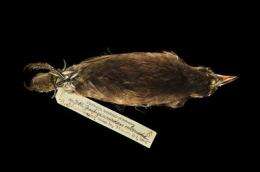
A research team from across the United States and Ecuador has pinpointed 1898 as the year the avipoxvirus, or avian pox, hit the Galapagos Islands and started infecting its birds. This estimation is vital to understanding avian diseases that affect today's Galapagos birds. The scientists' paper on the subject, "110 Years of Avipoxvirus on the Galapagos Islands," will be published on January 13 in PLoS ONE.
The research team, led by Dr. Patricia Parker of the University of Missouri–St. Louis, examined 3,607 finches and mockingbirds collected in the Galapagos between 1898 and 1906 that are currently held at the California Academy of Sciences in San Francisco, along with 266 birds collected in 1891 and 1897 held at the Zoologische Staatssammlung in Munich, Germany. The scientists inspected the birds for skin lesions associated with avian pox infection and found 226 candidates dating from 1898 or later. For a small subset of these (59 specimens), the scientists took tissue samples for further pathological studies. In the end, a total of 21 specimens scored positive for avipoxvirus using histology (tissue examination under a microscope) and genotyping (screening for viral DNA).
"Without museum collections, work like this would never be possible," said Dr. Jack Dumbacher, Curator of Ornithology at the California Academy of Sciences. "Because museum specimens include detailed collection date and location data, they can be used to study not only a particular species, but also historical events and environmental conditions. Without this library of specimens, we might never have learned when or how this potentially devastating disease made its way to Darwin's famous islands."

The Academy has a deeply rooted history of research in the Galapagos, where it helped to found the Charles Darwin Research Station at Academy Bay, as well as the Galapagos National Park. The museum sent its first expedition to these storied islands in 1905. For about a year, the Academy's team of scientists inventoried everything from plants, fossils, and birds that are now extinct to the iconic marine iguanas that still bask on coastal rocks. By the time the team returned to San Francisco, the 1906 earthquake and fire had destroyed most of the Academy's research collections, so the 70,000 scientific specimens collected during the expedition formed the basis for rebuilding the institution. Since then, the Academy has organized dozens of return trips and is now home to the world's largest collection of scientific specimens from the Galapagos. Most of the museum's current field work in the Galapagos focuses on the marine environment, where dozens of new species have been discovered in the last decade.
The PLoS ONE study is the latest example of how this invaluable collection continues to provide insight into evolutionary and ecological processes on the islands. According to the paper, the role of disease in regulating populations is controversial, partly owing to the absence of good disease records in historic wildlife populations. The authors hope to fill that void with the new approaches taken in their paper.
"The combination of an extensive museum collection and modern genetics and histology have allowed us to home in on the arrival date of an important virus that threatens today's populations of unique birds," said Parker, Professor of Zoological Studies at the University of Missouri–St. Louis and lead author on the paper. "We are all excited to not only have the arrival date estimate, but to have important insights into the role that humans have played (and still play) in spreading pathogens like this virus."
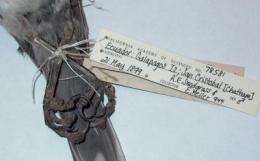
Parker and her colleagues note that while there have been no known extinctions of bird species on the Galapagos Islands as a whole, the extinction rate on individual islands is approximately 100 times higher since human colonization than before human arrival. The history of avipoxvirus on the Galapagos is an important data point for understanding this accelerated population-level extinction. The museum specimens demonstrate that shortly after its arrival, the virus was much more likely to be found on human-inhabited islands, suggesting that humans inadvertently helped it to spread.
"Now that we know that humans likely played a role in facilitating the spread of avian pox in the Galapagos, we'll be better equipped to develop policies designed to prevent further spread of the disease," says Dumbacher.
Provided by California Academy of Sciences


