Voyager celebrates 25 years since Uranus visit
January 24, 2011 By Jia-Rui C. Cook
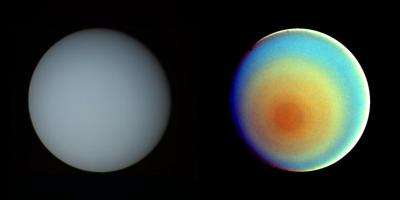
These two pictures of Uranus -- one in true color (left) and the other in false color -- were compiled from images returned Jan. 17, 1986, by the narrow-angle camera of Voyager 2. Image credit: NASA/JPL
(PhysOrg.com) -- As NASA's Voyager 2 spacecraft made the only close approach to date of our mysterious seventh planet Uranus 25 years ago, Project Scientist Ed Stone and the Voyager team gathered at NASA's Jet Propulsion Laboratory, Pasadena, Calif., to pore over the data coming in.
Images of the small, icy Uranus moon Miranda were particularly surprising. Since small moons tend to cool and freeze over rapidly after their formation, scientists had expected a boring, ancient surface, pockmarked by crater-upon-weathered-crater. Instead they saw grooved terrain with linear valleys and ridges cutting through the older terrain and sometimes coming together in chevron shapes. They also saw dramatic fault scarps, or cliffs. All of this indicated that periods of tectonic and thermal activity had rocked Miranda's surface in the past.
The scientists were also shocked by data showing that Uranus' magnetic north and south poles were not closely aligned with the north-south axis of the planet's rotation. Instead, the planet's magnetic field poles were closer to the Uranian equator. This suggested that the material flows in the planet's interior that are generating the magnetic field are closer to the surface of Uranus than the flows inside Earth, Jupiter and Saturn are to their respective surfaces.
"Voyager 2's visit to Uranus expanded our knowledge of the unexpected diversity of bodies that share the solar system with Earth," said Stone, who is based at the California Institute of Technology in Pasadena. "Even though similar in many ways, the worlds we encounter can still surprise us."
Voyager 2 was launched on Aug. 20, 1977, 16 days before its twin, Voyager 1. After completing its prime mission of flying by Jupiter and Saturn, Voyager 2 was sent on the right flight path to visit Uranus, which is about 3 billion kilometers (2 billion miles) away from the sun. Voyager 2 made its closest approach within 81,500 kilometers (50,600 miles) of the Uranian cloud tops on Jan. 24, 1986.
Before Voyager 2's visit, scientists had to learn about Uranus by using Earth-based and airborne telescopes. By observing dips in starlight as a star passed behind Uranus, scientists knew Uranus had nine narrow rings. But it wasn't until the Voyager 2 flyby that scientists were able to capture for the first time images of the rings and the tiny shepherding moons that sculpted them. Unlike Saturn's icy rings, they found Uranus' rings to be dark gray, reflecting only a few percent of the incident sunlight.
Scientists had also determined an average temperature for Uranus (59 Kelvin, or minus 350 degrees Fahrenheit) before this encounter, but the distribution of that temperature came as a surprise. Voyager showed there was heat transport from pole to pole in Uranus' atmosphere that maintained the same temperature at both poles, even though the sun was shining directly for decades on one pole and not the other.
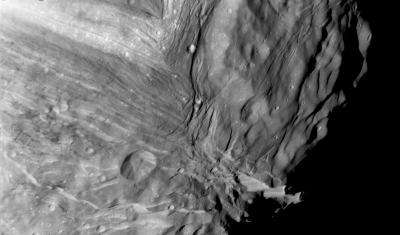
Miranda, innermost of Uranus' large satellites, is seen at close range in this Voyager 2 image, taken Jan. 24, 1986, as part of a high-resolution mosaicing sequence. Image credit: NASA/JPL
By the end of the Uranus encounter and science analysis, data from Voyager 2 enabled the discovery of 11 new moons and two new rings, and generated dozens of science papers about the quirky seventh planet.Voyager 2 moved on to explore Neptune, the last planetary target, in August 1989. It is now hurtling toward interstellar space, which is the space between stars. It is about 14 billion kilometers (9 billion miles) away from the sun. Voyager 1, which explored only Jupiter and Saturn before heading on a faster track toward interstellar space, is about 17 billion kilometers (11 billion miles) away from the sun.
"The Uranus encounter was one of a kind," said Suzanne Dodd, Voyager project manager, based at JPL. "Voyager 2 was healthy and durable enough to make it to Uranus and then to Neptune. Currently both Voyager spacecraft are on the cusp of leaving the sun's sphere of influence and once again blazing a trail of scientific discovery."
The Voyagers were built by NASA's Jet Propulsion Laboratory in Pasadena, Calif., which continues to operate both spacecraft. For more information about the Voyager spacecraft, visit: http://www.nasa.gov/voyager . JPL is a division of the California Institute of Technology in Pasadena.
Provided by
JPL/NASA
-
From lemons to lemonade: Reaction uses carbon dioxide to make carbon-based semiconductor,
29 comments
-
Thioridazine kills cancer stem cells in human while avoiding toxic side-effects of conventional cancer treatments,
3 comments
-
SpaceX private rocket blasts off for space station (Update),
42 comments
-
Climate scientists say they have solved riddle of rising sea,
30 comments
-
Scotland passes turbine test to harness tidal power,
41 comments
-
revamping general concept and cosmological principle
May 25, 2012
-
Transiting Exoplanet Light Curve
May 25, 2012
-
Math behind Theoretical Physics
May 24, 2012
-
Do we know whats at the center of galaxies yet?
May 23, 2012
-
Structure of the Milky Way?
May 20, 2012
-
What would it take to terraform Pluto and Charon?
May 19, 2012
- More from Physics Forums - General Astronomy
More news stories
SpaceX capsule has 'new car' smell, astronauts say (Update)
SpaceX's Dragon cargo vessel smells like a new car, said astronauts at the International Space Station after opening the hatches Saturday following the spacecraft's landmark mission to the orbiting lab.
Space & Earth / Space Exploration
10 hours ago |
4.5 / 5 (12) |
0
Australia hails surprise super-telescope decision
Australia has hailed a surprise decision giving it a role in a radio telescope project aimed at revolutionising astronomy, vowing to draw on its decades of experience in space science.
10 hours ago |
5 / 5 (2) |
0
Astronomers seize last chance in lifetime for Venus Transit
Astronomers are gearing for one the rarest events in the Solar System: an alignment of Earth, Venus and the Sun that will not be seen for another 105 years.
10 hours ago |
5 / 5 (1) |
0
Astronauts enter world's 1st private supply ship
(AP) -- Space station astronauts floated into the Dragon on Saturday, a day after its heralded arrival as the world's first commercial supply ship.
Space & Earth / Space Exploration
10 hours ago |
5 / 5 (5) |
0
Dragon arrives at space station in historic 1st (Update 2)
The privately bankrolled Dragon capsule made a historic arrival at the International Space Station on Friday, triumphantly captured by astronauts wielding a giant robot arm.
Space & Earth / Space Exploration
May 25, 2012 |
5 / 5 (10) |
19
Dell tablet leak: 10.1-inch display, two-battery choice
(Phys.org) -- Headline after headline talks about vendors tablets in the wings as likely number-one contenders for the iPad. Such claims have justifiably been taken with a grain of salt, considering ...
Scientist: Evolution debate will soon be history
(AP) -- Richard Leakey predicts skepticism over evolution will soon be history. Not that the avowed atheist has any doubts himself.
Keep food safety in mind this memorial day weekend
(HealthDay) -- Picnics, parades and cookouts are as much a part of Memorial Day weekend as tributes to the United States' war veterans.
SpotterRF debuts Radar Backpack Kit (w/ Video)
(Phys.org) -- SpotterRF has announced a special radar backpack kit designed to enhance situational awareness for soldiers on the ground. The company says its special radar is designed for warfighters as part ...
Thousands of shellfish found dead in Peru
Thousands of crustaceans were found dead off the coast of Lima following the mystery mass death of dolphins and pelicans, the Peruvian Navy said Friday.
Family history of Alzheimer's affects functional connectivity
(HealthDay) -- Cognitively normal individuals with a family history of late-onset Alzheimer's disease (AD) may display lower resting state functional connectivity in the default mode network (DMN) of the brain, ...

Jan 24, 2011
Rank: 5 / 5 (5)
We're stuck here on this tiny planet for the immediate future!
Jan 24, 2011
Rank: 5 / 5 (4)
Jan 24, 2011
Rank: not rated yet
Actually, Voyager 1 has traveled 1/557 of a light year, while Voyager 2 has traveled 1/676 of a light year.
the europeans have made an electric solar sail recently, which I had calculated could theoretically propell a voyager sized craft enough to overtake the original voyagers within about 6 years using no gravity assist, if such a craft were launched immediately. A solar powered VASIMIR would be even faster, but cost more because it must carry it's own propellant.
So our deep space propulsion technology has improved around 6 fold since the voyagers were launched.
Of course, the longer they wait to launch, the longer it would take to overtake the voyagers. however, they may develop more efficient electric solar sail in the future, capable of making up for the lost time even more so.
Jan 24, 2011
Rank: 1 / 5 (1)
Jan 25, 2011
Rank: not rated yet