Thunderstorms hurling antimatter into space caught by Fermi (w/ Video)
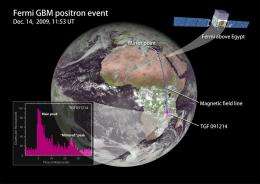
On Dec. 14, 2009, while NASA's Fermi flew over Egypt, the spacecraft intercepted a particle beam from a terrestrial gamma-ray flash (TGF) that occurred over its horizon. Fermi's Gamma-ray Burst Monitor detected the signal of positrons annihilating on the spacecraft -- not once, but twice. After passing Fermi, some of the particles reflected off of a magnetic "mirror" point and returned. Credit: NASA's Goddard Space Flight Center
(PhysOrg.com) -- Scientists using NASA's Fermi Gamma-ray Space Telescope have detected beams of antimatter produced above thunderstorms on Earth, a phenomenon never seen before.
Scientists think the antimatter particles were formed in a terrestrial gamma-ray flash (TGF), a brief burst produced inside thunderstorms and shown to be associated with lightning. It is estimated that about 500 TGFs occur daily worldwide, but most go undetected.
"These signals are the first direct evidence that thunderstorms make antimatter particle beams," said Michael Briggs, a member of Fermi's Gamma-ray Burst Monitor (GBM) team at the University of Alabama in Huntsville (UAH). He presented the findings Monday, during a news briefing at the American Astronomical Society meeting in Seattle.
This video is not supported by your browser at this time.
TGFs produce high-energy electrons and positrons. Moving near the speed of light, these particles travel into space along Earth's magnetic field.
Fermi is designed to monitor gamma rays, the highest energy form of light. When antimatter striking Fermi collides with a particle of normal matter, both particles immediately are annihilated and transformed into gamma rays. The GBM has detected gamma rays with energies of 511,000 electron volts, a signal indicating an electron has met its antimatter counterpart, a positron.Although Fermi's GBM is designed to observe high-energy events in the universe, it's also providing valuable insights into this strange phenomenon. The GBM constantly monitors the entire celestial sky above and the Earth below. The GBM team has identified 130 TGFs since Fermi's launch in 2008.
"In orbit for less than three years, the Fermi mission has proven to be an amazing tool to probe the universe. Now we learn that it can discover mysteries much, much closer to home," said Ilana Harrus, Fermi program scientist at NASA Headquarters in Washington.
The spacecraft was located immediately above a thunderstorm for most of the observed TGFs, but in four cases, storms were far from Fermi. In addition, lightning-generated radio signals detected by a global monitoring network indicated the only lightning at the time was hundreds or more miles away. During one TGF, which occurred on Dec. 14, 2009, Fermi was located over Egypt. But the active storm was in Zambia, some 2,800 miles to the south. The distant storm was below Fermi's horizon, so any gamma rays it produced could not have been detected.
"Even though Fermi couldn't see the storm, the spacecraft nevertheless was magnetically connected to it," said Joseph Dwyer at the Florida Institute of Technology in Melbourne, Fla. "The TGF produced high-speed electrons and positrons, which then rode up Earth's magnetic field to strike the spacecraft."
The beam continued past Fermi, reached a location, known as a mirror point, where its motion was reversed, and then hit the spacecraft a second time just 23 milliseconds later. Each time, positrons in the beam collided with electrons in the spacecraft. The particles annihilated each other, emitting gamma rays detected by Fermi's GBM.
This video is not supported by your browser at this time.
Interactions with matter can produce gamma rays and vice versa. So-called "bremsstrahlung" gamma rays result when high-energy electrons traveling close to the speed of light become deflected by passing near an atom or molecule. In pair production, a gamma ray passing through the electron shell of an atom transforms into two particles: an electron and its antimatter opposite, a positron.
Scientists long have suspected TGFs arise from the strong electric fields near the tops of thunderstorms. Under the right conditions, they say, the field becomes strong enough that it drives an upward avalanche of electrons. Reaching speeds nearly as fast as light, the high-energy electrons give off gamma rays when they're deflected by air molecules. Normally, these gamma rays are detected as a TGF.But the cascading electrons produce so many gamma rays that they blast electrons and positrons clear out of the atmosphere. This happens when the gamma-ray energy transforms into a pair of particles: an electron and a positron. It's these particles that reach Fermi's orbit.
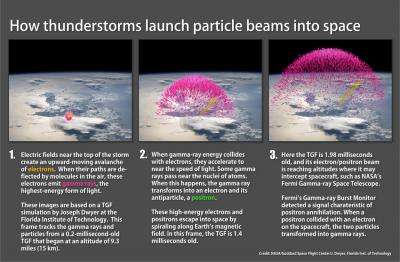
How thunderstorms launch particle beams into space. Credit: NASA's Goddard Space Flight Center/J. Dwyer, Florida Inst. of Technology
The detection of positrons shows many high-energy particles are being ejected from the atmosphere. In fact, scientists now think that all TGFs emit electron/positron beams. A paper on the findings has been accepted for publication in Geophysical Research Letters."The Fermi results put us a step closer to understanding how TGFs work," said Steven Cummer at Duke University. "We still have to figure out what is special about these storms and the precise role lightning plays in the process."
Provided by
JPL/NASA
-
From lemons to lemonade: Reaction uses carbon dioxide to make carbon-based semiconductor,
29 comments
-
Thioridazine kills cancer stem cells in human while avoiding toxic side-effects of conventional cancer treatments,
3 comments
-
SpaceX private rocket blasts off for space station (Update),
42 comments
-
Climate scientists say they have solved riddle of rising sea,
30 comments
-
Scotland passes turbine test to harness tidal power,
41 comments
-
More human population = greater mass?
May 25, 2012
-
Conversion from aircraft bearing to normal degrees
May 23, 2012
-
Interpretation/Analysis of the Lab results(HEPA filter)
May 22, 2012
-
Has anyone here attended the The Urbino Summer School in Paleoclimatology?
May 22, 2012
-
Earthquakes: Mag 6 N. Italy and Mag 5.6 W. Bulgaria
May 21, 2012
-
determining time frame for most recent geological layers
May 17, 2012
- More from Physics Forums - Earth
More news stories
SpaceX capsule has 'new car' smell, astronauts say (Update)
SpaceX's Dragon cargo vessel smells like a new car, said astronauts at the International Space Station after opening the hatches Saturday following the spacecraft's landmark mission to the orbiting lab.
Space & Earth / Space Exploration
10 hours ago |
4.5 / 5 (12) |
0
Australia hails surprise super-telescope decision
Australia has hailed a surprise decision giving it a role in a radio telescope project aimed at revolutionising astronomy, vowing to draw on its decades of experience in space science.
10 hours ago |
5 / 5 (2) |
0
Astronomers seize last chance in lifetime for Venus Transit
Astronomers are gearing for one the rarest events in the Solar System: an alignment of Earth, Venus and the Sun that will not be seen for another 105 years.
10 hours ago |
5 / 5 (1) |
0
Astronauts enter world's 1st private supply ship
(AP) -- Space station astronauts floated into the Dragon on Saturday, a day after its heralded arrival as the world's first commercial supply ship.
Space & Earth / Space Exploration
10 hours ago |
5 / 5 (5) |
0
Dragon arrives at space station in historic 1st (Update 2)
The privately bankrolled Dragon capsule made a historic arrival at the International Space Station on Friday, triumphantly captured by astronauts wielding a giant robot arm.
Space & Earth / Space Exploration
May 25, 2012 |
5 / 5 (10) |
16
Dell tablet leak: 10.1-inch display, two-battery choice
(Phys.org) -- Headline after headline talks about vendors tablets in the wings as likely number-one contenders for the iPad. Such claims have justifiably been taken with a grain of salt, considering ...
Scientist: Evolution debate will soon be history
(AP) -- Richard Leakey predicts skepticism over evolution will soon be history. Not that the avowed atheist has any doubts himself.
Keep food safety in mind this memorial day weekend
(HealthDay) -- Picnics, parades and cookouts are as much a part of Memorial Day weekend as tributes to the United States' war veterans.
SpotterRF debuts Radar Backpack Kit (w/ Video)
(Phys.org) -- SpotterRF has announced a special radar backpack kit designed to enhance situational awareness for soldiers on the ground. The company says its special radar is designed for warfighters as part ...
Thousands of shellfish found dead in Peru
Thousands of crustaceans were found dead off the coast of Lima following the mystery mass death of dolphins and pelicans, the Peruvian Navy said Friday.
Family history of Alzheimer's affects functional connectivity
(HealthDay) -- Cognitively normal individuals with a family history of late-onset Alzheimer's disease (AD) may display lower resting state functional connectivity in the default mode network (DMN) of the brain, ...

Jan 11, 2011
Rank: 4.8 / 5 (5)
Jan 11, 2011
Rank: 5 / 5 (10)
i hope spammers get hit by an anti-matter beam.
...need some anti-spam..
Jan 11, 2011
Rank: 4 / 5 (4)
This made me snort while laughing!
Jan 11, 2011
Rank: 4 / 5 (1)
Perhaps those extreme energy flashes we see every now and then out in the universe are other earthlike planets going through rough weather.
Jan 11, 2011
Rank: 2 / 5 (4)
Jan 11, 2011
Rank: 4.3 / 5 (4)
Don't know the answer, but it is a good question.
Compared to the total energy of a Tstorm, though, I suspect it would be a tiny fraction.
Jan 11, 2011
Rank: 5 / 5 (4)
Jan 12, 2011
Rank: not rated yet
Jan 12, 2011
Rank: 4 / 5 (4)
a normal Midwest summer storm is making antimatter beams..not just a odd particle or two but a beam into space..not something cooked up in a lab but in that thundercloud over my head---antimatter beams--
wonderful...
Jan 12, 2011
Rank: 5 / 5 (1)
If we can unlock the secret to make our own antimatter from this, then nothing can stop us from expanding outward in the Solar System. Perhaps we should aim Fermi to our own Sun to monitor for 511keV GRB's ?
Jan 12, 2011
Rank: not rated yet
Yes, my thought exactly. No more particle accelerators producing a handful of atoms a year, if they can reproduce this over-electrification in a laboratory, we could actually harvest them at experimentable amounts in less time.
Save we still can't contain them for long...
Jan 14, 2011
Rank: not rated yet
Jan 17, 2011
Rank: not rated yet
But I wonder if we will be able to not only make antimatter with this promising new phenomenon perhaps they can use the gamma rays and postrons and the heat from the reaction to create electricity.
Jan 18, 2011
Rank: not rated yet