Teen brains over-process rewards, suggesting root of risky behavior, mental ills
January 26, 2011

Pitt team finds teen brains over-process rewards, suggesting root of risky behavior, mental ills

Enlarge

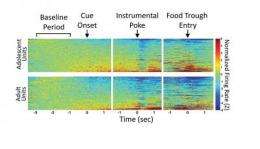
Each row represents the activity in a neuron at key times during the task. At the time of reward, nearly one-third of adolescent neurons became excited (shown in red) though the level of inhibition (in blue) changed marginally. Adult neurons registered much higher inhibitory activity and less excitation. Credit: B. Moghaddam

University of Pittsburgh researchers have recorded neuron activity in adolescent rat brains that could reveal the biological root of the teenage propensity to consider rewards over consequences and explain why adolescents are more vulnerable to drug addiction, behavioral disorders, and other psychological ills.

The team reports in the that electrode recordings of adult and brain-cell activity during the performance of a reward-driven task show that adolescent brains react to rewards with far greater excitement than adult brains. This frenzy of stimulation occurred with varying intensity throughout the study along with a greater degree of disorganization in adolescent brains. The brains of adult rats, on the other hand, processed their prizes with a consistent balance of excitation and inhibition.

The extreme difference in provides a possible physiological explanation as to why teenagers are more prone than adults to rash behavior, addiction, and mental diseases, said lead researcher Bita Moghaddam, a professor of neuroscience in Pitt's School of Arts and Sciences. She and coauthor David Sturman, a Pitt neuroscience doctoral student, observed the disparate reactions to reward in individual neurons in the orbitofrontal cortex, a brain region that weighs payoff and punishment to plan and make decisions.

"The disorganized and excess excitatory activity we saw in this part of the brain means that reward and other stimuli are processed differently by adolescents," Moghaddam said. "This could intensify the effect of reward on decision making and answer several questions regarding adolescent behavior, from their greater susceptibility to substance abuse to their more extreme reactions to pleasurable and upsetting experiences."

In addition, malfunctions in the orbitofrontal cortex have been observed in cases of schizophrenia, mood disorders, and other psychological disturbances, Moghaddam said. The type of erratic activity in the cortex that she and Sturman observed could aggravate these conditions at a time when the maturing brain is vulnerable.

"The symptoms of these illnesses generally begin to appear during adolescence," Moghaddam said. "Adolescence is a period of behavioral and psychiatric vulnerabilities, so the disorganized brain activity and excess excitation could push a brain already predisposed to mental disorders too far, triggering the onset of symptoms."
Pitt team finds teen brains over-process rewards, suggesting root of risky behavior, mental ills
Enlarge

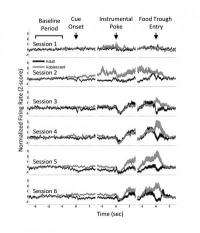
Adult and adolescent neural activity was similar at first. When a reward was expected (sessions 3-6), adolescent brain activity spiked, followed by a slow decrease after the sugar pellet was received (food trough entry). Adults experienced a similar rapid increase in activity followed by a quick return to baseline. Credit: B. Moghaddam

The study is the first to record and compare individual in adult and adolescent brains during the performance of a task. Moghaddam and Sturman presented adult and adolescent rats—which exhibit behavioral and biological similarities to adult and teenage humans—with three holes to poke their noses through; the rats each received a sugar pellet when they chose the center hole.

activity in the adolescents was similar to that of the adults most of the time but striking differences arose when the younger rats retrieved rewards. As each of the adult rats collected a sugar pellet, the neurons showed the normal increase in both excitation and inhibition, with consistent levels of each impulse throughout the study.

Adolescents, on the other hand, exhibited surges of excitation that ranged from twice to four times the levels in adults. At the same time, the inhibitory impulses in the adolescents' brains barely changed from the low levels they experienced before receiving the sugar pellet.

Provided by University of Pittsburgh

Filter


Move the slider to adjust rank threshold, so that you can hide some of the comments.


Display comments: newest first

GSwift7
Jan 26, 2011

Rank: 5 / 5 (1)
Teen brains over-process rewards


This is total BS. Prove to me that teens have brains and then we'll talk about how they work.
steveo_the_nuclear_scientist
Jan 26, 2011

Rank: 1 / 5 (1)
THEY COULD HAVE TOLD US THAT THEY WERE ACTUALLY STUDYING RAT BRAINS NOT HUMAN BRAINS. ARE RAT BRAINS REALLY THAT SIMILAR TO HUMAN BRAINS? I REALLY CANNOT IMAGINE THAT THEY ARE!! LOL
skybluskyblue
Jan 26, 2011

Rank: not rated yet
"I REALLY CANNOT IMAGINE THAT THEY ARE!! LOL" You must be a teenager. lol
Lack of imagination about negative material seems to fit the study fine.
ormondotvos
Jan 27, 2011

Rank: not rated yet
Gee, you think some sort of parental discipline and training in suppression of impulsive behavior might be in order here?

Nah, forget it. The helicopter moms would drop bombs on ya...
Rank 5 /5 (1 vote)
Relevant PhysicsForums posts
  • Potential Breakthrough in Seizure Control
    created15 hours ago
  • Popping/Cracked sternum.
    created19 hours ago
  • Which Mental Illness Encompasses This Problem?
    created20 hours ago
  • A question about drug tolerance
    createdMay 23, 2012
  • Poor nutrition leading to overeating?
    createdMay 23, 2012
  • Math and dyslexia?
    createdMay 21, 2012
  • More from Physics Forums - Medical Sciences

More news stories

Keep food safety in mind this memorial day weekend

(HealthDay) -- Picnics, parades and cookouts are as much a part of Memorial Day weekend as tributes to the United States' war veterans.

Medicine & Health / Health

created 23 minutes ago | popularity not rated yet | comments 0

Family history of Alzheimer's affects functional connectivity

(HealthDay) -- Cognitively normal individuals with a family history of late-onset Alzheimer's disease (AD) may display lower resting state functional connectivity in the default mode network (DMN) of the brain, ...

Medicine & Health / Alzheimer's disease & dementia

created 9 hours ago | popularity not rated yet | comments 0

Transvaginal mesh op restores pelvic organ prolapse at price

(HealthDay) -- Transvaginal mesh (TVM) procedures are effective for anatomical restoration of pelvic organ prolapse (POP), but patients report a worsening of sexual function following surgery, according to ...

Medicine & Health / Other

created 9 hours ago | popularity not rated yet | comments 0

Travel to high altitudes tied to Crohn's, colitis flare-ups

(HealthDay) -- People with inflammatory bowel disease, which includes Crohn's disease and colitis, may be at increased risk for flare-ups when they fly or travel to high altitudes for skiing or mountain climbing, ...

Medicine & Health / Inflammatory disorders

created 10 hours ago | popularity not rated yet | comments 1 | with audio podcast

Of mice and mental models: Neuroscientific implications of risk-optimized behavior in the mouse

(Medical Xpress) -- Regardless of an organism’s biological complexity, every encephalized animal continuously makes under-informed behavioral choices that can have serious consequences. Despite its ubiquity, ...

Medicine & Health / Neuroscience

created May 25, 2012 | popularity not rated yet | comments 0 | with audio podcast feature


Dell tablet leak: 10.1-inch display, two-battery choice

(Phys.org) -- Headline after headline talks about vendors’ tablets in the wings as likely number-one contenders for the iPad. Such claims have justifiably been taken with a grain of salt, considering ...

Scientist: Evolution debate will soon be history

(AP) -- Richard Leakey predicts skepticism over evolution will soon be history. Not that the avowed atheist has any doubts himself.

SpaceX capsule has 'new car' smell, astronauts say (Update)

SpaceX's Dragon cargo vessel smells like a new car, said astronauts at the International Space Station after opening the hatches Saturday following the spacecraft's landmark mission to the orbiting lab.

SpotterRF debuts Radar Backpack Kit (w/ Video)

(Phys.org) -- SpotterRF has announced a special radar backpack kit designed to enhance situational awareness for soldiers on the ground. The company says its special radar is designed for warfighters as part ...

Australia hails surprise super-telescope decision

Australia has hailed a surprise decision giving it a role in a radio telescope project aimed at revolutionising astronomy, vowing to draw on its decades of experience in space science.

Thousands of shellfish found dead in Peru

Thousands of crustaceans were found dead off the coast of Lima following the mystery mass death of dolphins and pelicans, the Peruvian Navy said Friday.