Supercomputer unravels structures in DVD materials
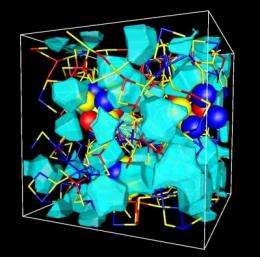
Although the storage of films and music on a DVD is part of our digital world, the physical basis of the storage mechanism is not understood in detail. In the current issue of the leading journal Nature Materials, researchers from Jülich, Finland, and Japan provide insight into the read and write processes in a DVD. This knowledge should enable improved storage materials to be developed.
Information is stored in a DVD in the form of microscopic bits (each less than 100 nanometres in size) in a thin layer of a polycrystalline alloy containing several elements. The bits can have a disordered, amorphous or an ordered, crystalline structure. The transition between the two phases lasts only a few nanoseconds and can be triggered by a laser pulse. Common alloys for storage materials such as DVD-RAMs or Blu-ray Discs contain germanium (Ge), antimony (Sb) und tellurium (Te) and are known as GST after the initials of the elements. The most popular alloys for DVD-RW are AIST alloys, which contain small amounts of silver (Ag) and indium (In) as well as antimony (Sb) and tellurium (Te).
"Both alloy families contain antimony and tellurium and appear to have much in common, but the phase change mechanisms are quite different", explains Dr. Robert Jones of Forschungszentrum Julich, who has collaborated with an international team on the problem. In addition to experimental data and x-ray spectra from the Japanese synchrotron SPring-8, the world's most powerful x-ray source, the team used extensive simulations on the Jülich supercomputer JUGENE. The combination of experiment and simulations has enabled the structures of both phases to be determined for the first time and allowed the development of a model to explain the rapid phase change.
The phase change in AIST alloys proceeds from the outside of the bit, where it adjoins the crystalline surroundings, towards its interior. In Nature Materials, the team explains this using a "bond exchange model", where the local environment in the amorphous bit is changed by small movements of an antimony atom (see figure). A sequence of many such steps results in reorientation (crystallization), without requiring empty regions or large motions. The antimony atoms, stimulated by the laser pulse, have simply exchanged the strengths of the bonds to two neighbours, hence the name "bond exchange" model.
The team had clarified the phase transition in GST materials in earlier work (DOI: 10.1103/PhysRevB.80.020201). Here the amorphous bit crystallizes via nucleation, i.e. small crystallites formed in the interior grow rapidly until they covered the whole bit. The speed of the transition can be explained by observing that amorphous and crystalline phases contain the same structural units, "ABAB" rings. These four-membered rings contain two germanium or antimony atoms (A) and two tellurium atoms (B) and can rearrange in the available empty space without breaking many atomic bonds.
The calculation of the structure of amorphous AIST is the largest yet performed in this area of research, with simulations of 640 atoms over the comparatively long time of several hundred picoseconds. Some 4000 processors of the Julich supercomputer JUGENE were used for over four months in order to obtain the necessary precision. In addition to sheer computing power, however, experience in scientific computing and the simulation of condensed matter is essential. Jones notes: "Forschungszentrum Jülich is one of the few places where all these aspects come together."
The deeper theoretical understanding of the processes involved in writing and erasing a DVD should aid the development of phase change storage media with longer life, larger capacity, or shorter access times.
More information:
Experimentally constrained density-functional calculations of the amorphous structure of the prototypical phase-change material Ge2Sb2Te5
Phys. Rev. B 80, 020201(R) (2009); DOI: 10.1103/PhysRevB.80.020201
Structure of liquid phase change material AgInSbTe from density functional/molecular dynamics simulations
Appl. Phys. Lett. 94, 251905 (2009); DOI:10.1063/1.3157166
Structure of amorphous Ge8Sb2Te11: GeTe-Sb2Te3 alloys and optical storage
Phys. Rev. B 79, 134118 (2009); DOI: 10.1103/PhysRevB.79.134118
Structural phase transitions on the nanoscale: The crucial pattern in the phase change materials Ge2Sb2Te5 and GeTe
Phys. Rev. B 76, 235201 (2007); DOI: 10.1103/PhysRevB.76.235201
Provided by Helmholtz Association of German Research Centres


