Summer fallow stores water in central great plains
January 12, 2011 By Don Comis

Summer fallow stores water in central great plains

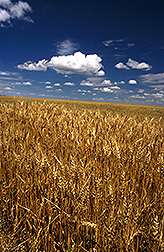
ARS researchers have calculated that storing just one inch of water in an acre of soil is worth $25 to $30 per acre to farmers in the Central Great Plains. Click the image for more information about it.

Storing just one inch of water in an acre of soil is worth $25 to $30 per acre. That gets the attention of Central Great Plains farmers served by U.S. Department of Agriculture (USDA) researchers.

Soil scientist Merle Vigil and his colleagues at the Agricultural Research Service (ARS) Central Great Plains Research Station at Akron, Colo., calculated this by using 10-year average crop prices in equations they developed to relate crop yields to stored water levels. ARS is USDA's principal intramural scientific research agency, and this research supports USDA's commitment to agricultural sustainability.

Four to six passes with various tillage equipment to kill weeds over 14 months of leaving land idle or fallow result in a loss of 3 acre-inches of water to evaporation. Those six passes also cost $24 to $48 an acre in fuel and labor costs. Add that to the cost of lost, and you have $99 to $138 an acre that never makes it into the farmers' pockets.

Plains farmers traditionally grow wheat only every other year, leaving fields fallow in between, because most years there isn't enough precipitation to grow wheat annually.

The scientists are approaching their 20th year of a major project determining which alternative crops farmers could add into a rotation with wheat to eliminate, or at least reduce the frequency of, fallow fields.

The scientists have shown that farmers can prevent much of that loss-and store more precipitation-just by eliminating tillage. And by combining no-till with intensive crop rotation management, can capture even more of the precious 14 to 18 inches of rain or snowmelt that may occur each year in various parts of the Central Plains.

Their tests of various crops showed that the most profitable rotation is growing no-till wheat one year and no-till millet the next. An economic analysis based on a hypothetical 160-acre farm showed this rotation could increase a farmer's net income by as much as $1,300 a year, compared to a no-till wheat-fallow rotation.

More information: Read more about this research in the January 2011issue of Agricultural Research magazine, available online at: http://www.ars.usd … ions0111.htm
This research was published in Agronomy Abstracts and presented at the 2010 annual meeting of the American Society of Agronomy, Crop Science Society of America, and Soil Science Society of America.

Provided by USDA Agricultural Research Service


Rank not rated yet
Relevant PhysicsForums posts

More news stories

Thousands of shellfish found dead in Peru

Thousands of crustaceans were found dead off the coast of Lima following the mystery mass death of dolphins and pelicans, the Peruvian Navy said Friday.

Biology / Ecology

created 8 hours ago | popularity 4.7 / 5 (3) | comments 4

It's in the genes: Research pinpoints how plants know when to flower

Scientists believe they've pinpointed the last crucial piece of the 80-year-old puzzle of how plants "know" when to flower.

Biology / Biotechnology

created 23 hours ago | popularity 3.9 / 5 (8) | comments 1 | with audio podcast

Researchers solve structure of human protein critical for silencing genes

In a study published in the journal Cell on May 24, Cold Spring Harbor Laboratory (CSHL) scientists describe the three-dimensional atomic structure of a human protein bound to a piece of RNA that "guides" the pr ...

Biology / Cell & Microbiology

created 23 hours ago | popularity 4.7 / 5 (7) | comments 0 | with audio podcast

More plant species responding to global warming than previously thought

(Phys.org) -- Far more wild plant species may be responding to global warming than previous large-scale estimates have suggested.

Biology / Ecology

created May 22, 2012 | popularity 4.6 / 5 (14) | comments 18 | with audio podcast

Totally rad: Scientists create rewritable digital data storage in DNA

(Phys.org) -- Scientists from Stanford's Department of Bioengineering have devised a method for repeatedly encoding, storing and erasing digital data within the DNA of living cells.

Biology / Biotechnology

created May 21, 2012 | popularity 4.9 / 5 (15) | comments 11 | with audio podcast


SpotterRF debuts Radar Backpack Kit (w/ Video)

(Phys.org) -- SpotterRF has announced a special radar backpack kit designed to enhance situational awareness for soldiers on the ground. The company says its special radar is designed for warfighters as part ...

Australia hails surprise super-telescope decision

Australia has hailed a surprise decision giving it a role in a radio telescope project aimed at revolutionising astronomy, vowing to draw on its decades of experience in space science.

Astronomers seize last chance in lifetime for Venus Transit

Astronomers are gearing for one the rarest events in the Solar System: an alignment of Earth, Venus and the Sun that will not be seen for another 105 years.

SpaceX capsule has 'new car' smell, astronauts say

SpaceX's Dragon cargo vessel smells like a new car, said astronauts at the International Space Station after opening the hatches Saturday following the spacecraft's landmark mission to the orbiting lab.

Family history of Alzheimer's affects functional connectivity

(HealthDay) -- Cognitively normal individuals with a family history of late-onset Alzheimer's disease (AD) may display lower resting state functional connectivity in the default mode network (DMN) of the brain, ...

High-speed method to aid search for solar energy storage catalysts

Eons ago, nature solved the problem of converting solar energy to fuels by inventing the process of photosynthesis.