Research shows when stem cell descendants lose their versatility
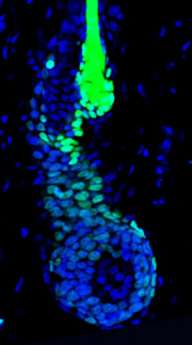
(PhysOrg.com) -- Stem cells are the incomparably versatile progenitors of every cell in our body. Some maintain this remarkable plasticity throughout the life of an animal, prepared to respond as needed to repair an injury, for instance. Others differentiate into specialized cells, regenerating tissue or facilitating some other process before dying. Now new research from Rockefeller University defines the point at which hair follicle stem cells abandon their trademark versatility, or “stemness,” having left their niche to make new hairs. It also shows how these fated stem cell descendants then regulate the activity of their forebears.
“We and others have been focusing on what mobilizes stem cells to make tissue,” says Elaine Fuchs, Rebecca C. Lancefield Professor and head of the Laboratory of Mammalian Cell Biology and Development. “However, it is just as important for stem cells to know when to stop the process, which is what we’ve found here.”
The researchers, led by Ya-Chieh Hsu, a postdoctoral associate in Fuchs’ lab, focused on mouse hair follicles, which undergo cyclical bouts of growth, destruction and rest, a process requiring the activation of stem cells. Stem cells are usually inactive, at rest in their niche, but when activated, they proliferate and leave that niche to make new hairs. In the new research, published last week by Cell, the researchers drilled down on this cycle, defining the point at which activated stem cells become irreversibly committed to becoming the specialized cells needed to grow hair.
Through gene expression analysis and experiments designed to test the cells’ function at different stages in the cycle, the researchers show that early stem cell descendents can retain their stemness and return back to their niche when hair growth stops. In fact, even after their proliferating descendants irreversibly lose their stemness, some can still find their way back to the niche, where they continue to serve two primary purposes: they hold the hairs tightly in place to prevent hair loss, and they release inhibitory signals that prevent the stem cells from activating too early.
“This study shows that committed stem cell descendents transmit inhibitory signals back to the stem cells and return them to a dormant state,” says Fuchs, who is also a Howard Hughes Medical Insititute investigator. “The finding gives us new insights into why our spurts of hair growth are followed by a resting period. For many tissues of the body, such negative feedback loops could provide the necessary signals to prevent tissue overgrowth.”
These findings is work represents a new concept in stem cell biology — that an irreversibly committed cell that is downstream in a stem cell lineage can become an essential regulator of stem cells, the researchers say. In other words, the children tell the parents how to behave. “In many systems, stem cells and their differentiated progeny coexist in close proximity,” Hsu says. “The ability of the progeny to regulate stem cell activity could be a general but previously unrecognized phenomenon which enables stem cells to know when to stop making tissue.”
More information: Cell 144: 92–105 (January 7, 2011), Dynamics between Stem Cells, Niche, and Progeny in the Hair Follicle. Ya-Chieh Hsu, et al. www.cell.com/abstract/S0092-8674(10)01371-1
Provided by Rockefeller University


