Solar panels track the sun for more efficiency
January 31, 2011

Solar panels track the sun for more efficiency

Enlarge

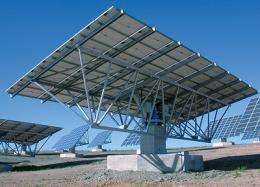
Photovoltaic modules equipped with a moveable mounting and a new control system from Siemens are able to precisely follow the course of the sun. Thanks to a new algorithm based on astronomical data, the solar panels track the sun in line with not only the time of day but also the time of year and the precise geographical location of the photovoltaic installation. As a result, their energy yield is more than 35 percent higher than fixed systems.

A decisive factor in the of a is the angle of incidence at which sunlight strikes the surface of the module. In the case of fixed panels, sunlight hits the at an oblique angle for most of the day. A maximum yield in terms of energy and therefore is only achieved when sunlight strikes the cells perpendicular to their surface. So the obvious solution is to fit the solar modules to a movable tracking system that precisely follows the course of the sun. The sun’s position depends on not only the time of day but also the time of year and the location of the photovoltaic installation. The Simatic S7-1200 control system from therefore calculates the perfect alignment for the solar modules on the basis of their precise location, anywhere in the world, and the exact time and date.

This calculation is based on the “Simatic Library for Solar Position Algorithm,” which is stored in every control unit. Siemens obtained a license for the very precise from the National Renewable Energy Laboratory (NREL) in the U.S. On this basis, the control system is able to determine the position of the sun to an accuracy of 0.0003° and align the photovoltaic module accordingly. Three-phase AC motors power a dual-axis tracking system: This swivels the module in a semicircle along the azimuthal axis, thus tracking the sun’s daily course from east to west, and tilts the module along the zenithal axis, tracking the height of the according to the time of day and year. In the process, the control system also prevents neighboring modules from overshadowing one another during the morning and evening hours, when shadows are especially long. The software bases its astronomical calculations on parameters such as longitude, latitude, and the exact time.

In addition, the control system can also take weather conditions into account. When faced with high winds, for example, it moves the modules to a position of least resistance, where they can withstand winds of up to 130 kilometers per hour. In a similar manner, the tracking system can be programmed to react to snow, thunderstorms, fog, and darkness.

Source: Siemens

Filter


Move the slider to adjust rank threshold, so that you can hide some of the comments.


Display comments: newest first

Eikka
Jan 31, 2011

Rank: 5 / 5 (1)
A very simple analog circuit with feedback would be able to track the sun automatically by following a bunch of light dependent resistors.

No need to know where the sun will be in a minute, because the robot will automatically point towards the direction where there's more light.

And you only have to control one axis, because the other axis follows a 24 hour cycle anyways.
semmsterr
Jan 31, 2011

Rank: not rated yet
A very simple analog circuit with feedback would be able to track the sun automatically by following a bunch of light dependent resistors.

No need to know where the sun will be in a minute, because the robot will automatically point towards the direction where there's more light.

And you only have to control one axis, because the other axis follows a 24 hour cycle anyways.

...remember the part about the wind and storms etc.
geokstr
Jan 31, 2011

Rank: 1 / 5 (1)
I wonder if they've calculated whether the electricity required to continuously move the panels during the day and return them to their starting position to be ready for the dawn, vs the added electricity gained from this process, results in a net gain or not? The article doesn't say whether the 35% increase is net or gross.
VOR
Jan 31, 2011

Rank: 1 / 5 (1)
I wonder if they've calculated whether the electricity required to continuously move the panels during the day and return them to their starting position to be ready for the dawn..."

You should've known that a properly balanced and well-designed carriage would use a minimal amount of power. Of course the net gain far outways the useage. The useage would be higher when a certain amount of wind is present, but it depends on how cleverly they design it. For example it might not
hurt the output for it to be able to lock for a while then move, etc, cutting down on the power needed to hold it, especially against a breeze.
or it could just be geared to resist- 'fighting' wind power here lol.
RealScience
Jan 31, 2011

Rank: 5 / 5 (2)
Eikka - the astronomical tracking also allows the system to be ready when the sun breaks out from the clouds.
The other axis also follows a 24-hour cycle only with a 'polar axle' tracker (also called a daily/seasonal tracker). Both axes can be clockwork with this axle (Google 'brant axle nasa' for a great example).

Geokstr - the motors on a two-axis track consume very little power because the system moves slowly. Typically the parasitic loss for the motors is around 0.1%.

VOR - correct for the flat panels shown. CPV (which in general requires trackers) needs to keep tracking the sun to be productive.
geokstr
Feb 01, 2011

Rank: not rated yet
You should've known that a properly balanced and well-designed carriage would use a minimal amount of power.

I sincerely apologize and abjectly prostrate myself before your almighty knowledge, and should understand humbly that I must aspire to be as brilliant as yourself in all areas of science and engineering so I don't have to waste the oh so valuable time of someone so far above me by asking questions.

VOR - I'm laughing at the "superior intellect".

As a matter of fact, I didn't major in engineering only because I hate trains.

RealScience, I appreciate your civil and informative response to my question which was apparently way to dumb for the likes of some others.
Rank 5 /5 (3 votes)
Relevant PhysicsForums posts

More news stories

SpotterRF debuts Radar Backpack Kit (w/ Video)

(Phys.org) -- SpotterRF has announced a special radar backpack kit designed to enhance situational awareness for soldiers on the ground. The company says its special radar is designed for warfighters as part ...

Technology / Hi Tech & Innovation

created 7 hours ago | popularity 5 / 5 (2) | comments 7 | with audio podcast report

Yahoo kills 'Livestand' just 6 months after debut

(AP) -- Yahoo is killing a tablet magazine called Livestand just six months its debut on the iPad.

Technology / Business

created 22 hours ago | popularity not rated yet | comments 1

Yahoo! ditches digital newsstand for iPads

Yahoo! shuttered its fledgling digital newsstand for iPads on Friday in what it said was the start of a product purge intended to make the floundering Internet pioneer more nimble.

Technology / Internet

created 23 hours ago | popularity not rated yet | comments 0

Probability of contamination from severe nuclear reactor accidents is higher than expected: study

Catastrophic nuclear accidents such as the core meltdowns in Chernobyl and Fukushima are more likely to happen than previously assumed. Based on the operating hours of all civil nuclear reactors and the number ...

Technology / Energy & Green Tech

created May 22, 2012 | popularity 3.4 / 5 (17) | comments 49 | with audio podcast

Delphi gasoline-injection engine technique rivals hybrid's edge

(Phys.org) -- Running a diesel like engine on gasoline is something Delphi is doing in notable fashion. They claim they are on to a promising way to enjoy an engine that gives the vehicle owner high efficiency ...

Technology / Energy & Green Tech

created May 21, 2012 | popularity 4.6 / 5 (17) | comments 33 | with audio podcast report


Australia hails surprise super-telescope decision

Australia has hailed a surprise decision giving it a role in a radio telescope project aimed at revolutionising astronomy, vowing to draw on its decades of experience in space science.

Astronomers seize last chance in lifetime for Venus Transit

Astronomers are gearing for one the rarest events in the Solar System: an alignment of Earth, Venus and the Sun that will not be seen for another 105 years.

Thousands of shellfish found dead in Peru

Thousands of crustaceans were found dead off the coast of Lima following the mystery mass death of dolphins and pelicans, the Peruvian Navy said Friday.

SpaceX capsule has 'new car' smell, astronauts say

SpaceX's Dragon cargo vessel smells like a new car, said astronauts at the International Space Station after opening the hatches Saturday following the spacecraft's landmark mission to the orbiting lab.

Family history of Alzheimer's affects functional connectivity

(HealthDay) -- Cognitively normal individuals with a family history of late-onset Alzheimer's disease (AD) may display lower resting state functional connectivity in the default mode network (DMN) of the brain, ...

Astronauts enter world's 1st private supply ship

(AP) -- Space station astronauts floated into the Dragon on Saturday, a day after its heralded arrival as the world's first commercial supply ship.