Skeletons in the pre-Cambrian closet
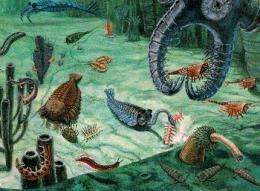
The Cambrian explosion marked a major blossoming in the tree of life around 540 million years ago. Nearly all of the major phyla in the animal kingdom appeared in a sudden burst of evolution. One of the drivers of this rapid diversification was likely the appearance of skeletal-bearing animals a mere 10 million years before. Researchers are studying these first skeletons to gain a better understanding of what led to their development.
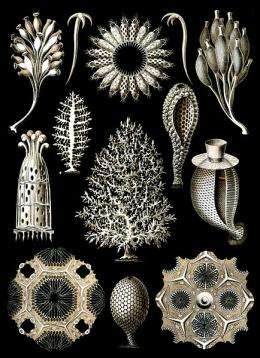
We have long taken for granted the benefit of a hard skeleton. Vertebrates like ourselves can grow large and nimble thanks to bones containing calcium and phosphorous. Mollusks and other animals are protected by shells made of calcium carbonate, whereas certain sponges construct an internal framework of silica to help them filter food.
"It is hard to imagine that life would have advanced very far without skeletons," says Shuhai Xiao from Virginia Tech.
The first instance of biomineralization – i.e. the biologic use of minerals – was around 2 billion years ago when certain bacteria precipitated grains of magnetite to apparently help orient themselves in the Earth's magnetic field. However, the first animal skeletons didn't appear until right before the Cambrian explosion, at the end of the Ediacaran Period.
These early shell-bearing creatures help to resolve Charles Darwin's concern over the sudden appearance of so many new animal species during the Cambrian explosion. The fossil record gives the impression of a "Creation" event, but in reality, animals had evolved prior to the explosion. They just didn't leave much for paleontologists to find until they developed the skeleton-making trait.
And once a few animals started building with minerals, a "housing boom" erupted across the animal kingdom. In order to understand the driving factors of this biomineralization event, Xiao and his colleagues are studying the first skeleton-builders at a unique site in China. They want to find out what kind of organisms these Pre-Cambrian organisms were, and whether they left any descendents. They will be doing this work with help from the NASA Astrobiology: Exobiology and Evolutionary Biology program.
First skeletons
Biomineralization is not the only way organisms can make hard, rigid structures. Trees rely on an organic polymer, lignin, to grow tall and strong. Some animals, like insects and crustaceans, use the glucose-derivative chitin to build their exoskeletons.
However, Xiao explains that biomineral skeletons give better mechanical support and are less expensive to produce than organic skeletons. Biominerals are basically absorbed from the environment, whereas organic molecules, like lignin and chitin, have to be chemically produced by the organism.
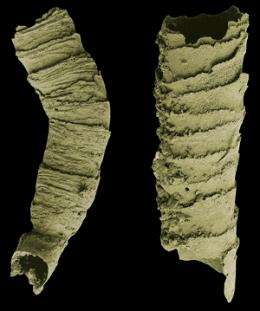
The oldest mineral skeletons were discovered in the 1970s. Some look like little sponges or goblets, but the majority of the fossils are tubes (like the nested cones of Cloudina) that one could imagine a worm or a coral calling home. Regardless of this resemblance, it's far from clear what kind of organisms these were.
To help figure this out, Xiao's group is examining the so-called Gaojiashan biota of the Dengying Formation in South China. This site, which spans 541 to 551 million years ago, is similar to other Ediacaran formations in Oman and Siberia, Xiao says. But it is special because the fossils are found in several different types of rock.
"This gives researchers several windows on how the specimens were preserved," says Susannah Porter of UC Santa Barbara, who is not involved in the present work.
There had been some uncertainty over whether Pre-Cambrian skeletons were just an artifact of the preservation process, but Xiao says they have ample evidence that at least some of these organisms employed biomineralization.
The tubular fossils in Xiao's samples are a few millimeters long and about one millimeter in diameter. Some of them show evidence of being deformed, implying that the original body part was flexible, not brittle like bone or shell. They may have therefore been a mixture of minerals and organic tissue.
The minerals have degraded over time, but researchers believe the original skeletons contained calcium carbonate. Xiao hopes their current work will determine exactly which crystal form of calcium carbonate (calcite or aragonite) was used. This is an important clue in identifying what sort of organism made the skeleton, since distinct groups of animals are often characterized by the type of biomineral they employ.
Whatever these first skeleton-makers were, they didn't stick around for very long. According to Porter, there's no evidence of them in the Cambrian. Furthermore, she doesn't believe they passed on their skeleton-making skills to any descendants, which implies biomineralization was "re-invented" a few million years later.
"Skeletons evolved more than three dozen times within animals -- and about half of these did so in the early Cambrian," Porter says.
What's striking about this is how rampant biomineralization became in a relatively short period of time. Skeletons turned into the "must-have" accessory, with different species utilizing entirely different minerals (mainly calcium carbonate, calcium phosphate and silica). The questions is: what drove so many organisms to develop the skeleton-forming trait?
First predation?
Some researchers believe animals co-opted biomineralization from a process completely unrelated to skeletal features. The theory is that biomineralization started out as a way to get rid of excess calcium or phosphorous, both of which can be toxic in too high of a concentration. Animals may have learned to sequester these minerals into separate structures, and then later found these "toxic waste dumps" might be useful.
"Once something is evolved, it can be recruited for other purposes," Xiao says.
However, the dominant view is that biomineralization was part of an evolutionary arms race driven by predation. As animals began feeding on other animals, protective body armor became a distinct advantage. This can explain why skeletons appear to have evolved independently across the biological spectrum during the Cambrian explosion.
One of the "first shots" fired in this arms race was discovered two decades ago in the Pre-Cambrian fossils from the same Dengying Formation that Xiao is studying. Many of the tubular skeletons have holes drilled into them, which were apparently made by some sort of predator. Xiao and his colleagues will be searching for more evidence that predation played a central role in the origins of biomineralization.
Have skeleton, will evolve
Whatever the exact reason, the appearance of skeletons in the Pre-Cambrian was just the beginning.
"It ignited the fuse for the Cambrian explosion, in which many skeletal animals diversified," Xiao says.
Body morphology was limited prior to biomineralization because animals couldn't grow very big without a skeleton, Xiao says. Pre-Cambrian biomineralization would have opened up a world of possibilities for evolution to explore.
"I wouldn't say biomineralization is necessarily a pre-requisite for advanced life," Porter says. But she agrees that the first skeletons marked a new page in biology, as well as geology. For example, minerals containing carbon, calcium and silicon show dramatic shifts in their properties following the Cambrian explosion, reflecting the fact that animals started to play an active role in how these elements cycled through the biosphere.
Xiao believes these sorts of geological imprints from biomineralization could provide a signature of past or present life on other planets.
Source: Astrobio.net


