Sedation successfully used to disentangle North Atlantic right whale
January 19, 2011

Sedation used successfully to disentangle North Atlantic right whale

Enlarge

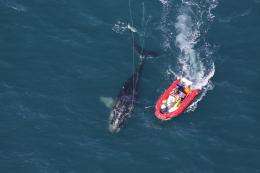
Scientists from NOAA Fisheries Service approaching the young North Atlantic right whale they disentangled on January 15 off the coast of Cape Canaveral, Fla. Credit: With permission from EcoHealth Alliance

Scientists from NOAA Fisheries Service and its state and nonprofit partners successfully used at-sea chemical sedation to help cut the remaining ropes from a young North Atlantic right whale on January 15 off the coast of Cape Canaveral, Fla. The sedative given to the whale allowed the disentanglement team to safely approach the animal and remove 50 feet of rope which was wrapped through its mouth and around its flippers.

This is only the second time a free-swimming whale has been successfully sedated to enable disentanglement efforts. The first time a whale was successfully sedated and disentangled was in March 2009 off the coast of Florida.

“Our recent progress with chemical sedation is important because it’s less stressful for the animal, and minimizes the amount of time spent working on these animals while maximizing the effectiveness of disentanglement operations,” said Jamison Smith, Atlantic Large Whale Disentanglement Coordinator for NOAA’s Fisheries Service. “This disentanglement was especially complex, but proved successful due to the detailed planning and collective expertise of the many response partners involved.”

The young female whale, born during the 2008-2009 calving season and estimated to be approximately 30 feet long, was originally observed entangled on Christmas Day by an aerial survey team. On December 30, a disentanglement team of trained responders from Georgia Department of Natural Resources and Florida Fish and Wildlife Conservation Commission were able to remove 150 feet of rope from the whale, but additional rope remained. NOAA and its partners continued to track the animal via satellite tag to determine if the animal would shed the remaining gear on its own. Calm weather conditions were necessary before attempting further intervention on January 15.

During this response, scientists used for the first time a special digital monitoring tag which recorded the whale’s behavior before, during, and after sedation. Sedating large at sea is in its infancy and data collected from the digital archival tag will be used to inform future sedation attempts that may be necessary. After disentangling the whale, scientists administered a dose of antibiotics to treat entanglement wounds and drug to reverse the sedation. The whale will be tracked up to 30-days via a temporary satellite tag.

The disentanglement and veterinarian team consisted of scientists from: NOAA Fisheries Service, Georgia Department of Natural Resources, Florida Fish and Wildlife Conservation Commission, Woods Hole Oceanographic Institution, University of Florida, EcoHealth Alliance, and Coastwise Consulting. The Provincetown Center for Coastal Studies and the New England Aquarium also provided offsite support.

Fishing gear removed from this whale included ropes and wire mesh material, similar to what is found in the trap or pot fisheries for fish, crab and lobster along the mid-Atlantic, northeast U.S., and Canadian coasts. However, the specific fishery and its geographic origin are pending examination by experts at NOAA’s Fisheries Service.

With only 300-400 in existence, North Atlantic right whales are among the most endangered whales in the world. They are protected under the U.S. Endangered Species Act of 1973 and the Marine Mammal Protection Act of 1972. Vessel strikes and entanglement in fixed fishing gear are the two greatest threats to their recovery.

Provided by NOAA

Filter


Move the slider to adjust rank threshold, so that you can hide some of the comments.


Display comments: newest first

jtdrexel
Jan 19, 2011

Rank: not rated yet
Thumbs up to the people who saved the whale!
Rank 5 /5 (1 vote)
Relevant PhysicsForums posts

More news stories

Thousands of shellfish found dead in Peru

Thousands of crustaceans were found dead off the coast of Lima following the mystery mass death of dolphins and pelicans, the Peruvian Navy said Friday.

Biology / Ecology

created 7 hours ago | popularity 4.7 / 5 (3) | comments 4

It's in the genes: Research pinpoints how plants know when to flower

Scientists believe they've pinpointed the last crucial piece of the 80-year-old puzzle of how plants "know" when to flower.

Biology / Biotechnology

created 22 hours ago | popularity 3.9 / 5 (8) | comments 1 | with audio podcast

Researchers solve structure of human protein critical for silencing genes

In a study published in the journal Cell on May 24, Cold Spring Harbor Laboratory (CSHL) scientists describe the three-dimensional atomic structure of a human protein bound to a piece of RNA that "guides" the pr ...

Biology / Cell & Microbiology

created 23 hours ago | popularity 4.7 / 5 (7) | comments 0 | with audio podcast

More plant species responding to global warming than previously thought

(Phys.org) -- Far more wild plant species may be responding to global warming than previous large-scale estimates have suggested.

Biology / Ecology

created May 22, 2012 | popularity 4.6 / 5 (14) | comments 18 | with audio podcast

Totally rad: Scientists create rewritable digital data storage in DNA

(Phys.org) -- Scientists from Stanford's Department of Bioengineering have devised a method for repeatedly encoding, storing and erasing digital data within the DNA of living cells.

Biology / Biotechnology

created May 21, 2012 | popularity 4.9 / 5 (15) | comments 11 | with audio podcast


SpotterRF debuts Radar Backpack Kit (w/ Video)

(Phys.org) -- SpotterRF has announced a special radar backpack kit designed to enhance situational awareness for soldiers on the ground. The company says its special radar is designed for warfighters as part ...

Australia hails surprise super-telescope decision

Australia has hailed a surprise decision giving it a role in a radio telescope project aimed at revolutionising astronomy, vowing to draw on its decades of experience in space science.

Astronomers seize last chance in lifetime for Venus Transit

Astronomers are gearing for one the rarest events in the Solar System: an alignment of Earth, Venus and the Sun that will not be seen for another 105 years.

SpaceX capsule has 'new car' smell, astronauts say

SpaceX's Dragon cargo vessel smells like a new car, said astronauts at the International Space Station after opening the hatches Saturday following the spacecraft's landmark mission to the orbiting lab.

Family history of Alzheimer's affects functional connectivity

(HealthDay) -- Cognitively normal individuals with a family history of late-onset Alzheimer's disease (AD) may display lower resting state functional connectivity in the default mode network (DMN) of the brain, ...

Astronauts enter world's 1st private supply ship

(AP) -- Space station astronauts floated into the Dragon on Saturday, a day after its heralded arrival as the world's first commercial supply ship.