Secrets of Swift's intimate letters revealed
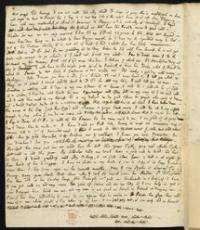
(PhysOrg.com) -- An Oxford University academic has applied digital image analysis to intimate letters sent simultaneously by Jonathan Swift to two women, with some surprising results.
Assisted by an FBI forensic document analyst, Dr Abigail Williams has found that the Anglican clergyman famous for writing sophisticated satires such as Gulliver's Travels and A Modest Proposal used a peculiar form of deletion to disguise his intimacies. Where some of Swift's most intimate lines have been crossed out, it has previously been thought that this was done by someone else - perhaps a censor – at a later date. But Dr Williams has claimed that it was Swift himself who scored through these lines.
Dr Abigail Williams of the Faculty of English Language and Literature has retranscribed and edited the letters from Jonathan Swift to two women (Esther Johnson and Rebecca Dingley), which constitute Swift's The Journal to Stella, as part of the Cambridge University Press edition of Swift's collected works for the first time. The original letters are held in the British Library.
Dr Williams, a Fellow at St Peter's College, said: ‘Swift had an intriguing life – he wrote classic and enduring satires about the religion and politics of his day, but they reveal little about his own feelings. These letters provide a window into his personal life which will fascinate anyone who has read the likes of Gulliver’s Travels or A Tale of Tub.
‘It is wonderful to be able to open these letters up to the general public in a new edition, and to be able to use modern technologies to reveal more of the text than has been visible before. The letters are written in a tiny, compressed hand, but with digital image analysis we can see more of Swift’s hidden words than ever before.
She added: ‘Until now, scholars thought that prudish eighteenth-century editors had crossed out the most intimate parts of Swift’s letters to preserve his reputation. What I have discovered is that Swift himself lightly crossed out those parts of the letters before he sent them. I think the effect was intended to be a kind of ‘now you see me, now you don’t’ guessing game with his readers. The women he was writing to needed to undress the text before they could fully enjoy it. This disguising of affectionate endearments is clearly part of a secret code of intimacy that characterises the Journal as a whole, which uses baby language and a series of special names to emphasise the closeness between Swift and his readers.’
Dr Williams has argued that the letters can only fully be understood if they are read out loud, because Swift developed a special baby language with which to address the two women. In this ‘little language’ he attempted to imitate the speech of small children by changing the consonants in familiar words. He writes ‘I expect a Rettle vely soon; & that MD is vely werr, and so Nite dee MD’ [I expect a letter very soon, and that my dears are very well, and so night dear my dears] or ‘I am sorry for poo poo ppt, pray walk hen oo can.’ [I am sorry for poor poor poppet, pray walk when you can].
Dr Williams' experience of her own small children’s speech has helped her to interpret some of the mysteries of Swift’s text. She explained: ‘If I am really struggling to understand a phrase, I ask my three year old son - who has an excellent lisp - to say it aloud for me!’
The Journal to Stella is also intriguing in terms of Swift’s relationship with its addressees. Dr Williams said: ‘The recipients of these letters were Stella, whose real name was Esther Johnson, and her living companion Rebecca Dingley – Swift addressed them collectively as ‘MD’.
‘He usually met the women together, and his contemporaries claimed that he was never once in his life alone in a room with Stella. However, since the eighteenth century, many scholars and readers of his works have also claimed that Stella and Swift were secretly married. Debate continues over whether that marriage was consummated or not.'
Dr Williams said: ‘What my edition will also show is that although the letters have traditionally been interpreted as letters from Swift to his beloved Stella, or Esther Johnson, the letters were actually intended to be read and interpreted by Rebecca Dingley, as well. Part of their sexual and emotional playfulness is related to this three-way readership. When he makes bawdy comments, as in a letter of February 1711, where he writes: ‘tis still terribly cold.- I wish my cold hand was in the warmest place about you, young women’, it is to shock or entertain them both at the same time. The evidence of my work suggests that even in these apparently personal and self revealing letters, intimacy is a complicated thing.’
Provided by Oxford University


