Scents latest weapons in fight against sea lamprey
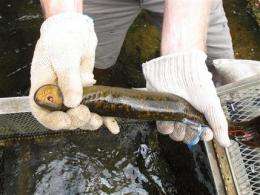
(AP) -- In the never-ending battle to prevent blood-sucking sea lamprey from wiping out some of the most popular fish species in the Great Lakes, biologists are developing new weapons that exploit three certainties in the eel-like parasites' lives: birth, sex and death.
Researchers are beginning the third and final year of testing lab-refined mating pheromones - scents emitted by male lampreys to attract females. They're also working on a mixture with the stench of rotting lamprey flesh, which live ones detest, and another that smells of baby lampreys, which adults love. If proven effective, the chemicals will be deployed across the region to steer the aquatic vermin to where they can be trapped or killed.
Early results appear promising. Yet no one expects the lures and repellents to finally rid the lakes of the despised invader and enable fisheries managers in the U.S. and Canada to end a battle that has cost more than $400 million over five decades. Especially when a single spawning female lays up to 60,000 eggs.
"When you have a large, open ecosystem like the Great Lakes and highly distributed, abundant organisms like sea lamprey, eradication is usually not an option," said Michael Wagner, a Michigan State University behavioral ecologist and member of the research team. "There's no technique that we could think of achieving that right now."
Instead, the goal is to keep their numbers low enough to prevent significant harm to the $7 billion Great Lakes fishing industry. The lamprey population has dropped by about 90 percent since researchers perfected a biocide in the late 1950s that kills lamprey but not other species. Yet they remain a constant threat and have rebounded whenever control measures have been relaxed.
"You've always got to be on guard," said Nick Johnson, a U.S. Geological Survey ecologist at the Hammond Bay Biological Station on the northwestern shore of Lake Huron.
Adult sea lampreys, which reach lengths of 2 to 3 feet, resemble eels but behave more like leeches. With round, disk-like mouths and sharp teeth, they latch onto fish and suck out their blood and other bodily fluids, killing or severely weakening the hosts.
Although native to the Atlantic, they can live in fresh water and migrated to the Great Lakes through shipping canals. By the late 1940s, the prolific invaders had decimated trout, whitefish and other sport and commercial species across the lakes.
The development of a poison called TFM eventually brought lamprey numbers sharply lower. TFM is applied in rivers, where lampreys spawn. Crews treat about 175 streams across the region on a rotating basis, said Mike Fodale, a supervisor with the U.S. Fish and Wildlife Service station in Marquette. Other control methods include placing barriers in streams to keep the lampreys from spawning areas and sterilizing up to 30,000 males a year before releasing them back into the wild, where they mate but produce no offspring.
The efforts make a big difference. But the price tag is steep - about $21 million a year - and lampreys continue taking their toll. About 15 percent of lake trout sampled at a Lake Huron research lab in Alpena have lamprey wounds, said biologist Jim Johnson of the Michigan Department of Natural Resources.
Lamprey predation has risen in Lake Michigan, Fodale said. That's where the pheromone applications come in. If biologists could guide spawning lampreys into streams baited with traps or treated with TFM, control programs would be more effective - and less of the expensive biocide might be needed.
To make the potions, scientists capture lampreys and keep them in tanks of water, where filters extract pheromones they have secreted. Other processes reduce the chemicals to potent concentrates.
Of those under development by the Hammond Bay Station team, the refined sex pheromone is furthest along. In tests, traps baited with the scents nabbed about 30 percent more lampreys than those without, said Johnson, the USGS ecologist. If the data is solid enough after more trials, scientists will ask the U.S. Environmental Protection Agency to certify the pheromone as the first ever to control populations of animals other than insects.
Work continues on other scents. Among them: a lure with the odor of larval lampreys, which could have the same effect as the sex pheromone, and the "necromone" that smells of death and could chase adults from untreated streams. The foul repellent could be particularly valuable because lampreys spawn in more than 430 Great Lakes streams and there isn't enough money or manpower to spread TFM in all of them.
Even if pheromones help reduce the lamprey population, the cost - and the fact that no end is in sight - should convey an urgent message as government agencies debate how to keep destructive Asian carp and other potential invaders out of the lakes, said Marc Gaden, spokesman for the Great Lakes Fishery Commission.
"We need to move heaven and earth to prevent new species from reaching us in the first place," Gaden said. "Yet we're barely more protected than when the lamprey came in. You could argue that with increased globalization, the Great Lakes have never been more vulnerable."
©2010 The Associated Press. All rights reserved. This material may not be published, broadcast, rewritten or redistributed.


