Physicists observe exotic state in an unconventional superconductor
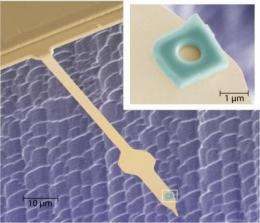
A new fractional vortex state observed in an unconventional superconductor may offer the first glimpse of an exotic state of matter predicted theoretically for more than 30 years. In a paper published in the January 14 issue of Science, University of Illinois physicists, led by Raffi Budakian, describe their observations of a new fractional vortex state in strontium ruthenium oxide (SRO). Such states may provide the basis for a novel form of quantum computing in which quantum information is encoded in the topological properties of a physical system.
"We've been on the trail of a state of matter called a half-quantum vortex for more than three years," said Budakian. "First proposed in the 1970s to exist in superfluid helium-3, a half-quantum vortex can be thought of as a 'texture' that arises from the spin phase of the superconducting order parameter."
Budukian's group investigated strontium ruthenium oxide (SRO), an unconventional superconductor that has been proposed as the solid-state analog of the A-phase of superfluid helium-3. Using state-of-the-art nanofabrication methods and exquisitely sensitive cantilever-based magnetometry techniques developed by the group, the researchers observed minute fluctuations in the magnetism of tiny rings of SRO.
"Strontium ruthenium oxide is a unique and fascinating material, and the half-quantum vortices that have been conjectured to exist in it are particularly interesting," said Anthony J. Leggett, the John D. and Catherine T. MacArthur Professor and Center for Advanced Study Professor of Physics, who shared the 2003 Nobel Prize in Physics for his work on superfluid helium-3. "It is believed that these half-quantum vortices in SRO may provide the basis for topological quantum computing. If this novel form of computing is eventually realized, this experiment will certainly be seen as a major milestone along the road there."
Budakian is an assistant professor of physics and a principal investigator in the Frederick Seitz Materials Research Laboratory at Illinois. Five years ago, he was instrumental in pioneering a technique, magnetic resonance force microscopy, to measure the force exerted on a micrometer-scale silicon cantilever by the spin of a single electron in a bulk material. He and his group have now adapted their ultrasensitive cantilever measurements to observe the magnetic behavior of SRO.
In the experiment, the researchers first fabricated a micron-sized ring of SRO and glued it to the tip of the silicon cantilever. How small are these rings? Fifty of them would fit across the width of a human hair. And the tips of the cantilevers are less than 2 μm wide.
"We take the high-energy physics approach to making these rings. First we smash the SRO, and then we sift through what's left," said Budakian.
The researchers first pulverize the large crystals of SRO into fragments, choose a likely micron-sized flake, and drill a hole in it using a focused beam of gallium ions. The resulting structure, which looks like a microscopic donut, is glued onto the sensitive silicon cantilever and then cooled to 0.4 degrees above absolute zero.
"Positioning the SRO ring on the cantilever is a bit like dropping one grain of sand precisely atop a slightly larger grain of sand," said Budakian, "only our 'grains of sand' are much smaller."
Budakian added that this technique is the first time such tiny superconducting rings have been fabricated in SRO.
Being able to make these rings is crucial to the experiment, according to Budakian, because the half-quantum vortex state is not expected to be stable in larger structures.
"Once we have the ring attached to the cantilever, we can apply static magnetic fields to change the 'fluxoid' state of the ring and detect the corresponding changes in the circulating current. In addition, we apply time-dependent magnetic fields to generate a dynamic torque on the cantilever. By measuring the frequency change of the cantilever, we can determine the magnetic moment produced by the currents circulating the ring," said Budakian.
"We've observed transitions between integer fluxoid states, as well as a regime characterized by 'half-integer' transitions," Budakian noted, "which could be explained by the existence of half-quantum vortices in SRO."
In addition to the advance in fundamental scientific understanding that Budakian's work provides, the experiment may be an important step toward the realization of a so-called "topological" quantum computer, as Leggett alluded.
Unlike a classical computer, which encodes information as bits whose values are either 0 or 1, a quantum computer would rely on the interaction among two-level quantum systems (e.g., the spins of electrons, trapped ions, or currents in superconducting circuits) to encode and process information. The massive parallelism inherent in quantal time evolution would provide rapid solutions to problems that are currently intractable, requiring vast amounts of time in conventional, classical machines.
For a functional quantum computer, the quantum bits or "qubits" must be strongly coupled to each other but remain sufficiently isolated from random environmental fluctuations, which cause the information stored in the quantum computer to decay—a phenomenon known as decoherence. Currently, large-scale, international projects are underway to construct quantum computers, but decoherence remains the central problem for real-world quantum computation.
According to Leggett, "A rather radical solution to the decoherence problem is to encode the quantum information nonlocally; that is, in the global topological properties of the states in question. Only a very restricted class of physical systems is appropriate for such topological quantum computing, and SRO may be one of them, provided that certain conditions are fulfilled in it. One very important such condition is precisely the existence of half-quantum vortices, as suggested by the Budakian experiment."
Provided by University of Illinois at Urbana-Champaign


