Mathematical model shows how groups split into factions
January 4, 2011 By Bill Steele
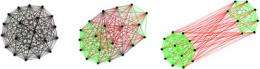
As changes in individual relationships spread through a group, eventually a split evolves.
(PhysOrg.com) -- The school dance committee is split; one group wants an "Alice in Wonderland" theme; the other insists on "Vampire Jamboree." Mathematics could have predicted it.
Social scientists have long argued that when under stress, social networks either end up all agreeing or splitting into two opposing factions. Either condition is referred to as "structural balance."
New Cornell research has generated a mathematical description of how this evolves. Previous mathematical approaches to structural balance have proven that when conditions are right, the result of group conflict will be a split into just two groups, the researchers said. The new work shows for the first time the steps through which friendships and rivalries shift over time and who ends up on each side.
This video is not supported by your browser at this time.
Watch the animation.
"Structural balance theory applies in situations where there's a lot of social stress -- gossip disparaging to one person, countries feeling pressure, companies competing -- where we need to make alliances and find our friends and enemies," said Cornell Ph.D. candidate Seth Marvel, lead author of a paper explaining the research published during the week of Jan. 3, 2011, in the online edition of the Proceedings of the National Academy of Sciences with co-authors Jon Kleinberg, the Tisch University Professor of Computer Science, Robert Kleinberg, assistant professor of computer science, and Steven Strogatz, the Jacob Gould Schurman Professor of Applied Mathematics.People may form alliances based on shared values, or may consider the social consequences of allying with a particular person, Marvel said. "The model shows that the latter is sufficient to divide a group into two factions," he said.
The model is a simple differential equation applied to a matrix, or grid of numbers, that can represent relationships between people, nations or corporations. The researchers tested their model on a classic sociological study of a karate club that split into two groups and got results that matched what happened in real life. They plugged in data on international relations prior to World War II and got almost perfect predictions on how the Axis and Allied alliances formed.
The smallest unit in such a network is a "relationship triangle," between, say, Bob and Carol and Ted, which can have four states:
- They're all good friends. That's a stable or "balanced" situation.
- Bob and Carol are friends, but neither gets along with Ted. That's also balanced.
- Bob and Carol dislike each other, but both are friends with Ted. Ted will try to get Bob and Carol together; he will either succeed or end up alienating one or both of his friends, so the situation is unbalanced and has a tendency to change.
- All three dislike each other. Various pairs will try to form alliances against the third, so this situation is also unbalanced.
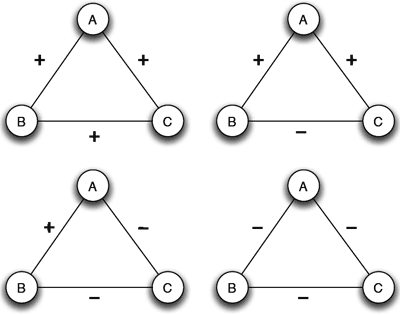
Social groups can be broken down to "relationship triangles" with four possibilities: A) A, B and C are mutual friends: balanced. B) A is friends with B and C, but they don't get along with each other: not balanced. C) A and B are friends with C as a mutual enemy: balanced. D) A, B, and C are mutual enemies: not balanced. Unbalanced triangles set off changes that spread through the group. From "Networks" by Jon Kleinberg and David Easley
Is there a way to avoid the mathematical certainty of a split, perhaps to make Republicans and Democrats in Congress less polarized? It depends on the initial conditions, Marvel said. The model shows that if the "mean friendliness" -- the average strength of connections across the entire network is positive, the system evolves to a single, all-positive pattern. "The model shows how to influence the result, but it doesn't tell you how to get there," Kleinberg cautioned.Marvel plans to test the model on other social networks, and perhaps work with psychologists to do lab experiments with human subjects. But he too cautions against leaning too heavily on the equations for practical advice. "This is a simple model and deterministic, and people aren't deterministic," he said.
The research was supported in part by the John D. and Catherine T. MacArthur Foundation, Google, the Yahoo! Research Alliance, a Microsoft Research New Faculty Fellowship, the Air Force Office of Scientific Research and the National Science Foundation.
Provided by
Cornell University
-
From lemons to lemonade: Reaction uses carbon dioxide to make carbon-based semiconductor,
28 comments
-
Thioridazine kills cancer stem cells in human while avoiding toxic side-effects of conventional cancer treatments,
3 comments
-
SpaceX private rocket blasts off for space station (Update),
41 comments
-
Climate scientists say they have solved riddle of rising sea,
30 comments
-
Scotland passes turbine test to harness tidal power,
41 comments
-
Limits
6 hours ago
-
Complex numbers: Why is the modulus of z...
8 hours ago
-
A close approximation for square root of 2.
18 hours ago
-
What are some interesting ways of proving the quadratic formula?
May 25, 2012
-
Punctuation in mathematical writing
May 25, 2012
-
Is there anything wrong with completing the square this way?
May 25, 2012
- More from Physics Forums - General Math
More news stories
Social welfare cuts ultimately come with heavy price, researchers say
(Phys.org) -- Slashing government funding for Medicaid, food stamps and other programs that serve the poor while politically popular with some lawmakers and many conservatives may do more harm ...
Other Sciences / Social Sciences
May 24, 2012 |
4.3 / 5 (12) |
99
Ancient Bethlehem seal unearthed in Jerusalem
Israeli archaeologists have discovered a 2,700-year-old seal that bears the inscription "Bethlehem," the Israel Antiquities Authority announced Wednesday, in what experts believe to be the oldest artifact ...
Other Sciences / Archaeology & Fossils
May 23, 2012 |
3.5 / 5 (14) |
22
Oldest Jewish archaeological evidence on the Iberian Peninsula
German archaeologists of the Friedrich Schiller University Jena found one of the oldest archaeological evidence so far of Jewish Culture on the Iberian Peninsula at an excavation site in the south of Portugal, ...
Other Sciences / Archaeology & Fossils
May 25, 2012 |
4.3 / 5 (4) |
12
Dollars and sense: Why are some people morally against tax?
As the U.S. presidential election campaigns heat up, the economic debate is dominated by bailouts, austerity and, inevitably, taxation. Now a new study published in Symbolic Interaction asks why tax is such an important issue ...
Other Sciences / Social Sciences
May 23, 2012 |
3 / 5 (2) |
12
Oldest art even older
New dates from Geißenklösterle Cave in Southwest Germany document the early arrival of modern humans and early appearance of art and music.
Other Sciences / Archaeology & Fossils
May 24, 2012 |
5 / 5 (2) |
6
SpotterRF debuts Radar Backpack Kit (w/ Video)
(Phys.org) -- SpotterRF has announced a special radar backpack kit designed to enhance situational awareness for soldiers on the ground. The company says its special radar is designed for warfighters as part ...
Australia hails surprise super-telescope decision
Australia has hailed a surprise decision giving it a role in a radio telescope project aimed at revolutionising astronomy, vowing to draw on its decades of experience in space science.
Astronomers seize last chance in lifetime for Venus Transit
Astronomers are gearing for one the rarest events in the Solar System: an alignment of Earth, Venus and the Sun that will not be seen for another 105 years.
Thousands of shellfish found dead in Peru
Thousands of crustaceans were found dead off the coast of Lima following the mystery mass death of dolphins and pelicans, the Peruvian Navy said Friday.
SpaceX capsule has 'new car' smell, astronauts say
SpaceX's Dragon cargo vessel smells like a new car, said astronauts at the International Space Station after opening the hatches Saturday following the spacecraft's landmark mission to the orbiting lab.
Family history of Alzheimer's affects functional connectivity
(HealthDay) -- Cognitively normal individuals with a family history of late-onset Alzheimer's disease (AD) may display lower resting state functional connectivity in the default mode network (DMN) of the brain, ...
Jan 04, 2011
Rank: 5 / 5 (1)
Jan 04, 2011
Rank: 4 / 5 (1)
I read that book "The Illusion of Conscious Will" that they referred to in the radiolab podcast (it was really good, and although the subject is difficult, the book was surprisingly easy to read and entertaining). The very next book I read was Taleb's Black Swan. I've come to a realization that what we call 'random' is really chaos. It's very possible nothing in our universe is random. We're just a big machine of equal and opposite reactions... and this probably includes human behavior. I also came to realize how little I know and how little the world knows.
Jan 04, 2011
Rank: 5 / 5 (2)
Jan 04, 2011
Rank: 3.7 / 5 (3)
Which reminds me of a saying I heard 50 years ago:
:-)