Malaria parasite caught red-handed invading blood cells
January 19, 2011

Malaria parasite caught red-handed invading blood cells

Enlarge

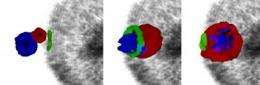
This image is a composite showing the behavior of different parts of the malaria parasite as it invades a red blood cell, at nanometer scales. The three components of the malaria parasite are labeled with fluorescent proteins (blue = parasite nucleus, red = secretory organelle, green = tight junction). The red blood cell is superimposed on the image for context. Image 1 (Attachment): The parasite is about to invade the red blood cell (unseen to the right of the picture). The tight junction (green) is like a window that the parasite brings with it and inserts into the red blood cell to gain entry. Image 2 (Invasion): This image is mid-invasion, the first time this step has even been visualized. The parasite "opens" the window it has inserted into the cell, and walks through. The secretory organelle (red) secretes its contents through the tight junction (green) and creates a vacuole which the parasite lives within in the red blood cell. In this image we see the parasite nucleus (blue) moving through the ‘window’ into the cell. Image 3 (Sealing): The parasite has completed invasion and is within a vacuole inside the host red blood cell. The window has been closed again, and will break down at a later stage. The parasite is now enclosed within its vacuole (red), the nucleus (blue) showing the parasite safely inside. Credit: David Riglar and Jacob Baum (Walter and Eliza Hall Institute) with support from Cynthia Whitchurch and Lynne Turnbull (University of Technology, Sydney).

Australian scientists using new image and cell technologies have for the first time caught malaria parasites in the act of invading red blood cells. The researchers, from the Walter and Eliza Hall Institute in Melbourne, Australia, and the University of Technology, Sydney (UTS), achieved this long-held aim using a combination of electron, light and super resolution microscopy, a technology platform new to Australia.

The detailed look at what occurs as the parasite burrows through the walls of red blood cells provides new insights into the molecular and cellular events that drive and may pave the way for developing new treatments for malaria. Institute researchers Dr Jake Baum, Mr David Riglar, Dr Dave Richard and colleagues from the institute's Infection and Immunity division led the research with colleagues from the i3 institute at UTS.

Dr Baum said the real breakthrough for the research team had been the ability to capture high-resolution images of the parasite at each and every stage of invasion, and to do so reliably and repeatedly. Their findings are published in today's issue of the journal Cell Host & Microbe.

"It is the first time we've been able to actually visualise this process in all its molecular glory, combining new advances developed at the institute for isolating viable parasites with innovative imaging technologies," Dr Baum said.

"Super resolution microscopy has opened up a new realm of understanding into how malaria parasites actually invade the human red blood cell. Whilst we have observed this miniature parasite drive its way into the cell before, the beauty of the new imaging technology is that it provides a quantum leap in the amount of detail we can see, revealing key molecular and cellular events required for each stage of the invasion process."

The imaging technology, called OMX 3D SIM super resolution microscopy, is a powerful new 3D tool that captures cellular processes unfolding at nanometer scales. The team worked closely with Associate Professor Cynthia Whitchurch and Dr Lynne Turnbull from the i3 institute at UTS to capture these images.

"This is just the beginning of an exciting new era of discoveries enabled by this technology that will lead to a better understanding of how microbes such as malaria, bacteria and viruses cause infectious disease," Associate Professor Whitchurch said.

Dr Baum said the methodology would be integral to the development of new malaria drugs and vaccines. "If, for example, you wanted to test a particular drug or vaccine, or investigate how a particular human antibody works to protect you from malaria, this imaging approach now gives us a window to see the actual effects that each reagent or antibody has on the precise steps of invasion," he said.

Malaria is caused by the Plasmodium parasite, which is transmitted by the bite of infected mosquitoes. Each year more than 400 million people contract malaria, and as many as a million, mostly children, die.

"Historically it has been very difficult to both isolate live and viable parasites for infection of and to employ imaging technologies sensitive enough to capture snapshots of the invasion process with these parasites, which are only one micron (one millionth of a metre) in diameter," Dr Baum said.

He said one of the most interesting discoveries the imaging approach revealed was that once the parasite has attached to the red blood cell and formed a tight bond with the cell, a master switch for invasion is initiated and invasion will continue unabated without any further checkpoints.

"The parasite actually inserts its own window into the cell, which it then opens and uses to walk into the cell, which is quite extraordinary," Dr Baum said. "Visually tracking the invasion of Plasmodium falciparum into a red blood cell is something I've been aiming at ever since I began at the Walter and Eliza Hall Institute in 2003; it's really thrilling to have reached that goal. This technology enables us to look at individual proteins that we always knew were involved in invasion, but we never knew what they did or where they were, and that, we believe, is a real leap for researchers worldwide."

Provided by Walter and Eliza Hall Institute


Rank 5 /5 (2 votes)
Relevant PhysicsForums posts
  • Potential Breakthrough in Seizure Control
    created12 hours ago
  • Popping/Cracked sternum.
    created17 hours ago
  • Which Mental Illness Encompasses This Problem?
    created17 hours ago
  • A question about drug tolerance
    createdMay 23, 2012
  • Poor nutrition leading to overeating?
    createdMay 23, 2012
  • Math and dyslexia?
    createdMay 21, 2012
  • More from Physics Forums - Medical Sciences

More news stories

Family history of Alzheimer's affects functional connectivity

(HealthDay) -- Cognitively normal individuals with a family history of late-onset Alzheimer's disease (AD) may display lower resting state functional connectivity in the default mode network (DMN) of the brain, ...

Medicine & Health / Alzheimer's disease & dementia

created 7 hours ago | popularity not rated yet | comments 0

Transvaginal mesh op restores pelvic organ prolapse at price

(HealthDay) -- Transvaginal mesh (TVM) procedures are effective for anatomical restoration of pelvic organ prolapse (POP), but patients report a worsening of sexual function following surgery, according to ...

Medicine & Health / Other

created 7 hours ago | popularity not rated yet | comments 0

Travel to high altitudes tied to Crohn's, colitis flare-ups

(HealthDay) -- People with inflammatory bowel disease, which includes Crohn's disease and colitis, may be at increased risk for flare-ups when they fly or travel to high altitudes for skiing or mountain climbing, ...

Medicine & Health / Inflammatory disorders

created 8 hours ago | popularity not rated yet | comments 1 | with audio podcast

Tongue analysis software uses ancient Chinese medicine to warn of disease

For 5,000 years, the Chinese have used a system of medicine based on the flow and balance of positive and negative energies in the body. In this system, the appearance of the tongue is one of the measures used to classify ...

Medicine & Health / Other

created 23 hours ago | popularity 1 / 5 (1) | comments 0 | with audio podcast

Of mice and mental models: Neuroscientific implications of risk-optimized behavior in the mouse

(Medical Xpress) -- Regardless of an organism’s biological complexity, every encephalized animal continuously makes under-informed behavioral choices that can have serious consequences. Despite its ubiquity, ...

Medicine & Health / Neuroscience

created May 25, 2012 | popularity not rated yet | comments 0 | with audio podcast feature


SpotterRF debuts Radar Backpack Kit (w/ Video)

(Phys.org) -- SpotterRF has announced a special radar backpack kit designed to enhance situational awareness for soldiers on the ground. The company says its special radar is designed for warfighters as part ...

Australia hails surprise super-telescope decision

Australia has hailed a surprise decision giving it a role in a radio telescope project aimed at revolutionising astronomy, vowing to draw on its decades of experience in space science.

Astronomers seize last chance in lifetime for Venus Transit

Astronomers are gearing for one the rarest events in the Solar System: an alignment of Earth, Venus and the Sun that will not be seen for another 105 years.

Thousands of shellfish found dead in Peru

Thousands of crustaceans were found dead off the coast of Lima following the mystery mass death of dolphins and pelicans, the Peruvian Navy said Friday.

SpaceX capsule has 'new car' smell, astronauts say

SpaceX's Dragon cargo vessel smells like a new car, said astronauts at the International Space Station after opening the hatches Saturday following the spacecraft's landmark mission to the orbiting lab.

High-speed method to aid search for solar energy storage catalysts

Eons ago, nature solved the problem of converting solar energy to fuels by inventing the process of photosynthesis.