Researchers demonstrating low-energy remediation with patented microbes
January 31, 2011

SRNL demonstrating low-energy remediation with patented microbes

Enlarge

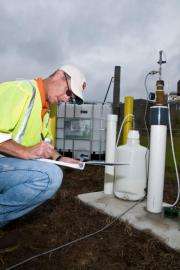
Savannah River National Laboratory personnel take readings at the site of the demonstration of MicroCED microbial consortium for natural cleanup of chlorinated solvents. Credit: Savannah River National Laboratory

Using funding provided under the American Reinvestment and Recovery Act, the U.S. Department of Energy's Savannah River National Laboratory has launched a demonstration project near one of the Savannah River Site's former production reactor sites to clean up chemically contaminated groundwater, naturally.

A portion of the subsurface at the Site's P Area has become contaminated with chlorinated that are essentially like dry-cleaning fluid. SRNL and Clemson University have patented a consortium of that have an appetite for that kind of material.

"If they are as effective as we expect in cleaning up the chemical contamination in the groundwater, it will be far cheaper than energy-intensive types of cleanup, such as pump-and-treat techniques or soil heating," said Mark Amidon, SRNL's project manager for the demonstration.

The mixture of microbes was found occurring naturally at SRS, where they were feeding on the same kind of chemical that was in groundwater seeping into an SRS creek. SRNL and Clemson University worked together on the discovery and characterization of the microbes. The mixture is called MicroCED, for "microbiological-based chlorinated ethene destruction," and when injected into the subsurface can completely transform lethal chlorinated ethenes to safe, nontoxic end products.

In P Area, the first step was to make groundwater conditions better for the microbes. "In late summer we injected more than 5,000 gallons of emulsified , buffering agents and amendments and 108,000 gallons of water to get the dissolved oxygen and acidity right," Amidon said. "Once the conditions were right, we started injecting the store of microbes we've been culturing." An initial application of 18 gallons of the microbes was recently injected to get things started. By the end of the demonstration, approximately 1,500 gallons of the microbes could be injected into the demonstration site.

Amidon estimated that it would take a year or more to see appreciable results. "You can't rush Mother Nature."

The current test site is about 100 by 120 feet at the surface and 85 to 100 feet below ground, and will be used to determine whether this approach should be used for full-scale treatment of the area. "If we were to go full-scale, there would be a 'biowall' about 1,000 feet long and between 50 and 145 feet below ground," Amidon said.

SRNL has been working in bioremediation for many years, using existing microorganisms as part of the strategy. The difference here is the culturing and injection of quantities of a specific mixture of microbes for use on chlorinated solvents. (Another SRNL invention, BioTiger, is a consortium of microbes used on petroleum contamination.)

Provided by Savannah River National Laboratory


Rank 5 /5 (1 vote)
Relevant PhysicsForums posts

More news stories

Thousands of shellfish found dead in Peru

Thousands of crustaceans were found dead off the coast of Lima following the mystery mass death of dolphins and pelicans, the Peruvian Navy said Friday.

Biology / Ecology

created 8 hours ago | popularity 4.7 / 5 (3) | comments 4

It's in the genes: Research pinpoints how plants know when to flower

Scientists believe they've pinpointed the last crucial piece of the 80-year-old puzzle of how plants "know" when to flower.

Biology / Biotechnology

created 23 hours ago | popularity 3.9 / 5 (8) | comments 1 | with audio podcast

Researchers solve structure of human protein critical for silencing genes

In a study published in the journal Cell on May 24, Cold Spring Harbor Laboratory (CSHL) scientists describe the three-dimensional atomic structure of a human protein bound to a piece of RNA that "guides" the pr ...

Biology / Cell & Microbiology

created 23 hours ago | popularity 4.7 / 5 (7) | comments 0 | with audio podcast

More plant species responding to global warming than previously thought

(Phys.org) -- Far more wild plant species may be responding to global warming than previous large-scale estimates have suggested.

Biology / Ecology

created May 22, 2012 | popularity 4.6 / 5 (14) | comments 18 | with audio podcast

Totally rad: Scientists create rewritable digital data storage in DNA

(Phys.org) -- Scientists from Stanford's Department of Bioengineering have devised a method for repeatedly encoding, storing and erasing digital data within the DNA of living cells.

Biology / Biotechnology

created May 21, 2012 | popularity 4.9 / 5 (15) | comments 11 | with audio podcast


SpotterRF debuts Radar Backpack Kit (w/ Video)

(Phys.org) -- SpotterRF has announced a special radar backpack kit designed to enhance situational awareness for soldiers on the ground. The company says its special radar is designed for warfighters as part ...

Australia hails surprise super-telescope decision

Australia has hailed a surprise decision giving it a role in a radio telescope project aimed at revolutionising astronomy, vowing to draw on its decades of experience in space science.

Astronomers seize last chance in lifetime for Venus Transit

Astronomers are gearing for one the rarest events in the Solar System: an alignment of Earth, Venus and the Sun that will not be seen for another 105 years.

SpaceX capsule has 'new car' smell, astronauts say

SpaceX's Dragon cargo vessel smells like a new car, said astronauts at the International Space Station after opening the hatches Saturday following the spacecraft's landmark mission to the orbiting lab.

Family history of Alzheimer's affects functional connectivity

(HealthDay) -- Cognitively normal individuals with a family history of late-onset Alzheimer's disease (AD) may display lower resting state functional connectivity in the default mode network (DMN) of the brain, ...

High-speed method to aid search for solar energy storage catalysts

Eons ago, nature solved the problem of converting solar energy to fuels by inventing the process of photosynthesis.