LCD projector used to control brain, muscles of tiny organisms such as worms (w/ Video)
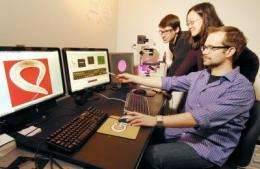
(PhysOrg.com) -- Researchers are using inexpensive components from ordinary liquid crystal display (LCD) projectors to control the brain and muscles of tiny organisms, including freely moving worms. Red, green and blue lights from a projector activate light-sensitive microbial proteins that are genetically engineered into the worms, allowing the researchers to switch neurons on and off like light bulbs and turn muscles on and off like engines.
Use of the LCD technology to control small animals advances the field of optogenetics -- a mix of optical and genetic techniques that has given researchers unparalleled control over brain circuits in laboratory animals. Until now, the technique could be used only with larger animals by placement of an optical fiber into an animal's brain, or required illumination of an animal's entire body.
A paper published Jan. 9 in the advance online edition of the journal Nature Methods describes how the inexpensive illumination technology allows researchers to stimulate and silence specific neurons and muscles of freely moving worms, while precisely controlling the location, duration, frequency and intensity of the light.
"This illumination instrument significantly enhances our ability to control, alter, observe and investigate how neurons, muscles and circuits ultimately produce behavior in animals," said Hang Lu, an associate professor in the School of Chemical & Biomolecular Engineering at the Georgia Institute of Technology.
Lu and graduate students Jeffrey Stirman and Matthew Crane developed the tool with support from the National Institutes of Health and the Alfred P. Sloan Foundation.
The illumination system includes a modified off-the-shelf LCD projector, which is used to cast a multi-color pattern of light onto an animal. The independent red, green and blue channels allow researchers to activate excitable cells sensitive to specific colors, while simultaneously silencing others.
"Because the central component of the illumination system is a commercially available projector, the system's cost and complexity are dramatically reduced, which we hope will enable wider adoption of this tool by the research community," explained Lu.
By connecting the illumination system to a microscope and combining it with video tracking, the researchers are able to track and record the behavior of freely moving animals, while maintaining the lighting in the intended anatomical position. When the animal moves, changes to the light's location, intensity and color can be updated in less than 40 milliseconds.
Once Lu and her team built the prototype system, they used it to explore the "touch" circuit of the worm Caenorhabditis elegans by exciting and inhibiting its mechano-sensory and locomotion neurons. Alexander Gottschalk, a professor in the Johann Wolfgang Goethe-University Frankfurt Institute of Biochemistry in Frankfurt, Germany, and his team provided the light-sensitive optogenetic reagents for the Georgia Tech experiments.
For their first experiment, the researchers illuminated the head of a worm at regular intervals while the animal moved forward. This produced a coiling effect in the head and caused the worm to crawl in a triangular pattern. In another experiment, the team scanned light along the bodies of worms from head to tail, which resulted in backward movement when neurons near the head were stimulated and forward movement when neurons near the tail were stimulated.
Additional experiments showed that the intensity of the light affected a worm's behavior and that several optogenetic reagents excited at different wavelengths could be combined in one experiment to understand circuit functions. The researchers were able to examine a large number of animals under a variety of conditions, demonstrating that the technique's results were both robust and repeatable.
"This instrument allowed us to control defined events in defined locations at defined times in an intact biological system, allowing us to dissect animal functional circuits with greater precision and nuance," added Lu.
While these proof-of-concept studies investigated the response of C. elegans to mechanical stimulation, the illumination system can also be used to evaluate responses to chemical, thermal and visual stimuli. Researchers can also use it to study a variety of neurons and muscles in other small animals, such as the zebrafish and fruit fly larvae.
"Experiments with this illumination system yield quantitative behavior data that cannot be obtained by manual touch assays, laser cell ablation, or genetic manipulation of neurotransmitters," said Lu.
More information: www.nature.com/nmeth/journal/v … full/nmeth.1555.html
Provided by Georgia Institute of Technology


