Kittiwakes' trans-Atlantic winter odyssey linked to breeding success
January 5, 2011

Kittiwakes' trans-Atlantic winter odyssey linked to breeding success

Enlarge

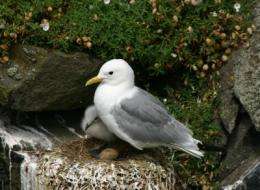
Kittiwake sits in its nest on the Isle of May NNR, Scotland. Credit: Mark Newell/Centre for Ecology & Hydrology

One of Britain's best known seabirds winters on opposite sides of the Atlantic depending on whether its breeding attempt has been successful according to new research published today in the journal Proceedings of the Royal Society B. The findings highlight previously unsuspected links between summer breeding performance and wintering distributions of kittiwakes.

The research team was led by Dr Maria Bogdanova from the Centre for Ecology & Hydrology (CEH) in conjunction with colleagues from CEH and the British Antarctic Survey (BAS).

The discovery of such patterns of segregated winter distributions is important for defining key wintering areas in declining species such as the kittiwake that are experiencing poor breeding seasons with increasing regularity.

The results show kittiwakes that experienced breeding failure left their colony earlier than successful breeders. Failed breeders then travelled over 3000km and wintered off Canada while their successful neighbours remained close to Britain. The two groups did not differ in the timing of return to the colony the following spring. However, over half the males from both groups made a previously undescribed long-distance journey out into the central Atlantic before the breeding season.
Kittiwakes' trans-Atlantic winter odyssey linked to breeding success
Enlarge

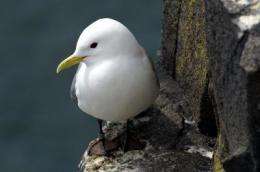
This is a kittiwake on the Isle of May, NNR, Scotland. Credit: Anke Addy

Lead author Dr Maria Bogdanova, an animal population ecologist at the Centre for Ecology & Hydrology, said, "Our results demonstrate important but previously poorly understood links between breeding performance and winter distribution, with significant implications for populations. It is fascinating that successful and unsuccessful pairs nesting only a few metres apart in the colony can be separated by thousands of kilometres in the winter."

This study used a tiny instrument (1.4g) known as a geolocator for tracking animal migration. During the 2007 breeding season, the team fitted 80 kittiwakes on the Isle of May NNR off the east coast of Scotland, with geolocators.

Geolocators were developed by BAS and have so far been used on animals such as geese, albatrosses, penguins and seals. They make regular recordings of light intensity, data which can be used to generate two geographical positions per day.

Co-author Francis Daunt, a seabird ecologist also from the Centre for Ecology & Hydrology said, "Kittiwakes have declined substantially in the last 25 years over much of their range. Conservation efforts to protect wintering grounds should consider that winter distributions may be shifting as failure is becoming more common."

Provided by Centre for Ecology & Hydrology


Rank not rated yet
Relevant PhysicsForums posts

More news stories

Thousands of shellfish found dead in Peru

Thousands of crustaceans were found dead off the coast of Lima following the mystery mass death of dolphins and pelicans, the Peruvian Navy said Friday.

Biology / Ecology

created 8 hours ago | popularity 4.7 / 5 (3) | comments 4

It's in the genes: Research pinpoints how plants know when to flower

Scientists believe they've pinpointed the last crucial piece of the 80-year-old puzzle of how plants "know" when to flower.

Biology / Biotechnology

created 23 hours ago | popularity 3.9 / 5 (8) | comments 1 | with audio podcast

Researchers solve structure of human protein critical for silencing genes

In a study published in the journal Cell on May 24, Cold Spring Harbor Laboratory (CSHL) scientists describe the three-dimensional atomic structure of a human protein bound to a piece of RNA that "guides" the pr ...

Biology / Cell & Microbiology

created 23 hours ago | popularity 4.7 / 5 (7) | comments 0 | with audio podcast

More plant species responding to global warming than previously thought

(Phys.org) -- Far more wild plant species may be responding to global warming than previous large-scale estimates have suggested.

Biology / Ecology

created May 22, 2012 | popularity 4.6 / 5 (14) | comments 18 | with audio podcast

Totally rad: Scientists create rewritable digital data storage in DNA

(Phys.org) -- Scientists from Stanford's Department of Bioengineering have devised a method for repeatedly encoding, storing and erasing digital data within the DNA of living cells.

Biology / Biotechnology

created May 21, 2012 | popularity 4.9 / 5 (15) | comments 11 | with audio podcast


SpotterRF debuts Radar Backpack Kit (w/ Video)

(Phys.org) -- SpotterRF has announced a special radar backpack kit designed to enhance situational awareness for soldiers on the ground. The company says its special radar is designed for warfighters as part ...

Australia hails surprise super-telescope decision

Australia has hailed a surprise decision giving it a role in a radio telescope project aimed at revolutionising astronomy, vowing to draw on its decades of experience in space science.

Astronomers seize last chance in lifetime for Venus Transit

Astronomers are gearing for one the rarest events in the Solar System: an alignment of Earth, Venus and the Sun that will not be seen for another 105 years.

SpaceX capsule has 'new car' smell, astronauts say

SpaceX's Dragon cargo vessel smells like a new car, said astronauts at the International Space Station after opening the hatches Saturday following the spacecraft's landmark mission to the orbiting lab.

Family history of Alzheimer's affects functional connectivity

(HealthDay) -- Cognitively normal individuals with a family history of late-onset Alzheimer's disease (AD) may display lower resting state functional connectivity in the default mode network (DMN) of the brain, ...

High-speed method to aid search for solar energy storage catalysts

Eons ago, nature solved the problem of converting solar energy to fuels by inventing the process of photosynthesis.