Japan rocket ferrying supplies to space station
January 22, 2011 By ERIC TALMADGE , Associated Press
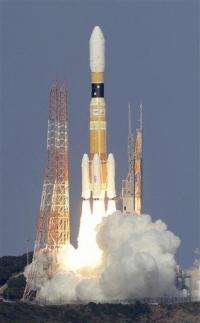
The H-2B Launch Vehicle No. 2 blasts off from the launching pad at Tanegashima Space Center on the southern Japanese island of Tanegashima on Saturday Jan. 22, 2011. The rocket carrying supplies for the International Space Station successfully lifted off from the remote island Saturday on a mission designed to help fill a hole left by the retirement of NASA's space shuttle program. (AP Photo/Kyodo News) JAPAN OUT, MANDATORY CREDIT, FOR COMMERCIAL USE ONLY IN NORTH AMERICA
(AP) -- A Japanese rocket carrying supplies for the International Space Station successfully lifted off from a remote island Saturday on a mission designed to help fill a hole left by the retirement of NASA's space shuttle program.
The unmanned rocket - Japan's second flight to the space station - was ferrying nearly 6 tons of food, water, clothing and experimental equipment to the astronauts in orbit aboard the international project involving 15 nations. The rocket also was carrying cargo for NASA.
After docking with the space station, dropping off its cargo and being loaded up with waste material, the rocket's transfer vehicle, named "Kounotori2," will be detached and burn itself up upon re-entering Earth's atmosphere. Kounotori means white stork in Japanese.
Applause broke out at the control center on Tanegashima Island as officials announced that the launch phase was a success. Tracking was switched to a center in Guam as the vehicle moved rapidly away from Japan.
Kounotori2 is expected to reach the space station on Jan. 27.
JAXA, Japan's space agency, hopes the project will help it build expertise for similar low-cost ferrying missions and push forward manned flights of Japan's own.
Cargo missions for the International Space Station have become more important now that the United States has scaled back its ability to launch supplies. Since 2009, the station has been manned by six astronauts, but keeping them fed and supplied has become a bigger challenge because of the retirement of the U.S. space shuttles.
NASA is linking up with commercial companies to launch future cargo expeditions.
JAXA officials say they are studying the possibility of reconfiguring the Kounotori vehicle - which is about the size of a large passenger bus - for manned flight.
Japan's space program has yet to attempt manned flight. Japan has a module attached to International Space Station that can be used by astronauts, but has relied on the United States to get them there. A Russian Soyuz is to take the next Japanese astronaut to the space station in May.
Japan sent cargo on its first unmanned carrier to the international station in 2009.
Money, more than technology, is generally seen as Japan's biggest hurdle.
JAXA's budget for last year was 180 billion yen ($2 billion), about one-fourteenth of what the U.S. spends on space exploration and less than half of what the EU spends, according to Japanese government estimates.
Even so, Japan boasts a reliable booster rocket in the domestically produced H-II series - the rocket used Saturday - and has been one of the leaders in launching satellites.
Still, its program in recent years has been marred by setbacks.
Last month, a Japanese probe to Venus failed to reach orbit. Officials said they have not completely given up hope and are trying to reprogram the probe to try again in another five - or if that fails six - years.
Japanese scientists had been hopeful of success with the Venus probe after the country brought a probe back from a trip to an asteroid.
Japan has never succeeded in an interplanetary mission. It launched a mission to Mars in 1998 that was plagued by technical glitches and finally abandoned in 2003. Russia, the United States and the Europeans have successfully explored other planets.
Japan has also been overshadowed in recent years by China, which sent its first astronaut into space in 2003 and carried out its first spacewalk in 2008.
©2010 The Associated Press. All rights reserved. This material may not be published, broadcast, rewritten or redistributed.
-
From lemons to lemonade: Reaction uses carbon dioxide to make carbon-based semiconductor,
28 comments
-
Thioridazine kills cancer stem cells in human while avoiding toxic side-effects of conventional cancer treatments,
3 comments
-
SpaceX private rocket blasts off for space station (Update),
41 comments
-
Climate scientists say they have solved riddle of rising sea,
30 comments
-
Scotland passes turbine test to harness tidal power,
41 comments
-
revamping general concept and cosmological principle
May 25, 2012
-
Transiting Exoplanet Light Curve
May 25, 2012
-
Math behind Theoretical Physics
May 24, 2012
-
Do we know whats at the center of galaxies yet?
May 23, 2012
-
Structure of the Milky Way?
May 20, 2012
-
What would it take to terraform Pluto and Charon?
May 19, 2012
- More from Physics Forums - General Astronomy
More news stories
Australia hails surprise super-telescope decision
Australia has hailed a surprise decision giving it a role in a radio telescope project aimed at revolutionising astronomy, vowing to draw on its decades of experience in space science.
8 hours ago |
5 / 5 (2) |
0
Astronomers seize last chance in lifetime for Venus Transit
Astronomers are gearing for one the rarest events in the Solar System: an alignment of Earth, Venus and the Sun that will not be seen for another 105 years.
8 hours ago |
5 / 5 (1) |
0
SpaceX capsule has 'new car' smell, astronauts say
SpaceX's Dragon cargo vessel smells like a new car, said astronauts at the International Space Station after opening the hatches Saturday following the spacecraft's landmark mission to the orbiting lab.
Space & Earth / Space Exploration
8 hours ago |
4.4 / 5 (10) |
0
Astronauts enter world's 1st private supply ship
(AP) -- Space station astronauts floated into the Dragon on Saturday, a day after its heralded arrival as the world's first commercial supply ship.
Space & Earth / Space Exploration
8 hours ago |
5 / 5 (3) |
0
Dragon makes history with space station docking
The private company SpaceX made history Friday with the docking of its Dragon capsule to the International Space Station, the most impressive feat yet in turning routine spaceflight over to the commercial ...
Space & Earth / Space Exploration
23 hours ago |
4.9 / 5 (9) |
0
SpotterRF debuts Radar Backpack Kit (w/ Video)
(Phys.org) -- SpotterRF has announced a special radar backpack kit designed to enhance situational awareness for soldiers on the ground. The company says its special radar is designed for warfighters as part ...
Thousands of shellfish found dead in Peru
Thousands of crustaceans were found dead off the coast of Lima following the mystery mass death of dolphins and pelicans, the Peruvian Navy said Friday.
Family history of Alzheimer's affects functional connectivity
(HealthDay) -- Cognitively normal individuals with a family history of late-onset Alzheimer's disease (AD) may display lower resting state functional connectivity in the default mode network (DMN) of the brain, ...
High-speed method to aid search for solar energy storage catalysts
Eons ago, nature solved the problem of converting solar energy to fuels by inventing the process of photosynthesis.
Transvaginal mesh op restores pelvic organ prolapse at price
(HealthDay) -- Transvaginal mesh (TVM) procedures are effective for anatomical restoration of pelvic organ prolapse (POP), but patients report a worsening of sexual function following surgery, according to ...
Travel to high altitudes tied to Crohn's, colitis flare-ups
(HealthDay) -- People with inflammatory bowel disease, which includes Crohn's disease and colitis, may be at increased risk for flare-ups when they fly or travel to high altitudes for skiing or mountain climbing, ...
Jan 22, 2011
Rank: 3 / 5 (2)
Jan 22, 2011
Rank: not rated yet